Visual summary
Keep testing, immunity, vaccination, and infection-control arrangements linked across every transition of care.
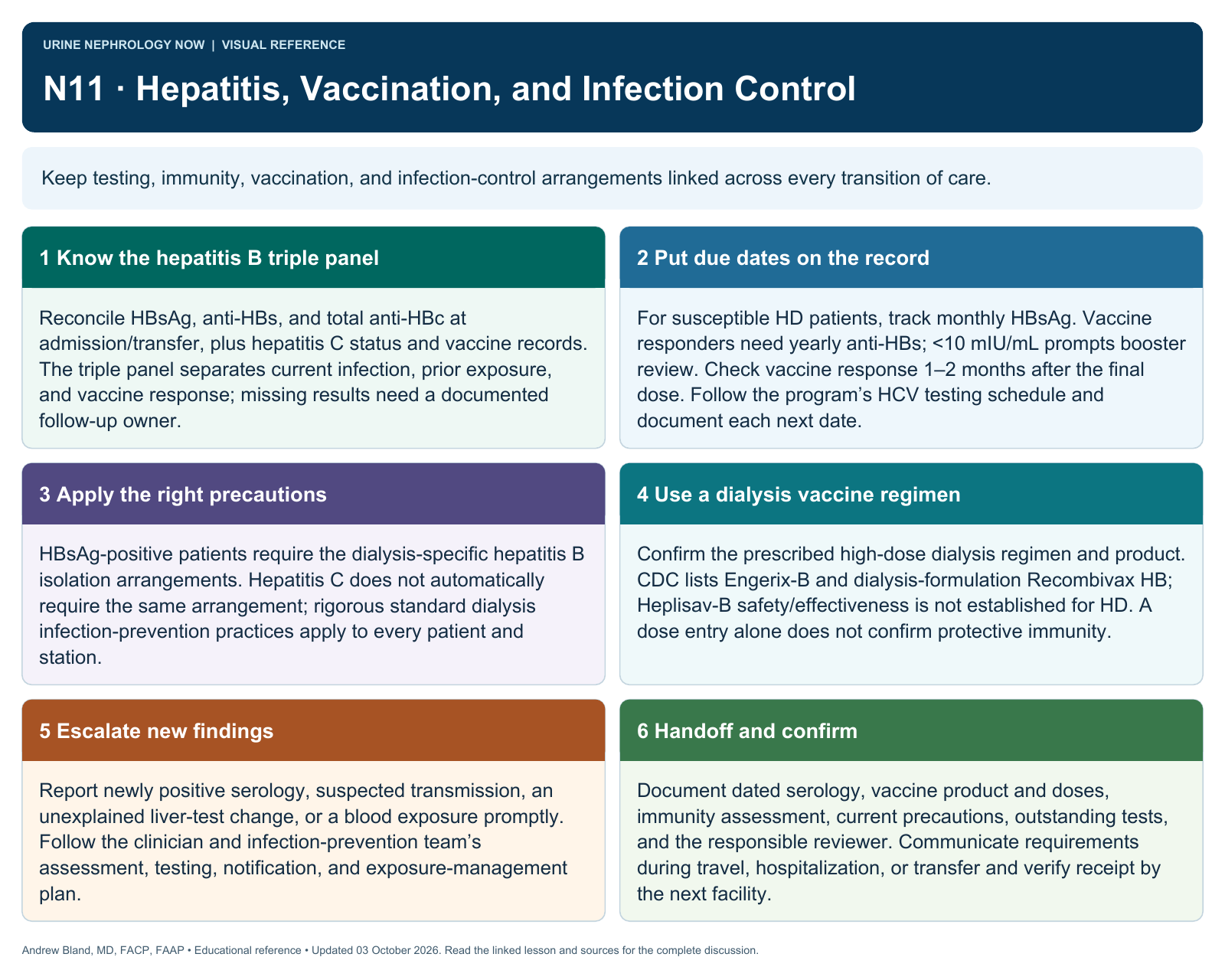
Text version
Know the hepatitis B triple panel
Reconcile HBsAg, anti-HBs, and total anti-HBc at admission/transfer, plus hepatitis C status and vaccine records. The triple panel separates current infection, prior exposure, and vaccine response; missing results need a documented follow-up owner.
Put due dates on the record
For susceptible HD patients, track monthly HBsAg. Vaccine responders need yearly anti-HBs; <10 mIU/mL prompts booster review. Check vaccine response 1–2 months after the final dose. Follow the program’s HCV testing schedule and document each next date.
Apply the right precautions
HBsAg-positive patients require the dialysis-specific hepatitis B isolation arrangements. Hepatitis C does not automatically require the same arrangement; rigorous standard dialysis infection-prevention practices apply to every patient and station.
Use a dialysis vaccine regimen
Confirm the prescribed high-dose dialysis regimen and product. CDC lists Engerix-B and dialysis-formulation Recombivax HB; Heplisav-B safety/effectiveness is not established for HD. A dose entry alone does not confirm protective immunity.
Escalate new findings
Report newly positive serology, suspected transmission, an unexplained liver-test change, or a blood exposure promptly. Follow the clinician and infection-prevention team’s assessment, testing, notification, and exposure-management plan.
Handoff and confirm
Document dated serology, vaccine product and doses, immunity assessment, current precautions, outstanding tests, and the responsible reviewer. Communicate requirements during travel, hospitalization, or transfer and verify receipt by the next facility.