Visual summary
Make anticoagulant exposure, access findings, and the dialysis anticoagulation plan explicit.
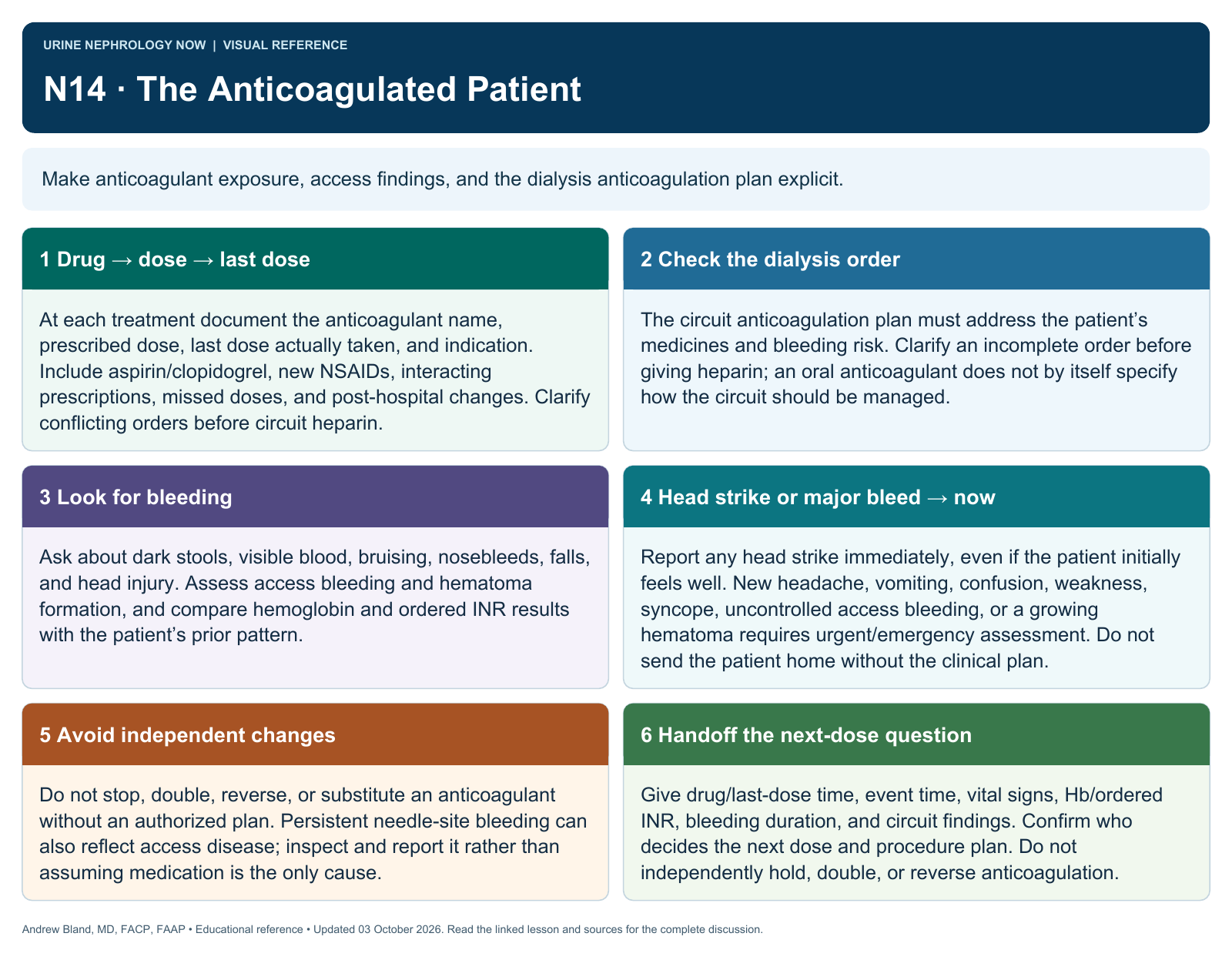
Text version
Reconcile every exposure
Confirm the anticoagulant, indication, prescribed dose, last dose, and recent changes. Include antiplatelets, nonprescription medicines, supplements, hospital discharge changes, and affordability problems that may alter actual use.
Check the dialysis order
The circuit anticoagulation plan must address the patient’s medicines and bleeding risk. Clarify an incomplete order before giving heparin; an oral anticoagulant does not by itself specify how the circuit should be managed.
Look for bleeding
Ask about dark stools, visible blood, bruising, nosebleeds, falls, and head injury. Assess access bleeding and hematoma formation, and compare hemoglobin and ordered INR results with the patient’s prior pattern.
Escalate urgent events
Uncontrolled bleeding, head injury with concerning symptoms, neurologic change, syncope, or hemodynamic instability requires immediate assessment. Report a head strike promptly even when the patient initially feels well; follow the emergency pathway.
Avoid independent changes
Do not stop, double, reverse, or substitute an anticoagulant without an authorized plan. Persistent needle-site bleeding can also reflect access disease; inspect and report it rather than assuming medication is the only cause.
Handoff the exact timeline
Provide drug and last dose, concurrent agents, bleeding or fall details, vital signs, laboratory trends, circuit clotting, and interventions. Clarify the next dose, any procedure plan, and who will reassess the patient.
Continue learning
This graphic summarizes a topic. The full educational pages provide the broader discussion and references.