Visual summary
Adequacy is part of quality: connect clearance with delivered treatment, symptoms, and the patient’s goals.
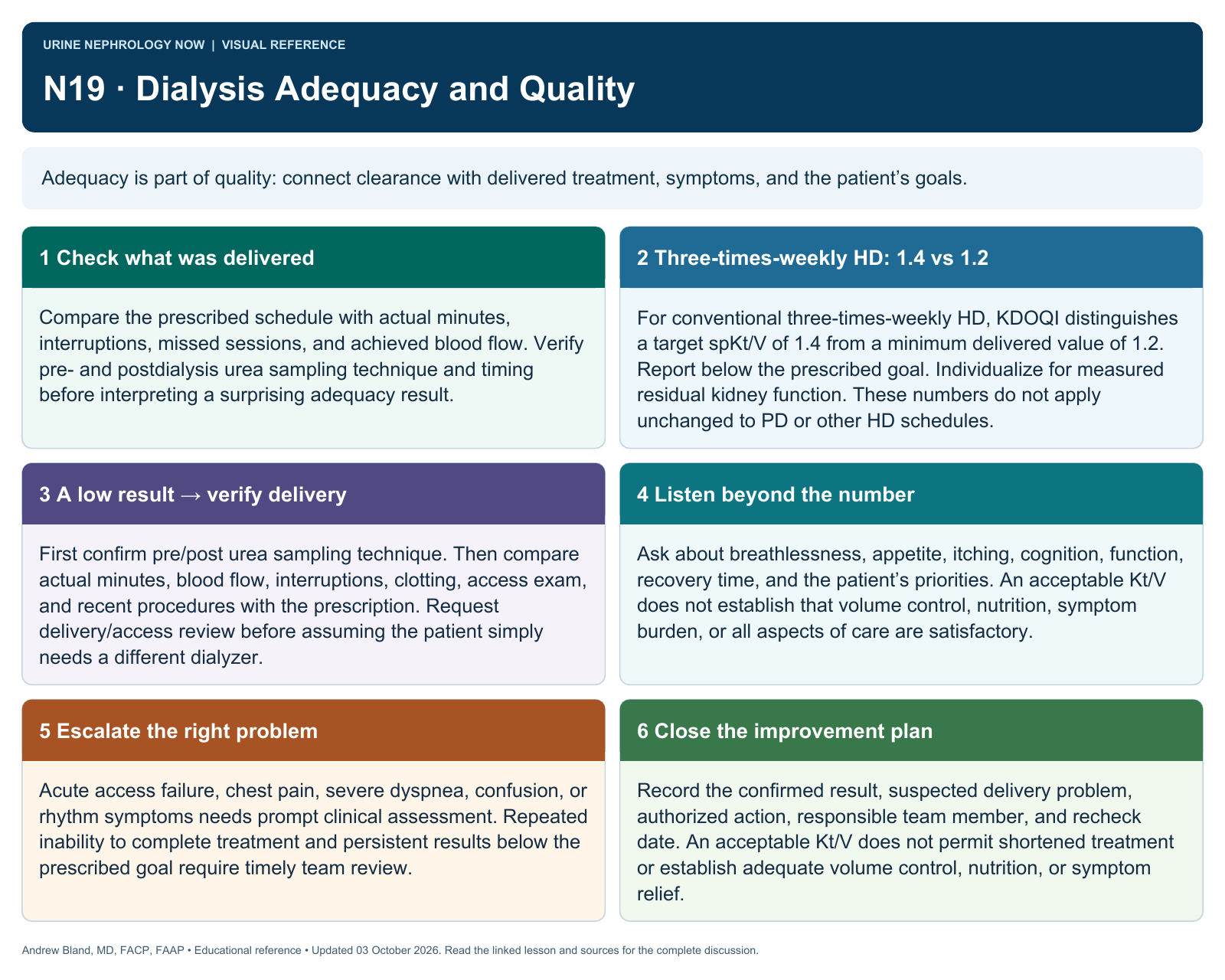
Text version
Check what was delivered
Compare the prescribed schedule with actual minutes, interruptions, missed sessions, and achieved blood flow. Verify pre- and postdialysis urea sampling technique and timing before interpreting a surprising adequacy result.
Use the right measure
Kt/V describes urea clearance within a specified treatment schedule. The target and minimum delivered dose differ; use the patient’s prescription and avoid applying a conventional three-times-weekly metric to every dialysis regimen.
Investigate a falling result
Review access findings, cannulation or catheter problems, recirculation concerns, alarms, clotting, early termination, and recent procedures. An unexplained decline needs a practical delivery and access review rather than an automatic dose assumption.
Listen beyond the number
Ask about breathlessness, appetite, itching, cognition, function, recovery time, and the patient’s priorities. An acceptable Kt/V does not establish that volume control, nutrition, symptom burden, or all aspects of care are satisfactory.
Escalate the right problem
Acute access failure, chest pain, severe dyspnea, confusion, or rhythm symptoms needs prompt clinical assessment. Repeated inability to complete treatment and persistent results below the prescribed goal require timely team review.
Handoff an improvement plan
Send sampling details, result trend, actual treatment delivery, access and alarm findings, symptoms, and barriers. Confirm the authorized plan and follow-up; do not shorten prescribed time because one clearance number is adequate.
Continue learning
This graphic summarizes a topic. The full educational pages provide the broader discussion and references.