Visual summary
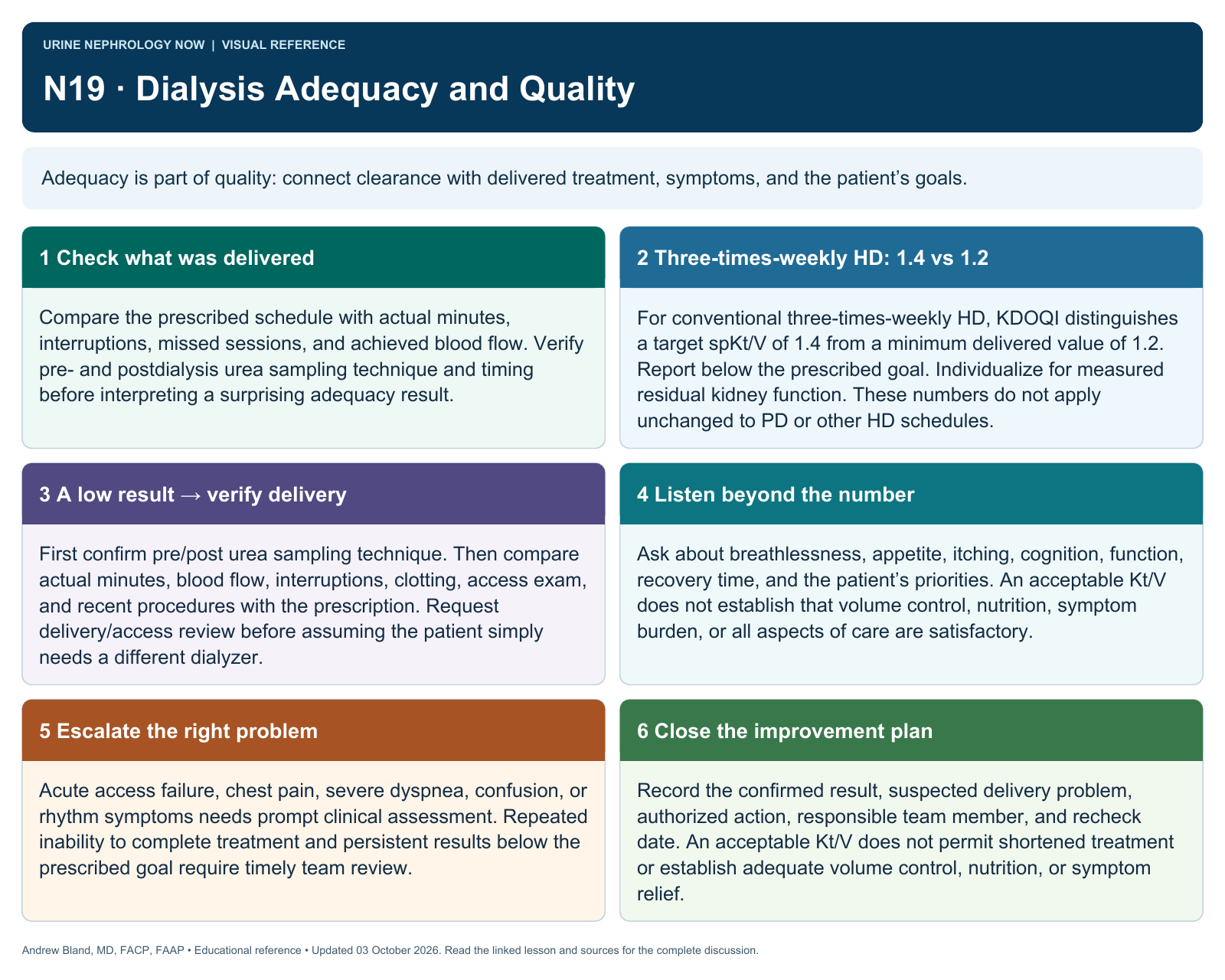
Adequacy is part of quality: connect clearance with delivered treatment, symptoms, and the patient’s goals.
Text version
Check what was delivered
Compare the prescribed schedule with actual minutes, interruptions, missed sessions, and achieved blood flow. Verify pre- and postdialysis urea sampling technique and timing before interpreting a surprising adequacy result.
Three-times-weekly HD: 1.4 vs 1.2
For conventional three-times-weekly HD, KDOQI distinguishes a target spKt/V of 1.4 from a minimum delivered value of 1.2. Report below the prescribed goal. Individualize for measured residual kidney function. These numbers do not apply unchanged to PD or other HD schedules.
A low result → verify delivery
First confirm pre/post urea sampling technique. Then compare actual minutes, blood flow, interruptions, clotting, access exam, and recent procedures with the prescription. Request delivery/access review before assuming the patient simply needs a different dialyzer.
Listen beyond the number
Ask about breathlessness, appetite, itching, cognition, function, recovery time, and the patient’s priorities. An acceptable Kt/V does not establish that volume control, nutrition, symptom burden, or all aspects of care are satisfactory.
Escalate the right problem
Acute access failure, chest pain, severe dyspnea, confusion, or rhythm symptoms needs prompt clinical assessment. Repeated inability to complete treatment and persistent results below the prescribed goal require timely team review.
Close the improvement plan
Record the confirmed result, suspected delivery problem, authorized action, responsible team member, and recheck date. An acceptable Kt/V does not permit shortened treatment or establish adequate volume control, nutrition, or symptom relief.