Visual summary
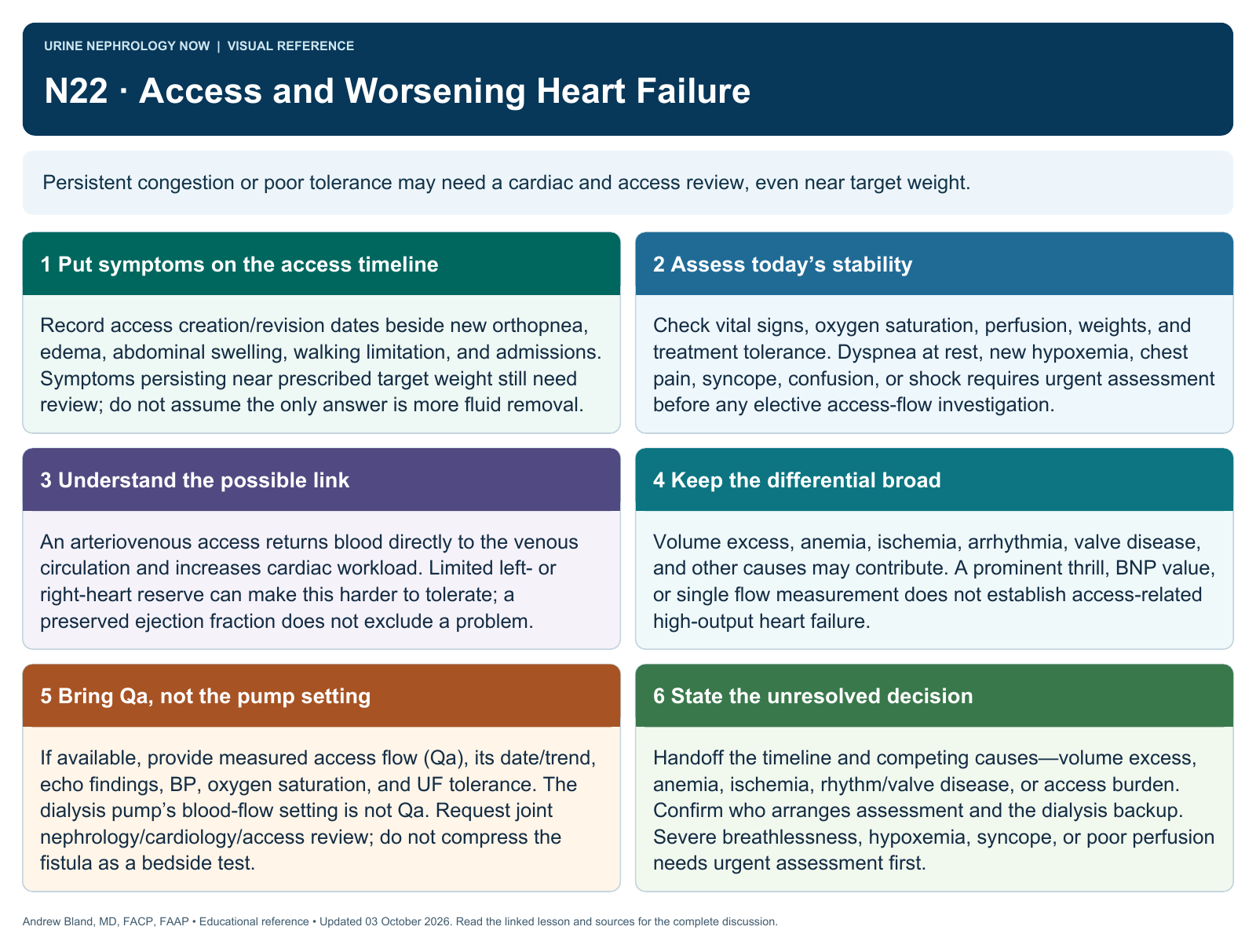
Persistent congestion or poor tolerance may need a cardiac and access review, even near target weight.
Text version
Put symptoms on the access timeline
Record access creation/revision dates beside new orthopnea, edema, abdominal swelling, walking limitation, and admissions. Symptoms persisting near prescribed target weight still need review; do not assume the only answer is more fluid removal.
Assess today’s stability
Check vital signs, oxygen saturation, perfusion, weights, and treatment tolerance. Dyspnea at rest, new hypoxemia, chest pain, syncope, confusion, or shock requires urgent assessment before any elective access-flow investigation.
Understand the possible link
An arteriovenous access returns blood directly to the venous circulation and increases cardiac workload. Limited left- or right-heart reserve can make this harder to tolerate; a preserved ejection fraction does not exclude a problem.
Keep the differential broad
Volume excess, anemia, ischemia, arrhythmia, valve disease, and other causes may contribute. A prominent thrill, BNP value, or single flow measurement does not establish access-related high-output heart failure.
Bring Qa, not the pump setting
If available, provide measured access flow (Qa), its date/trend, echo findings, BP, oxygen saturation, and UF tolerance. The dialysis pump’s blood-flow setting is not Qa. Request joint nephrology/cardiology/access review; do not compress the fistula as a bedside test.
State the unresolved decision
Handoff the timeline and competing causes—volume excess, anemia, ischemia, rhythm/valve disease, or access burden. Confirm who arranges assessment and the dialysis backup. Severe breathlessness, hypoxemia, syncope, or poor perfusion needs urgent assessment first.