Visual summary
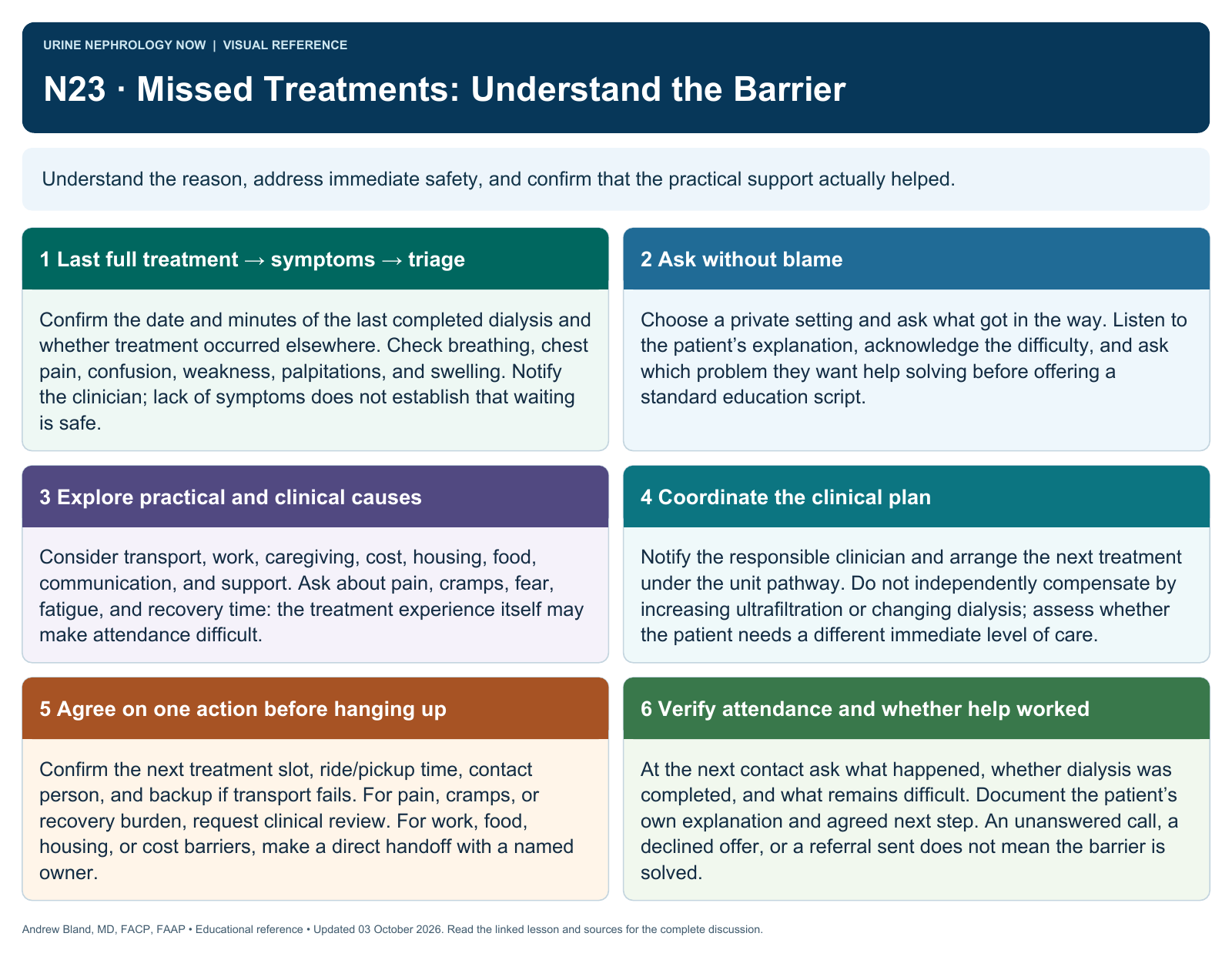
Understand the reason, address immediate safety, and confirm that the practical support actually helped.
Text version
Check immediate safety
Confirm the last completed treatment, current symptoms, and whether dialysis occurred elsewhere. Severe breathlessness, chest pain, confusion, syncope, or concerning weakness or palpitations requires urgent assessment; feeling well does not establish safety.
Ask without blame
Choose a private setting and ask what got in the way. Listen to the patient’s explanation, acknowledge the difficulty, and ask which problem they want help solving before offering a standard education script.
Explore practical and clinical causes
Consider transport, work, caregiving, cost, housing, food, communication, and support. Ask about pain, cramps, fear, fatigue, and recovery time: the treatment experience itself may make attendance difficult.
Coordinate the clinical plan
Notify the responsible clinician and arrange the next treatment under the unit pathway. Do not independently compensate by increasing ultrafiltration or changing dialysis; assess whether the patient needs a different immediate level of care.
Agree on one workable action
Connect the patient directly with the appropriate team member. Confirm the treatment slot, transport when needed, a backup option, a safe contact method, and a named person responsible for following the plan through.
Return to the outcome
At the next contact, ask whether the plan worked. Document the patient’s stated barrier, help accepted, unresolved needs, and follow-up; a referral, unanswered call, or declined offer does not prove the barrier is resolved.
Continue learning
This graphic summarizes a topic. The full educational pages provide the broader discussion and references.