Visual summary
Understand the reason, address immediate safety, and confirm that the practical support actually helped.
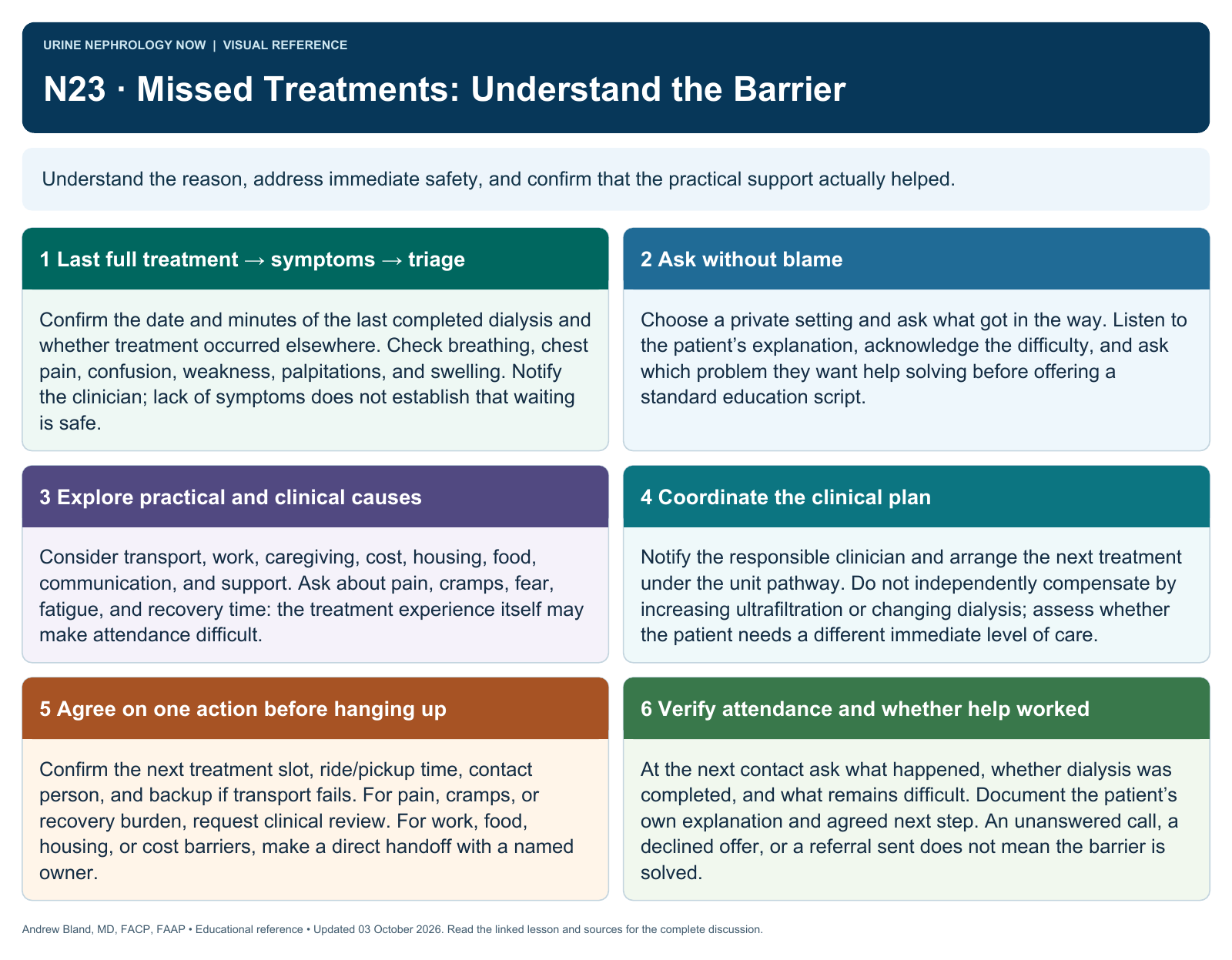
Text version
Last full treatment → symptoms → triage
Confirm the date and minutes of the last completed dialysis and whether treatment occurred elsewhere. Check breathing, chest pain, confusion, weakness, palpitations, and swelling. Notify the clinician; lack of symptoms does not establish that waiting is safe.
Ask without blame
Choose a private setting and ask what got in the way. Listen to the patient’s explanation, acknowledge the difficulty, and ask which problem they want help solving before offering a standard education script.
Explore practical and clinical causes
Consider transport, work, caregiving, cost, housing, food, communication, and support. Ask about pain, cramps, fear, fatigue, and recovery time: the treatment experience itself may make attendance difficult.
Coordinate the clinical plan
Notify the responsible clinician and arrange the next treatment under the unit pathway. Do not independently compensate by increasing ultrafiltration or changing dialysis; assess whether the patient needs a different immediate level of care.
Agree on one action before hanging up
Confirm the next treatment slot, ride/pickup time, contact person, and backup if transport fails. For pain, cramps, or recovery burden, request clinical review. For work, food, housing, or cost barriers, make a direct handoff with a named owner.
Verify attendance and whether help worked
At the next contact ask what happened, whether dialysis was completed, and what remains difficult. Document the patient’s own explanation and agreed next step. An unanswered call, a declined offer, or a referral sent does not mean the barrier is solved.