Visual summary
Every chemistry value has a physiologic meaning, a timing assumption, and possible measurement confounders; check all three before acting.
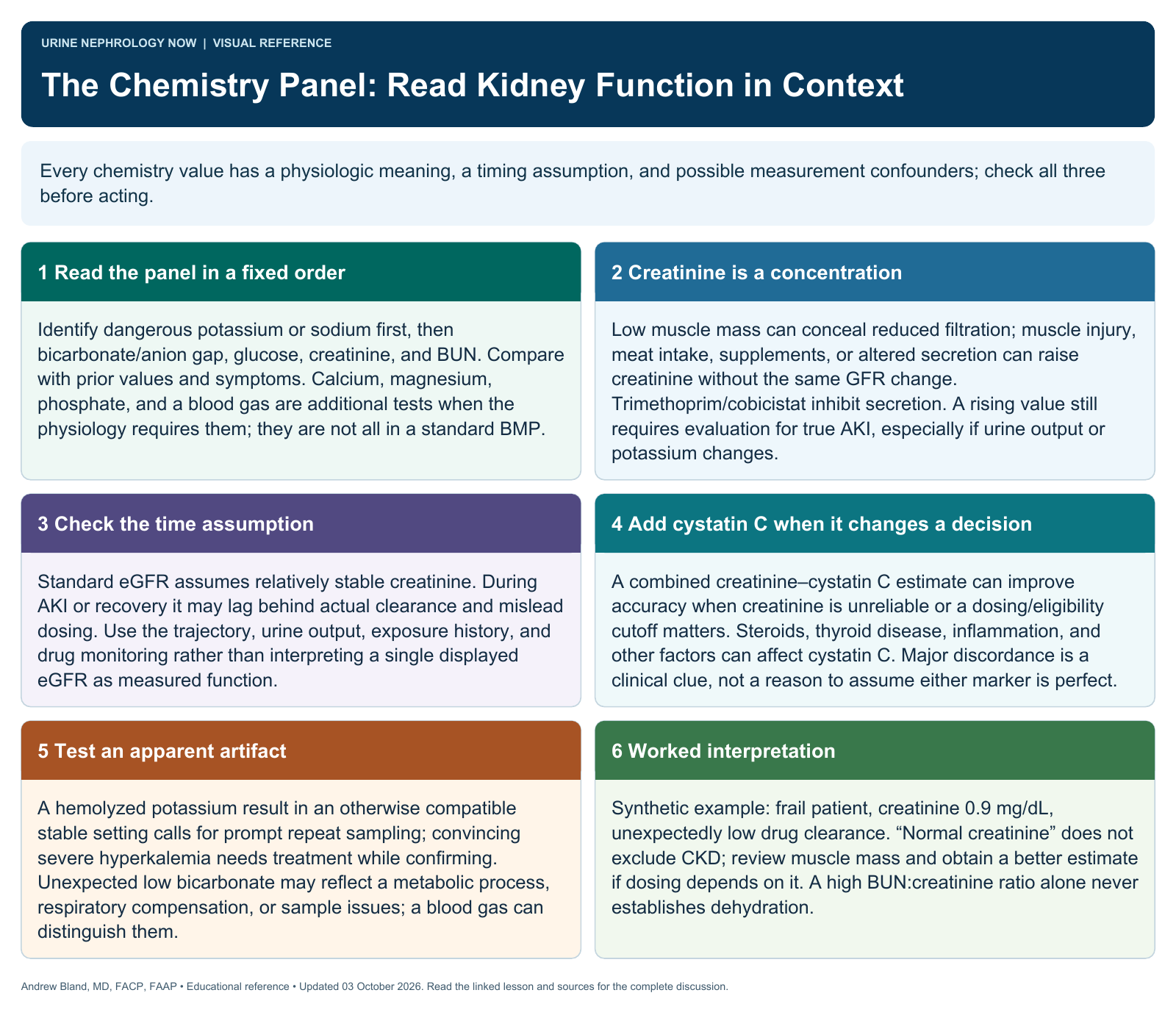
Text version
Read the panel in a fixed order
Identify dangerous potassium or sodium first, then bicarbonate/anion gap, glucose, creatinine, and BUN. Compare with prior values and symptoms. Calcium, magnesium, phosphate, and a blood gas are additional tests when the physiology requires them; they are not all in a standard BMP.
Creatinine is a concentration
Low muscle mass can conceal reduced filtration; muscle injury, meat intake, supplements, or altered secretion can raise creatinine without the same GFR change. Trimethoprim/cobicistat inhibit secretion. A rising value still requires evaluation for true AKI, especially if urine output or potassium changes.
Check the time assumption
Standard eGFR assumes relatively stable creatinine. During AKI or recovery it may lag behind actual clearance and mislead dosing. Use the trajectory, urine output, exposure history, and drug monitoring rather than interpreting a single displayed eGFR as measured function.
Add cystatin C when it changes a decision
A combined creatinine–cystatin C estimate can improve accuracy when creatinine is unreliable or a dosing/eligibility cutoff matters. Steroids, thyroid disease, inflammation, and other factors can affect cystatin C. Major discordance is a clinical clue, not a reason to assume either marker is perfect.
Test an apparent artifact
A hemolyzed potassium result in an otherwise compatible stable setting calls for prompt repeat sampling; convincing severe hyperkalemia needs treatment while confirming. Unexpected low bicarbonate may reflect a metabolic process, respiratory compensation, or sample issues; a blood gas can distinguish them.
Worked interpretation
Synthetic example: frail patient, creatinine 0.9 mg/dL, unexpectedly low drug clearance. “Normal creatinine” does not exclude CKD; review muscle mass and obtain a better estimate if dosing depends on it. A high BUN:creatinine ratio alone never establishes dehydration.