Visual summary
Before changing therapy, make sure the measurement method and the pattern of blood pressure are trustworthy.
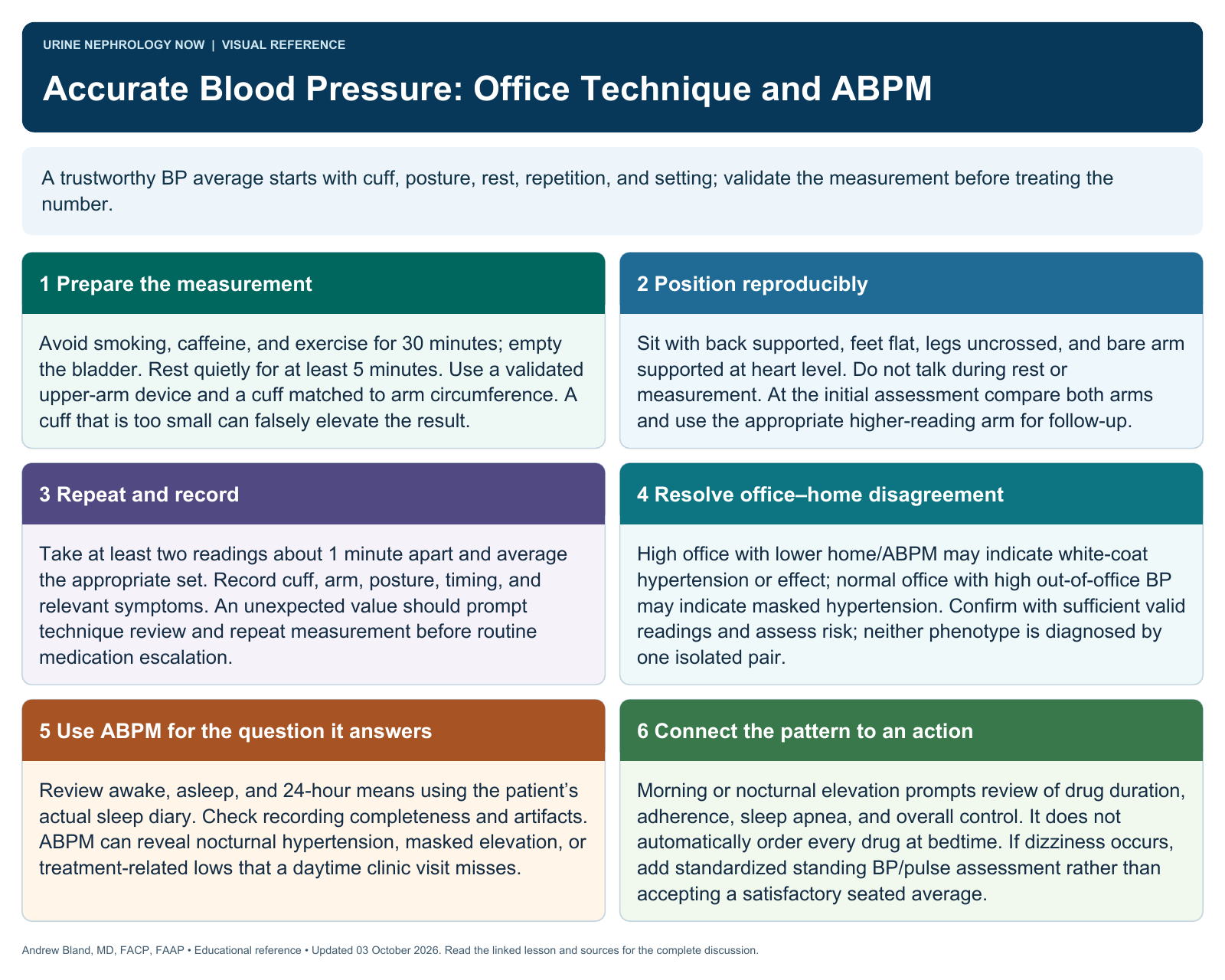
Text version
Measurement drives the diagnosis
Blood pressure varies with activity, stress, posture, timing, sleep, and technique. Reliable measurements reduce false labels and unnecessary medication changes, and they allow treatment goals to be interpreted as intended.
Recognize common errors
An incorrect cuff size, unsupported arm or back, talking, recent exertion, or insufficient rest can distort readings. Wrist or cuffless device readings should not automatically be treated as equivalent to a validated upper-arm method.
Standardize the office process
Use a validated device, appropriate cuff, supported positioning, and the recommended rest and repeated-reading protocol. Record relevant conditions and review orthostatic measurements when symptoms or clinical vulnerability make them important.
Use ambulatory monitoring purposefully
ABPM can identify white-coat, masked, nocturnal, and treatment-related patterns. Check that enough valid readings were obtained and interpret daytime and nighttime periods using the patient’s actual sleep and activity schedule.
Explain discordant patterns
Office elevation with lower out-of-office pressure and apparently normal office readings with higher home or ambulatory values carry different implications. Interpret patterns alongside cardiovascular risk and follow-up data rather than relying on one label.
Avoid chronotherapy overclaims
A nocturnal pattern may prompt evaluation of sleep, medications, and comorbidity, but it does not automatically prove a benefit from bedtime dosing. Outcome claims require confirmation from reliable trials and current guidance.
Self-check: Before escalating treatment for a high office reading, which technical errors and out-of-office patterns would you check?
Continue learning
This graphic summarizes a topic. The full educational pages provide the broader discussion and references.