Visual summary
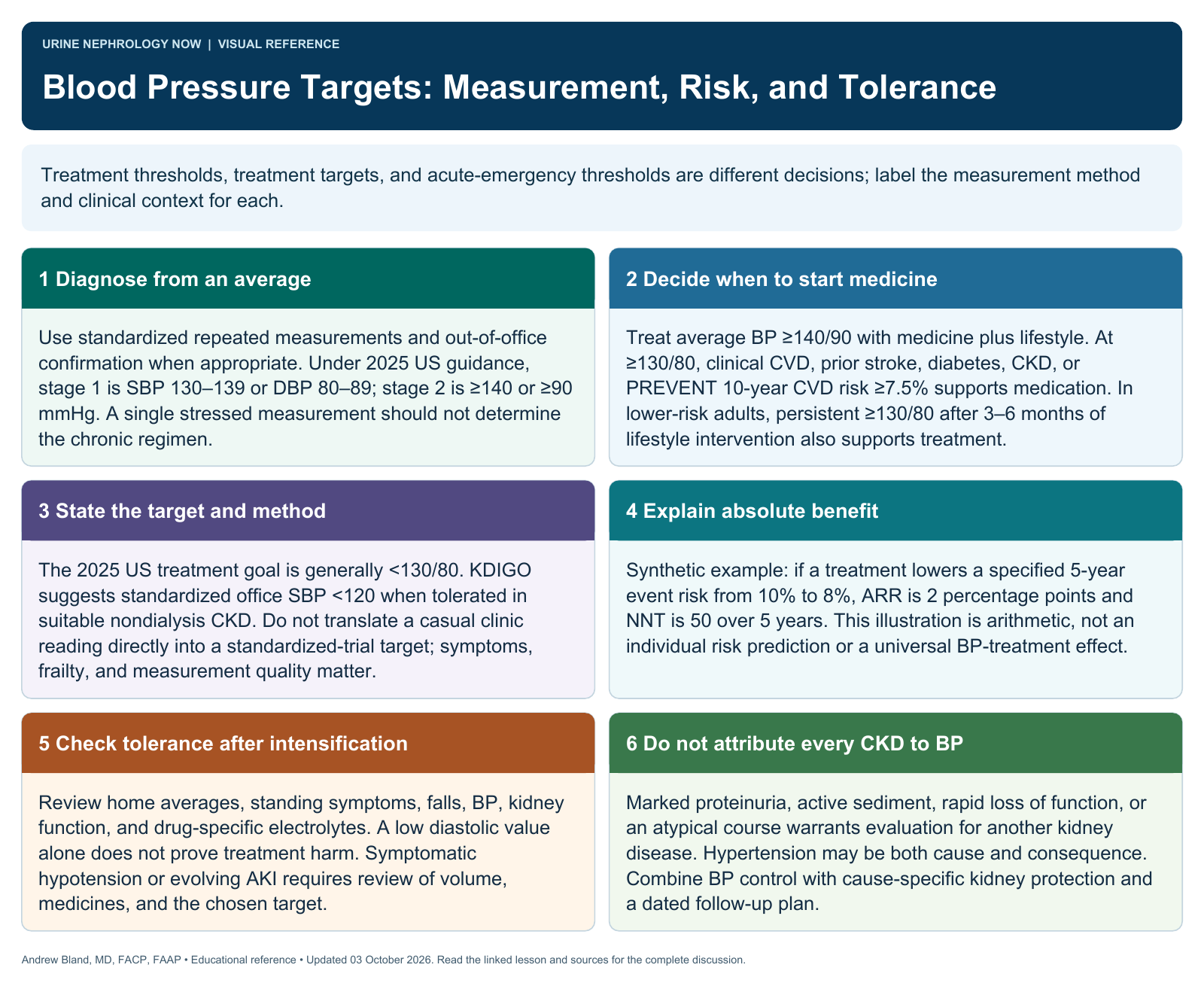
Treatment thresholds, treatment targets, and acute-emergency thresholds are different decisions; label the measurement method and clinical context for each.
Text version
Diagnose from an average
Use standardized repeated measurements and out-of-office confirmation when appropriate. Under 2025 US guidance, stage 1 is SBP 130–139 or DBP 80–89; stage 2 is ≥140 or ≥90 mmHg. A single stressed measurement should not determine the chronic regimen.
Decide when to start medicine
Treat average BP ≥140/90 with medicine plus lifestyle. At ≥130/80, clinical CVD, prior stroke, diabetes, CKD, or PREVENT 10-year CVD risk ≥7.5% supports medication. In lower-risk adults, persistent ≥130/80 after 3–6 months of lifestyle intervention also supports treatment.
State the target and method
The 2025 US treatment goal is generally <130/80. KDIGO suggests standardized office SBP <120 when tolerated in suitable nondialysis CKD. Do not translate a casual clinic reading directly into a standardized-trial target; symptoms, frailty, and measurement quality matter.
Explain absolute benefit
Synthetic example: if a treatment lowers a specified 5-year event risk from 10% to 8%, ARR is 2 percentage points and NNT is 50 over 5 years. This illustration is arithmetic, not an individual risk prediction or a universal BP-treatment effect.
Check tolerance after intensification
Review home averages, standing symptoms, falls, BP, kidney function, and drug-specific electrolytes. A low diastolic value alone does not prove treatment harm. Symptomatic hypotension or evolving AKI requires review of volume, medicines, and the chosen target.
Do not attribute every CKD to BP
Marked proteinuria, active sediment, rapid loss of function, or an atypical course warrants evaluation for another kidney disease. Hypertension may be both cause and consequence. Combine BP control with cause-specific kidney protection and a dated follow-up plan.