Visual summary
A careful AKI differential preserves both renal safety and the possibility of effective cancer treatment.
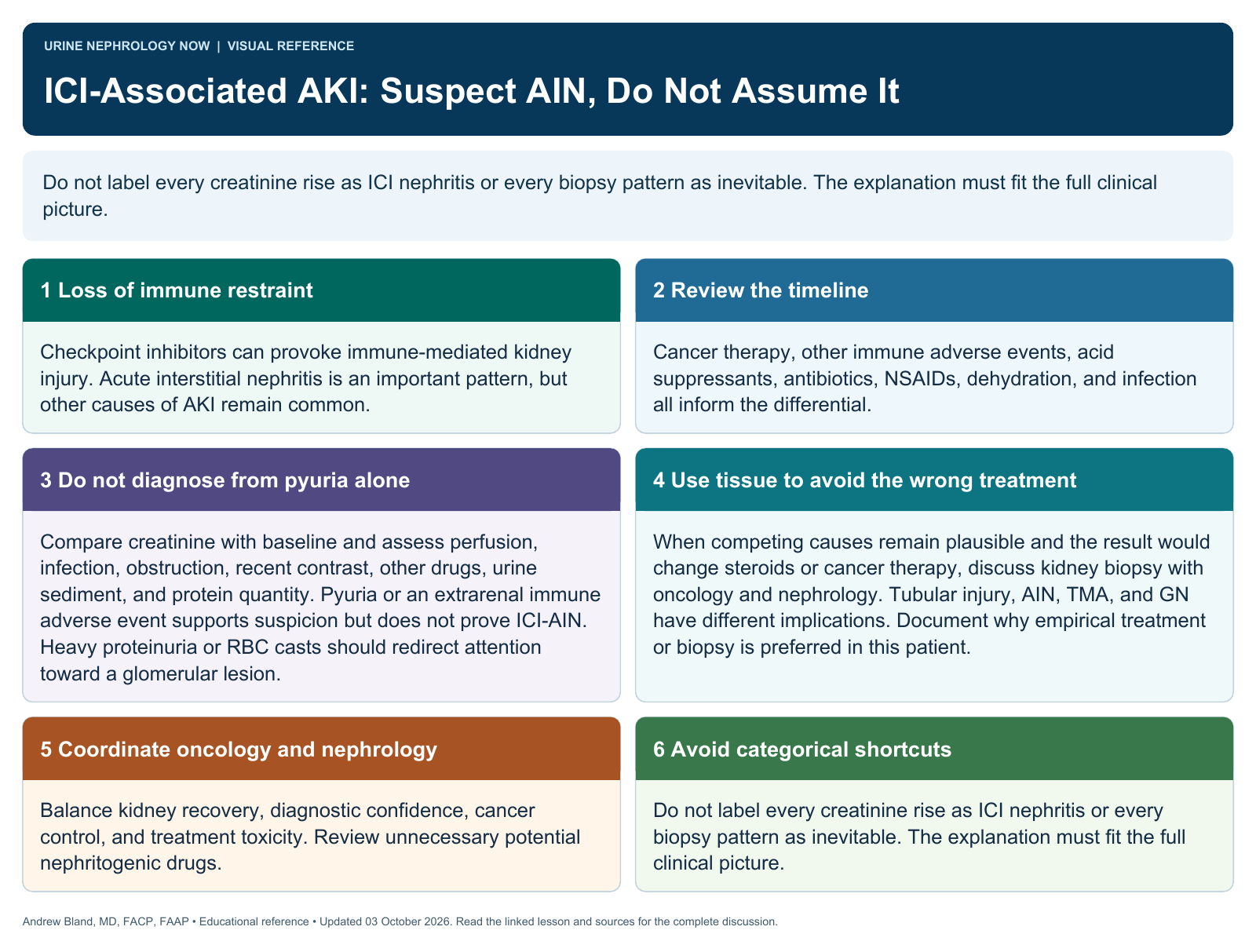
Text version
Immune activation can affect the kidney
Checkpoint inhibitors can trigger immune-mediated renal injury, commonly interstitial disease but also other lesions. Cancer patients also have many nonimmune causes of AKI, so treatment exposure alone does not establish the diagnosis.
Recognize the clinical change
Follow creatinine, urine findings, symptoms, and other immune-related adverse events. The onset can be variable, and kidney injury may appear without a classic hypersensitivity pattern or obvious extra-renal immune toxicity.
Investigate competing causes
Review perfusion, obstruction, infection, contrast, other drugs, and the cancer course. Quantify proteinuria and consider biopsy when the presentation or uncertainty could materially alter cancer treatment or immunosuppression decisions.
Coordinate oncology and nephrology
The severity, probable lesion, and cancer benefit determine whether therapy is held and how renal treatment proceeds. Steroid or other immunotherapy decisions need a disease-specific plan with infection and adverse-effect monitoring.
Follow recovery deliberately
Track kidney response and reconsider the diagnosis if recovery is inadequate. Discuss any rechallenge through shared decision-making, with clear monitoring and recognition that recurrence risk and oncologic benefit differ across patients.
Avoid automatic algorithms
Do not treat every creatinine rise as immune nephritis or assume every case requires identical steroid dosing. Published recommendations may differ on biopsy and management; make the source and clinical context explicit.
Continue learning
This graphic summarizes a topic. The full educational pages provide the broader discussion and references.