Visual summary
Present a kidney problem as time course + syndrome + likely compartment, then state the next action and its purpose.
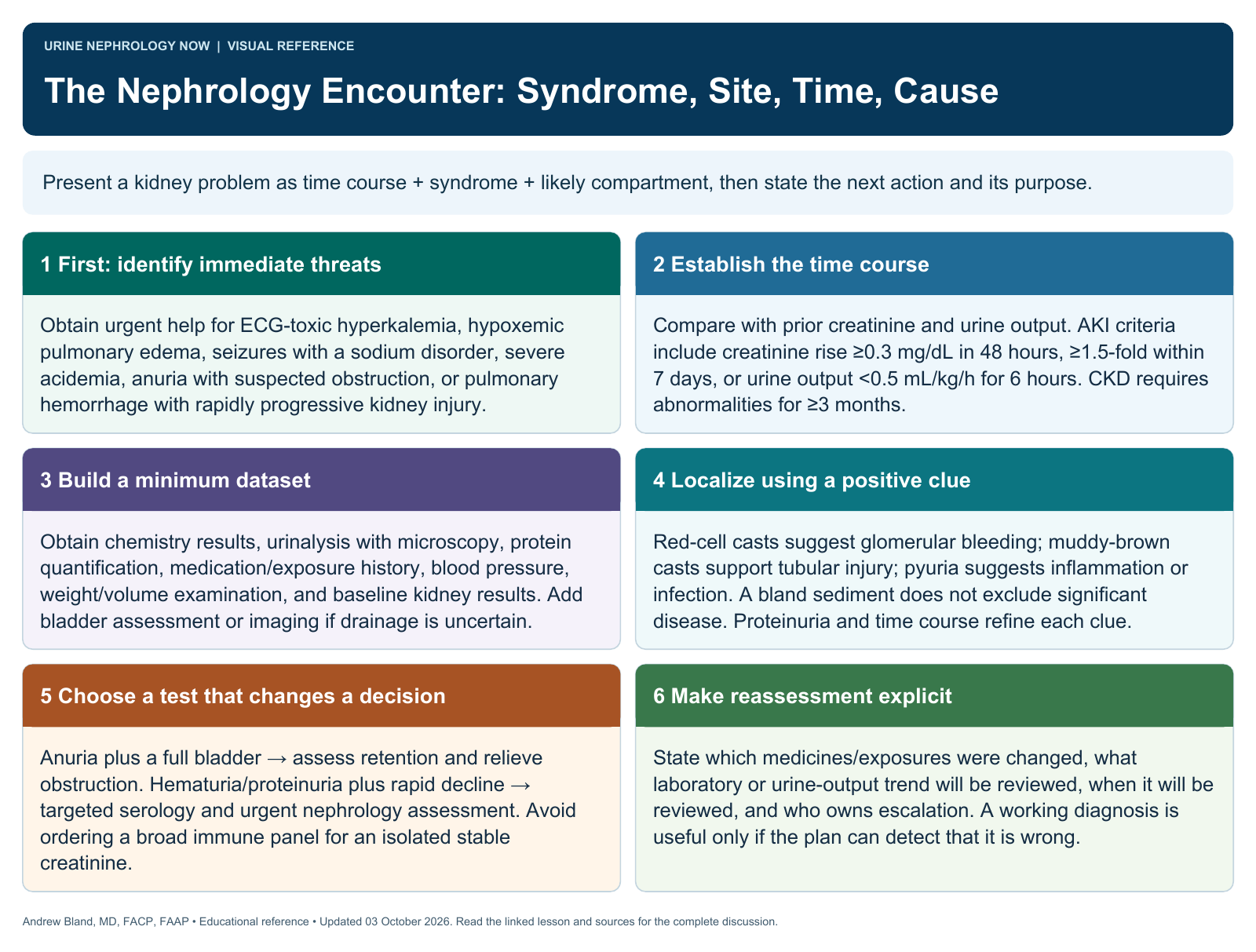
Text version
First: identify immediate threats
Obtain urgent help for ECG-toxic hyperkalemia, hypoxemic pulmonary edema, seizures with a sodium disorder, severe acidemia, anuria with suspected obstruction, or pulmonary hemorrhage with rapidly progressive kidney injury.
Establish the time course
Compare with prior creatinine and urine output. AKI criteria include creatinine rise ≥0.3 mg/dL in 48 hours, ≥1.5-fold within 7 days, or urine output <0.5 mL/kg/h for 6 hours. CKD requires abnormalities for ≥3 months.
Build a minimum dataset
Obtain chemistry results, urinalysis with microscopy, protein quantification, medication/exposure history, blood pressure, weight/volume examination, and baseline kidney results. Add bladder assessment or imaging if drainage is uncertain.
Localize using a positive clue
Red-cell casts suggest glomerular bleeding; muddy-brown casts support tubular injury; pyuria suggests inflammation or infection. A bland sediment does not exclude significant disease. Proteinuria and time course refine each clue.
Choose a test that changes a decision
Anuria plus a full bladder → assess retention and relieve obstruction. Hematuria/proteinuria plus rapid decline → targeted serology and urgent nephrology assessment. Avoid ordering a broad immune panel for an isolated stable creatinine.
Make reassessment explicit
State which medicines/exposures were changed, what laboratory or urine-output trend will be reviewed, when it will be reviewed, and who owns escalation. A working diagnosis is useful only if the plan can detect that it is wrong.