Visual summary
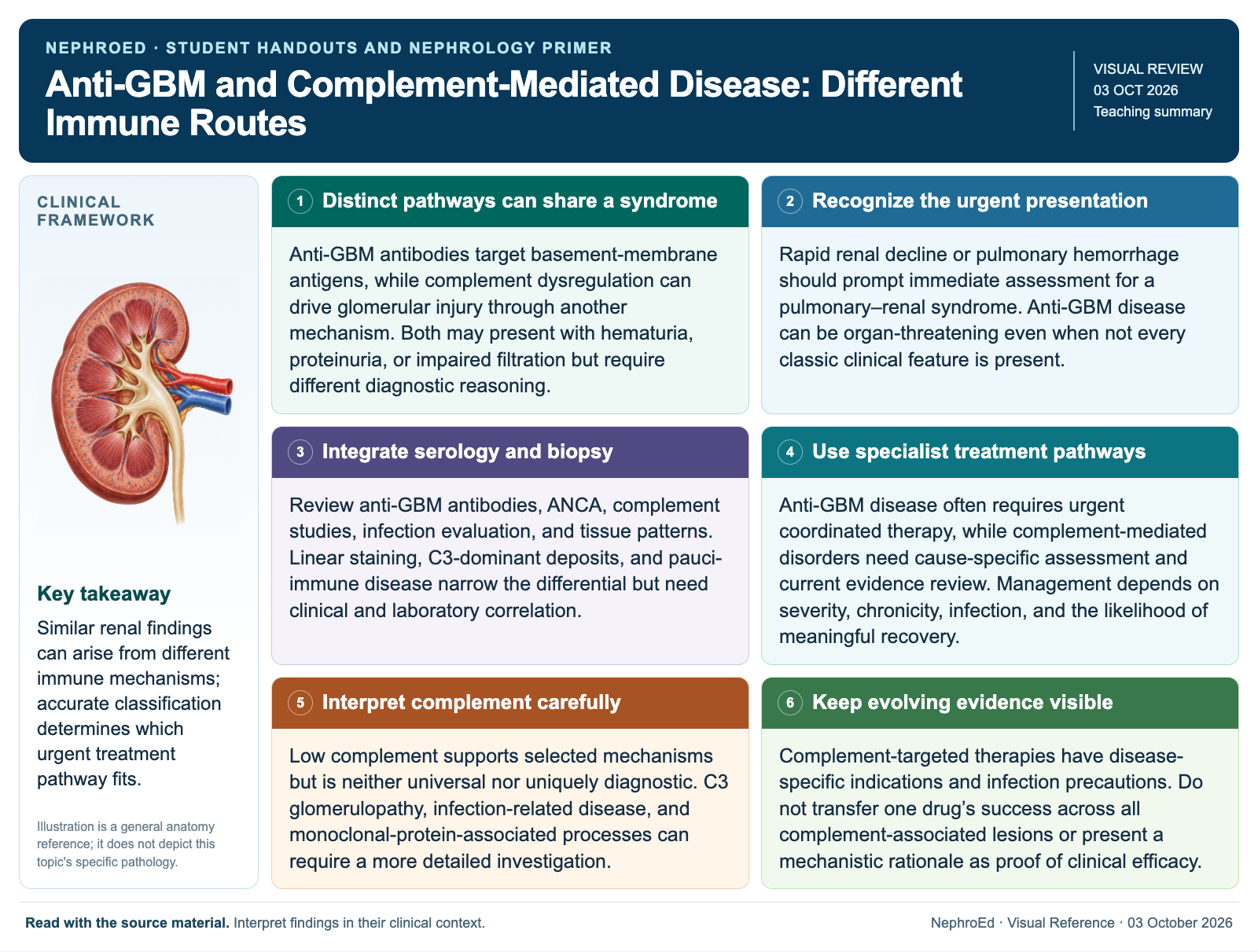
Similar renal findings can arise from different immune mechanisms; accurate classification determines which urgent treatment pathway fits.
Text version
Distinct pathways can share a syndrome
Anti-GBM antibodies target basement-membrane antigens, while complement dysregulation can drive glomerular injury through another mechanism. Both may present with hematuria, proteinuria, or impaired filtration but require different diagnostic reasoning.
Recognize the urgent presentation
Rapid renal decline or pulmonary hemorrhage should prompt immediate assessment for a pulmonary–renal syndrome. Anti-GBM disease can be organ-threatening even when not every classic clinical feature is present.
Integrate serology and biopsy
Review anti-GBM antibodies, ANCA, complement studies, infection evaluation, and tissue patterns. Linear staining, C3-dominant deposits, and pauci-immune disease narrow the differential but need clinical and laboratory correlation.
Use specialist treatment pathways
Anti-GBM disease often requires urgent coordinated therapy, while complement-mediated disorders need cause-specific assessment and current evidence review. Management depends on severity, chronicity, infection, and the likelihood of meaningful recovery.
Interpret complement carefully
Low complement supports selected mechanisms but is neither universal nor uniquely diagnostic. C3 glomerulopathy, infection-related disease, and monoclonal-protein-associated processes can require a more detailed investigation.
Keep evolving evidence visible
Complement-targeted therapies have disease-specific indications and infection precautions. Do not transfer one drug’s success across all complement-associated lesions or present a mechanistic rationale as proof of clinical efficacy.
Continue learning
This graphic summarizes a topic. The full educational pages provide the broader discussion and references.