Visual summary
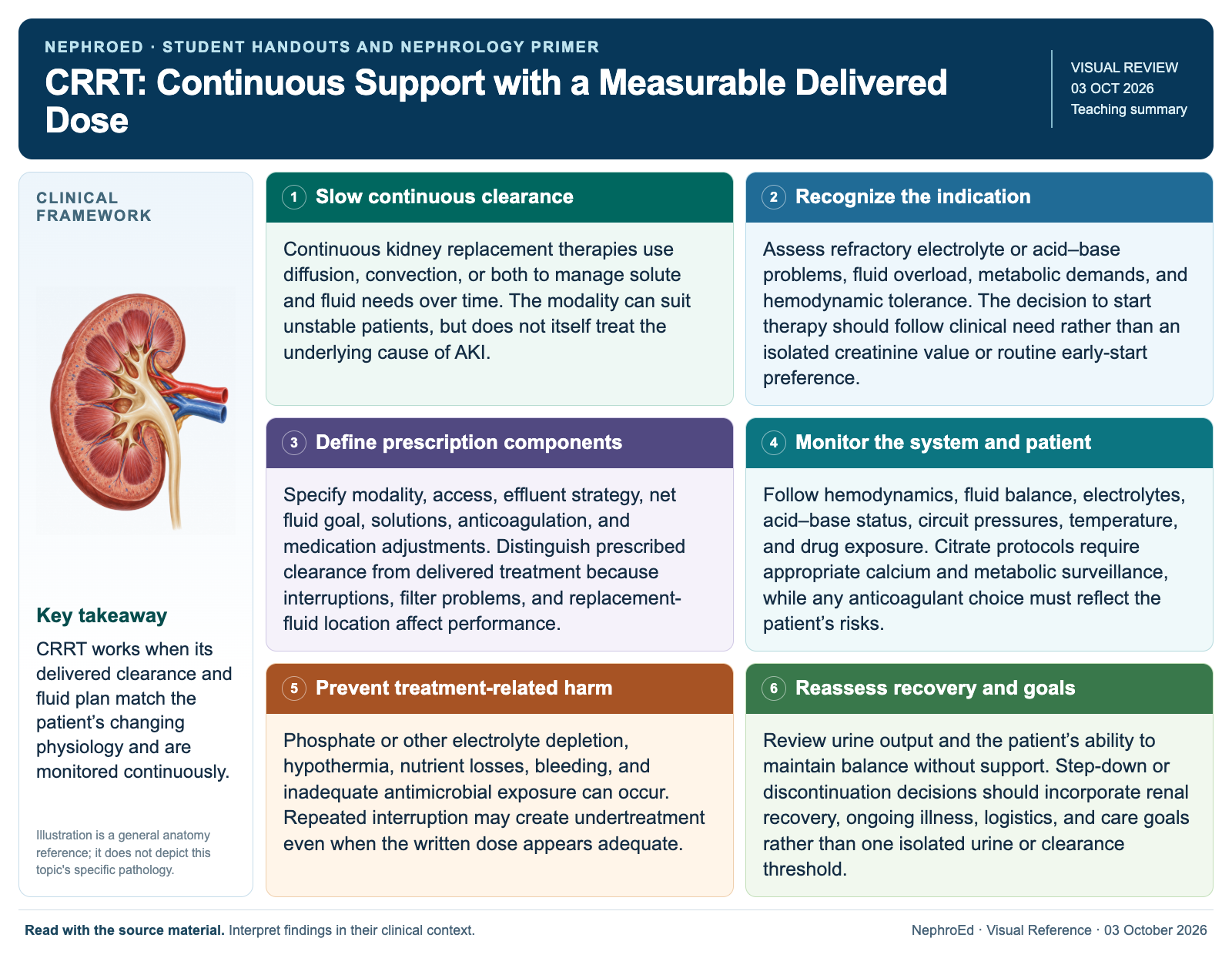
CRRT works when its delivered clearance and fluid plan match the patient’s changing physiology and are monitored continuously.
Text version
Slow continuous clearance
Continuous kidney replacement therapies use diffusion, convection, or both to manage solute and fluid needs over time. The modality can suit unstable patients, but does not itself treat the underlying cause of AKI.
Recognize the indication
Assess refractory electrolyte or acid–base problems, fluid overload, metabolic demands, and hemodynamic tolerance. The decision to start therapy should follow clinical need rather than an isolated creatinine value or routine early-start preference.
Define prescription components
Specify modality, access, effluent strategy, net fluid goal, solutions, anticoagulation, and medication adjustments. Distinguish prescribed clearance from delivered treatment because interruptions, filter problems, and replacement-fluid location affect performance.
Monitor the system and patient
Follow hemodynamics, fluid balance, electrolytes, acid–base status, circuit pressures, temperature, and drug exposure. Citrate protocols require appropriate calcium and metabolic surveillance, while any anticoagulant choice must reflect the patient’s risks.
Prevent treatment-related harm
Phosphate or other electrolyte depletion, hypothermia, nutrient losses, bleeding, and inadequate antimicrobial exposure can occur. Repeated interruption may create undertreatment even when the written dose appears adequate.
Reassess recovery and goals
Review urine output and the patient’s ability to maintain balance without support. Step-down or discontinuation decisions should incorporate renal recovery, ongoing illness, logistics, and care goals rather than one isolated urine or clearance threshold.
Continue learning
This graphic summarizes a topic. The full educational pages provide the broader discussion and references.