Visual summary
An adequate urea number is useful evidence, but adequate dialysis also requires tolerable fluid control and good clinical outcomes.
Text version
Clearance over a distribution volume
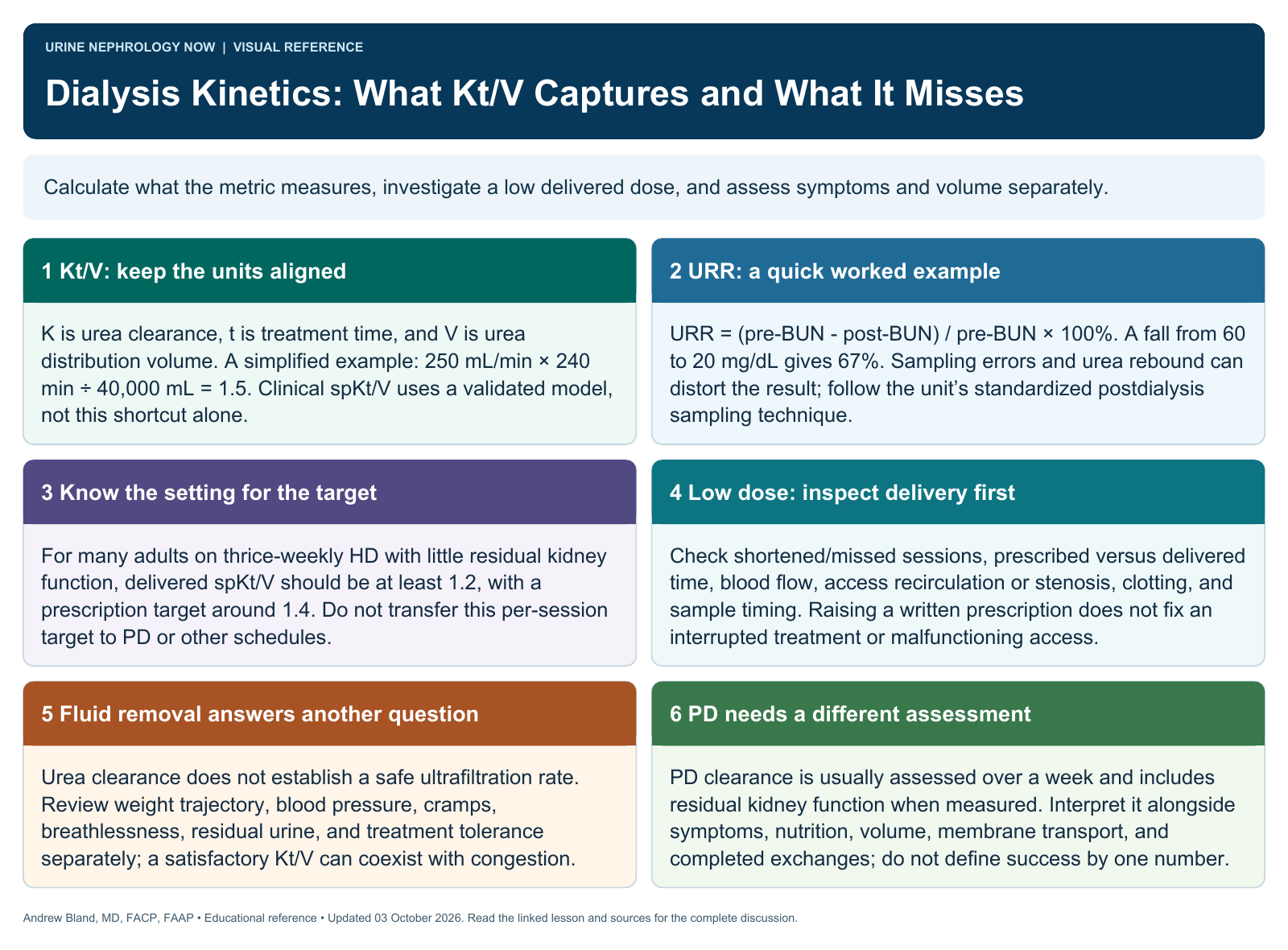
Kt/V relates dialyzer urea clearance and treatment time to the urea distribution volume. It is a useful standardized measure, but it represents one solute model rather than every dimension of dialysis adequacy.
Recognize measurement limitations
Sampling technique, access recirculation, interrupted treatments, body composition, and postdialysis rebound affect interpretation. Single-pool and equilibrated estimates answer related but different questions, so values should not be compared without method context.
Investigate an inadequate result
Review delivered time, blood flow, access function, membrane performance, missed sessions, and sample timing. A low result can reflect a correctable delivery problem, while a satisfactory result may coexist with important symptoms.
Assess fluid and residual function
Volume control, tolerated ultrafiltration, residual kidney clearance, electrolyte balance, and daily function add information that urea clearance alone cannot supply. More aggressive fluid removal is not automatically a better dialysis treatment.
Distinguish PD from hemodialysis
Peritoneal transport characteristics, residual kidney function, exchange schedule, and ultrafiltration influence PD assessment. Do not transfer a hemodialysis target or formula directly into a peritoneal treatment plan.
Judge the whole treatment
Ask whether the patient feels and functions well, remains nutritionally supported, and has controlled complications. Use adequacy metrics as part of ongoing clinical assessment instead of reducing treatment success to one monthly number.
Continue learning
This graphic summarizes a topic. The full educational pages provide the broader discussion and references.