Visual summary
Diuretic choice follows BP versus congestion needs; thiazide safety depends on sodium, potassium, kidney function, and the response after withdrawal.
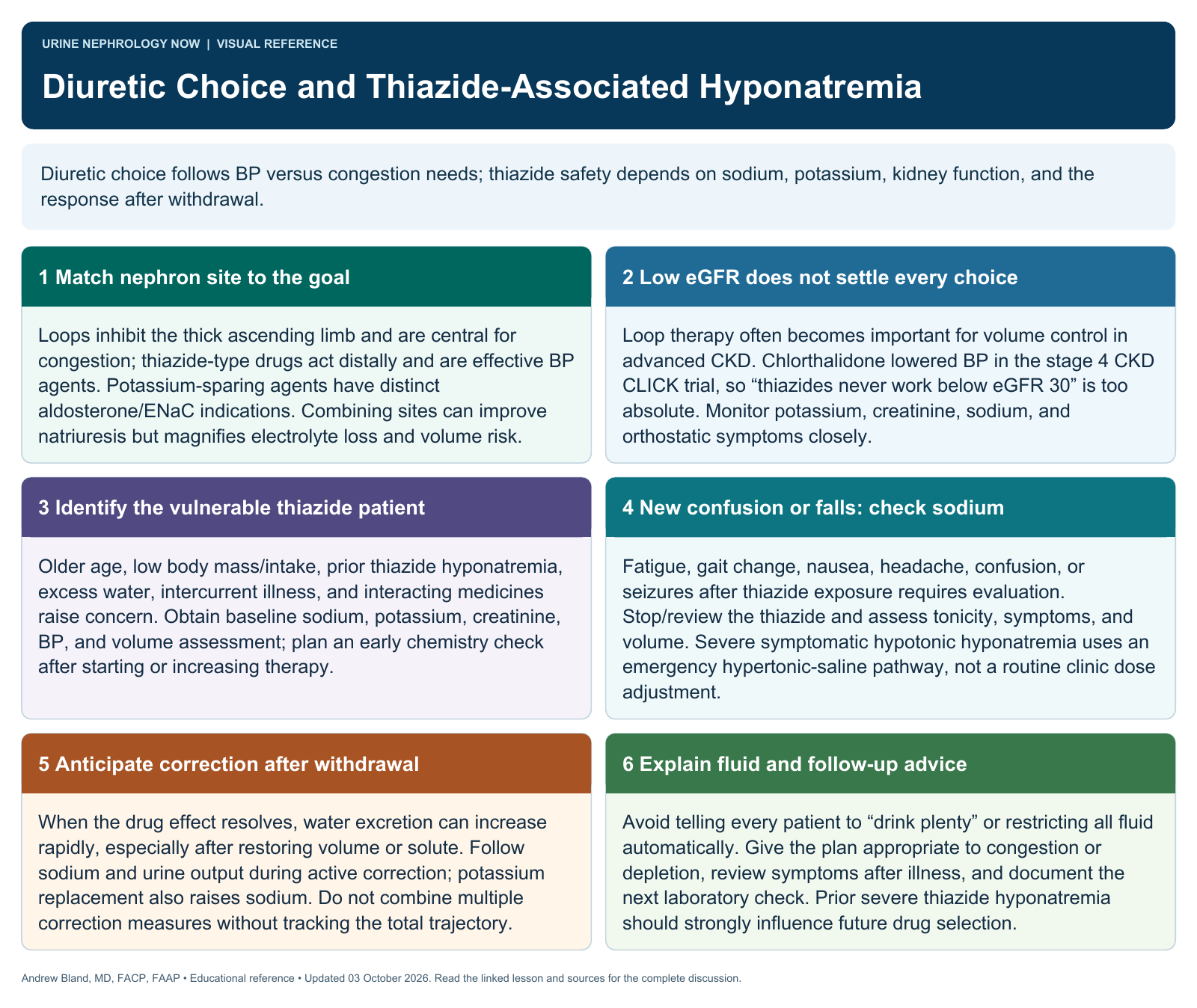
Text version
Match nephron site to the goal
Loops inhibit the thick ascending limb and are central for congestion; thiazide-type drugs act distally and are effective BP agents. Potassium-sparing agents have distinct aldosterone/ENaC indications. Combining sites can improve natriuresis but magnifies electrolyte loss and volume risk.
Low eGFR does not settle every choice
Loop therapy often becomes important for volume control in advanced CKD. Chlorthalidone lowered BP in the stage 4 CKD CLICK trial, so “thiazides never work below eGFR 30” is too absolute. Monitor potassium, creatinine, sodium, and orthostatic symptoms closely.
Identify the vulnerable thiazide patient
Older age, low body mass/intake, prior thiazide hyponatremia, excess water, intercurrent illness, and interacting medicines raise concern. Obtain baseline sodium, potassium, creatinine, BP, and volume assessment; plan an early chemistry check after starting or increasing therapy.
New confusion or falls: check sodium
Fatigue, gait change, nausea, headache, confusion, or seizures after thiazide exposure requires evaluation. Stop/review the thiazide and assess tonicity, symptoms, and volume. Severe symptomatic hypotonic hyponatremia uses an emergency hypertonic-saline pathway, not a routine clinic dose adjustment.
Anticipate correction after withdrawal
When the drug effect resolves, water excretion can increase rapidly, especially after restoring volume or solute. Follow sodium and urine output during active correction; potassium replacement also raises sodium. Do not combine multiple correction measures without tracking the total trajectory.
Explain fluid and follow-up advice
Avoid telling every patient to “drink plenty” or restricting all fluid automatically. Give the plan appropriate to congestion or depletion, review symptoms after illness, and document the next laboratory check. Prior severe thiazide hyponatremia should strongly influence future drug selection.