Visual summary
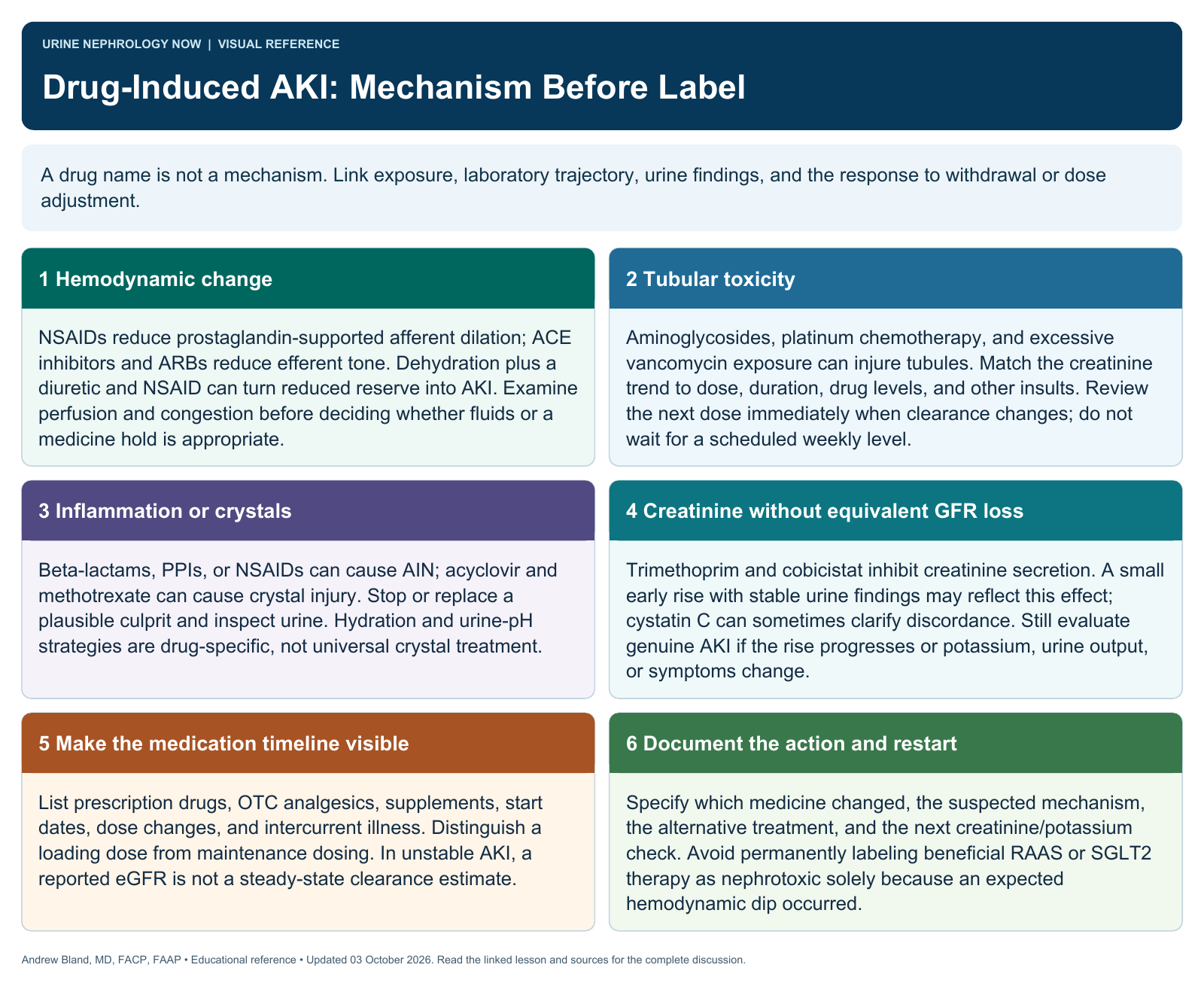
A drug name is not a mechanism. Link exposure, laboratory trajectory, urine findings, and the response to withdrawal or dose adjustment.
Text version
Hemodynamic change
NSAIDs reduce prostaglandin-supported afferent dilation; ACE inhibitors and ARBs reduce efferent tone. Dehydration plus a diuretic and NSAID can turn reduced reserve into AKI. Examine perfusion and congestion before deciding whether fluids or a medicine hold is appropriate.
Tubular toxicity
Aminoglycosides, platinum chemotherapy, and excessive vancomycin exposure can injure tubules. Match the creatinine trend to dose, duration, drug levels, and other insults. Review the next dose immediately when clearance changes; do not wait for a scheduled weekly level.
Inflammation or crystals
Beta-lactams, PPIs, or NSAIDs can cause AIN; acyclovir and methotrexate can cause crystal injury. Stop or replace a plausible culprit and inspect urine. Hydration and urine-pH strategies are drug-specific, not universal crystal treatment.
Creatinine without equivalent GFR loss
Trimethoprim and cobicistat inhibit creatinine secretion. A small early rise with stable urine findings may reflect this effect; cystatin C can sometimes clarify discordance. Still evaluate genuine AKI if the rise progresses or potassium, urine output, or symptoms change.
Make the medication timeline visible
List prescription drugs, OTC analgesics, supplements, start dates, dose changes, and intercurrent illness. Distinguish a loading dose from maintenance dosing. In unstable AKI, a reported eGFR is not a steady-state clearance estimate.
Document the action and restart
Specify which medicine changed, the suspected mechanism, the alternative treatment, and the next creatinine/potassium check. Avoid permanently labeling beneficial RAAS or SGLT2 therapy as nephrotoxic solely because an expected hemodynamic dip occurred.