Visual summary
Hemodiafiltration requires both evidence for the relevant patient and reliable delivery of the intended treatment.
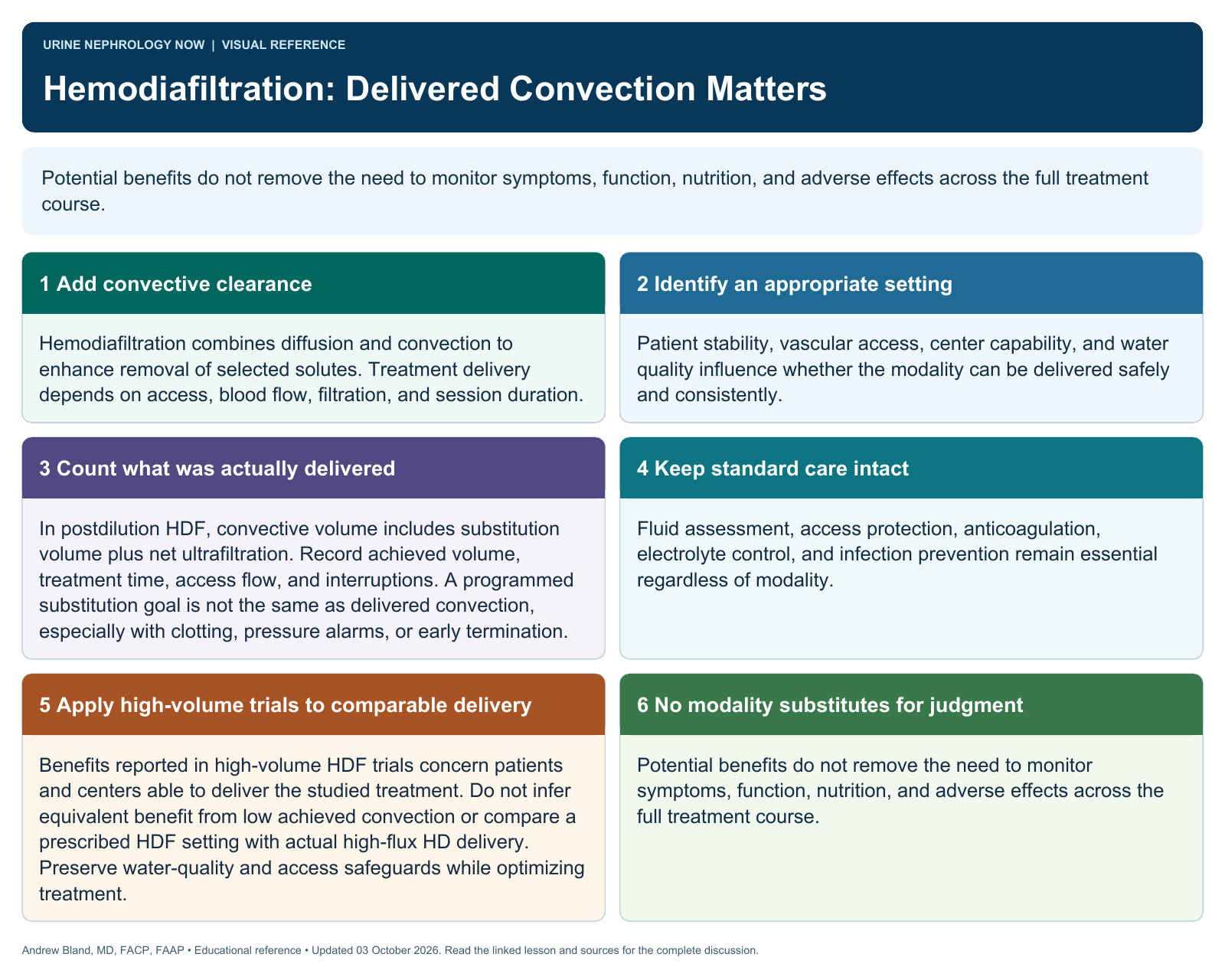
Text version
Two clearance mechanisms
Hemodiafiltration combines diffusive clearance with convective transport and replacement fluid. The delivered convection depends on access, blood flow, treatment duration, prescription, and whether technical requirements can be met safely.
Recognize implementation requirements
Adequate access performance, reliable treatment time, appropriate equipment, and stringent water and replacement-fluid quality are necessary. A modality label alone does not demonstrate that the intended dose was delivered.
Read the evidence by design
Compare randomized trials by patient selection, comparator, delivered convection, follow-up, and measured outcomes. Associations between achieved volume and survival can also reflect differences in health or treatment delivery.
Prescribe and verify
Use a locally validated protocol and monitor delivered treatment, hemodynamic tolerance, access function, and relevant laboratory results. Drug clearance may differ for selected compounds and needs agent-specific assessment rather than universal dose increases.
Consider the patient’s priorities
Discuss potential benefit, treatment burden, availability, and feasibility. Suitability may change with access limitations or clinical instability, and a technically impressive prescription is not useful if treatment cannot be delivered consistently.
Avoid mechanistic overclaims
Improved middle-molecule removal is not itself proof of every proposed cardiovascular or immune benefit. Distinguish the trial’s supported outcome from explanatory hypotheses and avoid transferring specialized HDF evidence to unrelated high-volume ICU hemofiltration.
Continue learning
This graphic summarizes a topic. The full educational pages provide the broader discussion and references.