Visual summary
Successful treatment replaces water, controls ongoing losses, and fixes the reason the patient could not maintain water balance.
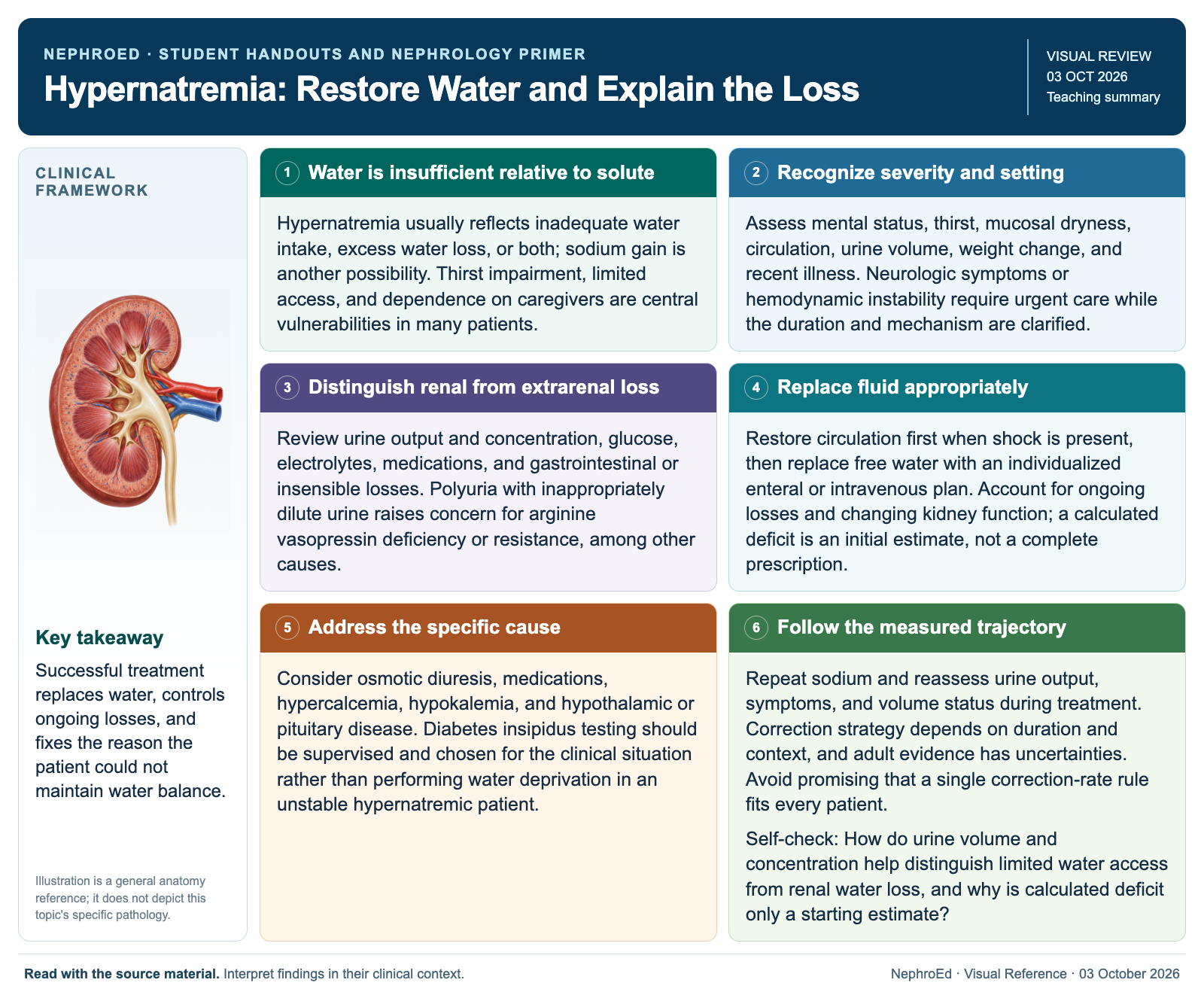
Text version
Water is insufficient relative to solute
Hypernatremia usually reflects inadequate water intake, excess water loss, or both; sodium gain is another possibility. Thirst impairment, limited access, and dependence on caregivers are central vulnerabilities in many patients.
Recognize severity and setting
Assess mental status, thirst, mucosal dryness, circulation, urine volume, weight change, and recent illness. Neurologic symptoms or hemodynamic instability require urgent care while the duration and mechanism are clarified.
Distinguish renal from extrarenal loss
Review urine output and concentration, glucose, electrolytes, medications, and gastrointestinal or insensible losses. Polyuria with inappropriately dilute urine raises concern for arginine vasopressin deficiency or resistance, among other causes.
Replace fluid appropriately
Restore circulation first when shock is present, then replace free water with an individualized enteral or intravenous plan. Account for ongoing losses and changing kidney function; a calculated deficit is an initial estimate, not a complete prescription.
Address the specific cause
Consider osmotic diuresis, medications, hypercalcemia, hypokalemia, and hypothalamic or pituitary disease. Diabetes insipidus testing should be supervised and chosen for the clinical situation rather than performing water deprivation in an unstable hypernatremic patient.
Follow the measured trajectory
Repeat sodium and reassess urine output, symptoms, and volume status during treatment. Correction strategy depends on duration and context, and adult evidence has uncertainties. Avoid promising that a single correction-rate rule fits every patient.
Self-check: How do urine volume and concentration help distinguish limited water access from renal water loss, and why is calculated deficit only a starting estimate?
Continue learning
This graphic summarizes a topic. The full educational pages provide the broader discussion and references.