Visual summary
A deficit calculation starts the plan; serial sodium, ongoing losses, and the reason for impaired water balance determine the actual treatment.
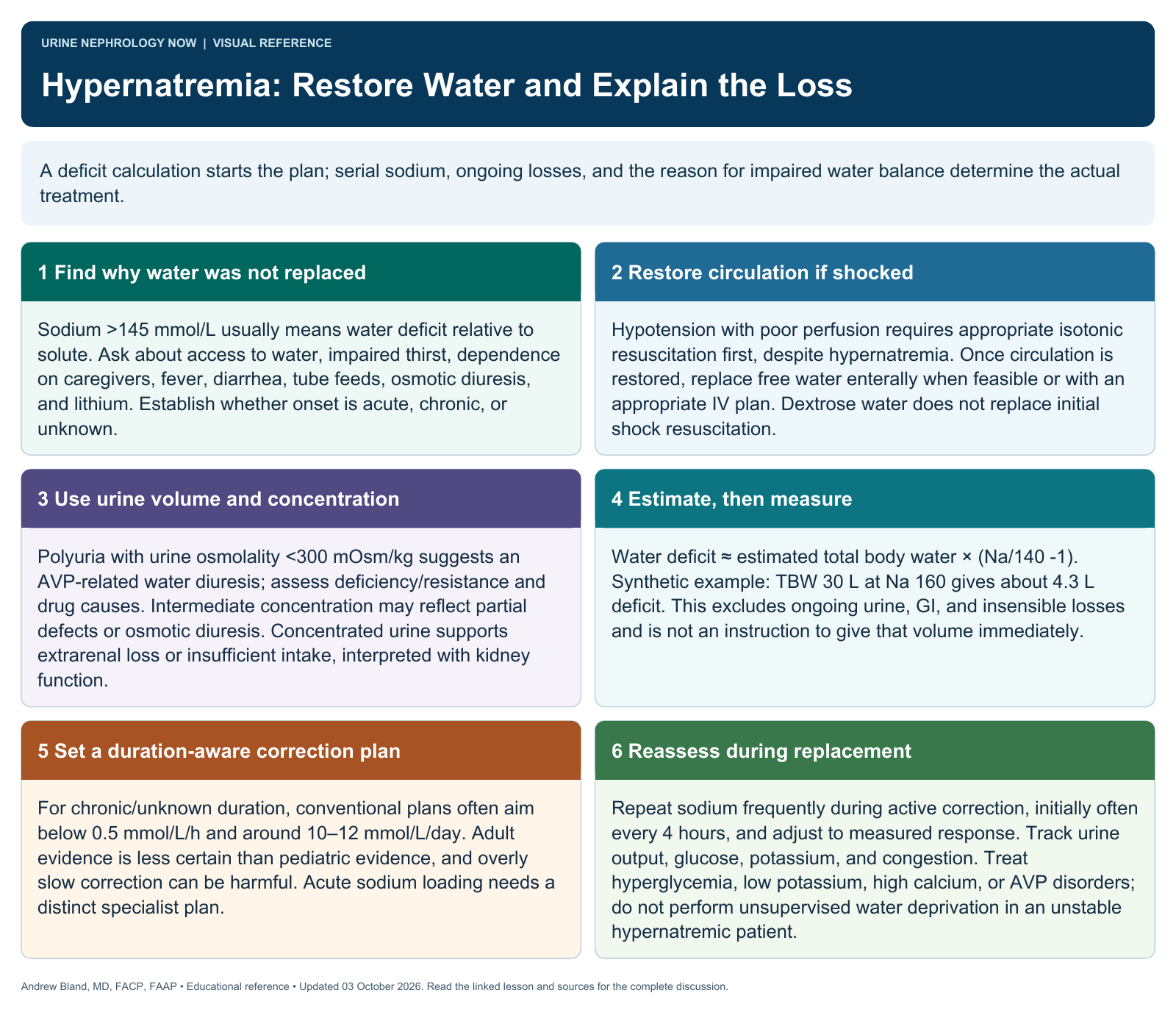
Text version
Find why water was not replaced
Sodium >145 mmol/L usually means water deficit relative to solute. Ask about access to water, impaired thirst, dependence on caregivers, fever, diarrhea, tube feeds, osmotic diuresis, and lithium. Establish whether onset is acute, chronic, or unknown.
Restore circulation if shocked
Hypotension with poor perfusion requires appropriate isotonic resuscitation first, despite hypernatremia. Once circulation is restored, replace free water enterally when feasible or with an appropriate IV plan. Dextrose water does not replace initial shock resuscitation.
Use urine volume and concentration
Polyuria with urine osmolality <300 mOsm/kg suggests an AVP-related water diuresis; assess deficiency/resistance and drug causes. Intermediate concentration may reflect partial defects or osmotic diuresis. Concentrated urine supports extrarenal loss or insufficient intake, interpreted with kidney function.
Estimate, then measure
Water deficit ≈ estimated total body water × (Na/140 −1). Synthetic example: TBW 30 L at Na 160 gives about 4.3 L deficit. This excludes ongoing urine, GI, and insensible losses and is not an instruction to give that volume immediately.
Set a duration-aware correction plan
For chronic/unknown duration, conventional plans often aim below 0.5 mmol/L/h and around 10–12 mmol/L/day. Adult evidence is less certain than pediatric evidence, and overly slow correction can be harmful. Acute sodium loading needs a distinct specialist plan.
Reassess during replacement
Repeat sodium frequently during active correction, initially often every 4 hours, and adjust to measured response. Track urine output, glucose, potassium, and congestion. Treat hyperglycemia, low potassium, high calcium, or AVP disorders; do not perform unsupervised water deprivation in an unstable hypernatremic patient.