Visual summary
Read the liver pattern and the patient’s function together, then identify the complications that change renal and overall management.
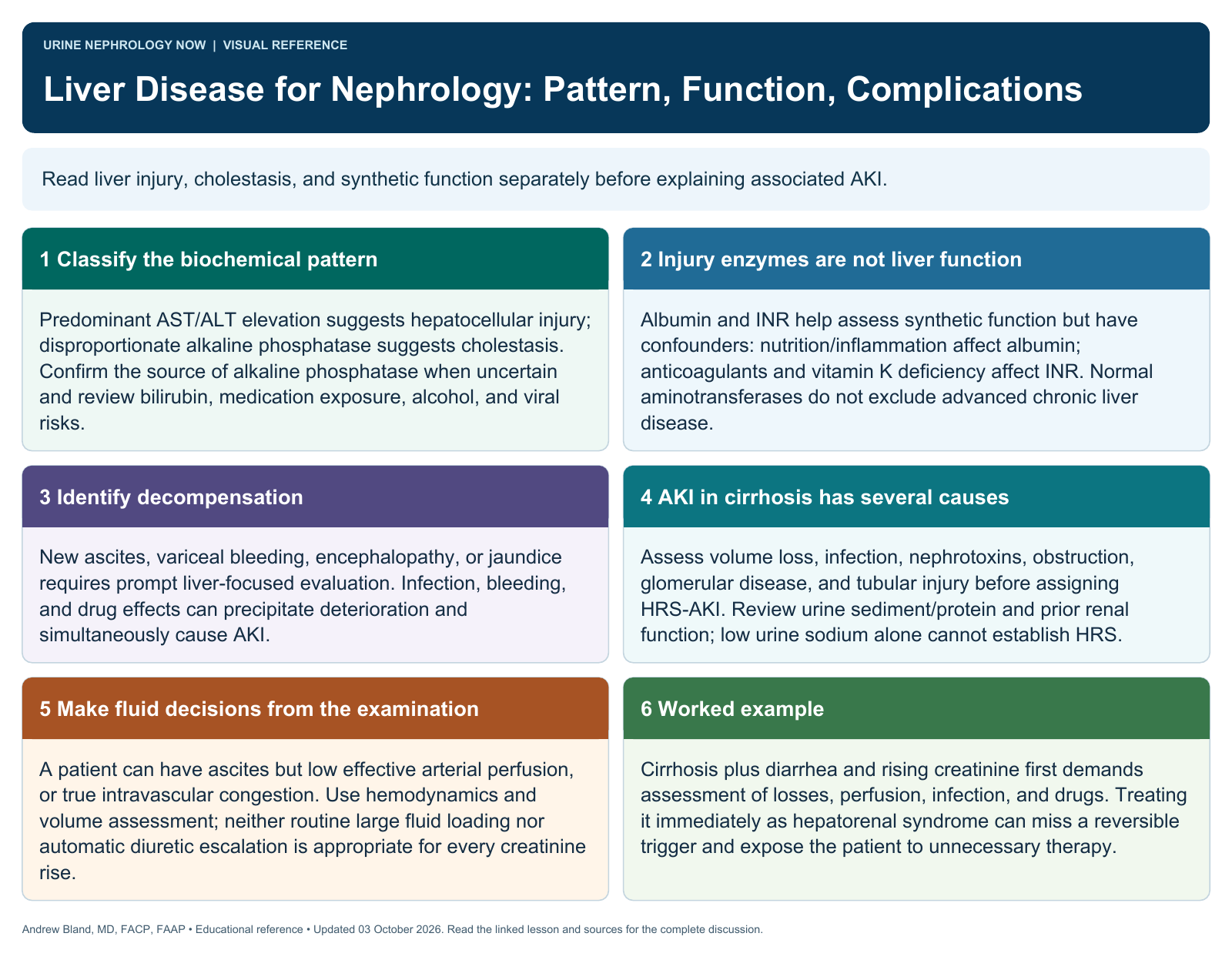
Text version
Liver injury and liver function differ
Aminotransferases indicate injury, while bilirubin, coagulation measures, and albumin provide different information about handling and synthesis. Kidney disease, nutrition, medications, and inflammation can complicate interpretation of several commonly labeled “liver function” tests.
Recognize the major pattern
Hepatocellular, cholestatic, and mixed laboratory patterns guide the differential. Metabolic, alcohol-associated, viral, autoimmune, drug-related, and obstructive processes require different evaluation rather than a diagnosis based on one enzyme value.
Assess severity and fibrosis
Review history, examination, trends, and appropriate imaging or noninvasive fibrosis assessment. Scores and elastography have population and clinical-state limitations, particularly when acute injury or other confounding conditions are present.
Look for decompensation
Ascites, encephalopathy, bleeding, jaundice, infection, and renal deterioration can signal a major change in disease. Acute instability warrants prompt coordinated evaluation rather than routine outpatient fibrosis monitoring.
Connect to the kidney
Portal-hypertensive physiology, infection, medications, and circulatory changes can contribute to AKI and sodium abnormalities. Do not assume every creatinine rise in cirrhosis is hepatorenal syndrome or that all edema needs more diuretic.
Plan disease-specific care
Treat the underlying liver disorder, address relevant exposures, and arrange specialist follow-up or transplant assessment when indicated. Explain which findings are reversible and which require ongoing surveillance without promising a fixed trajectory.
Continue learning
This graphic summarizes a topic. The full educational pages provide the broader discussion and references.