Visual summary
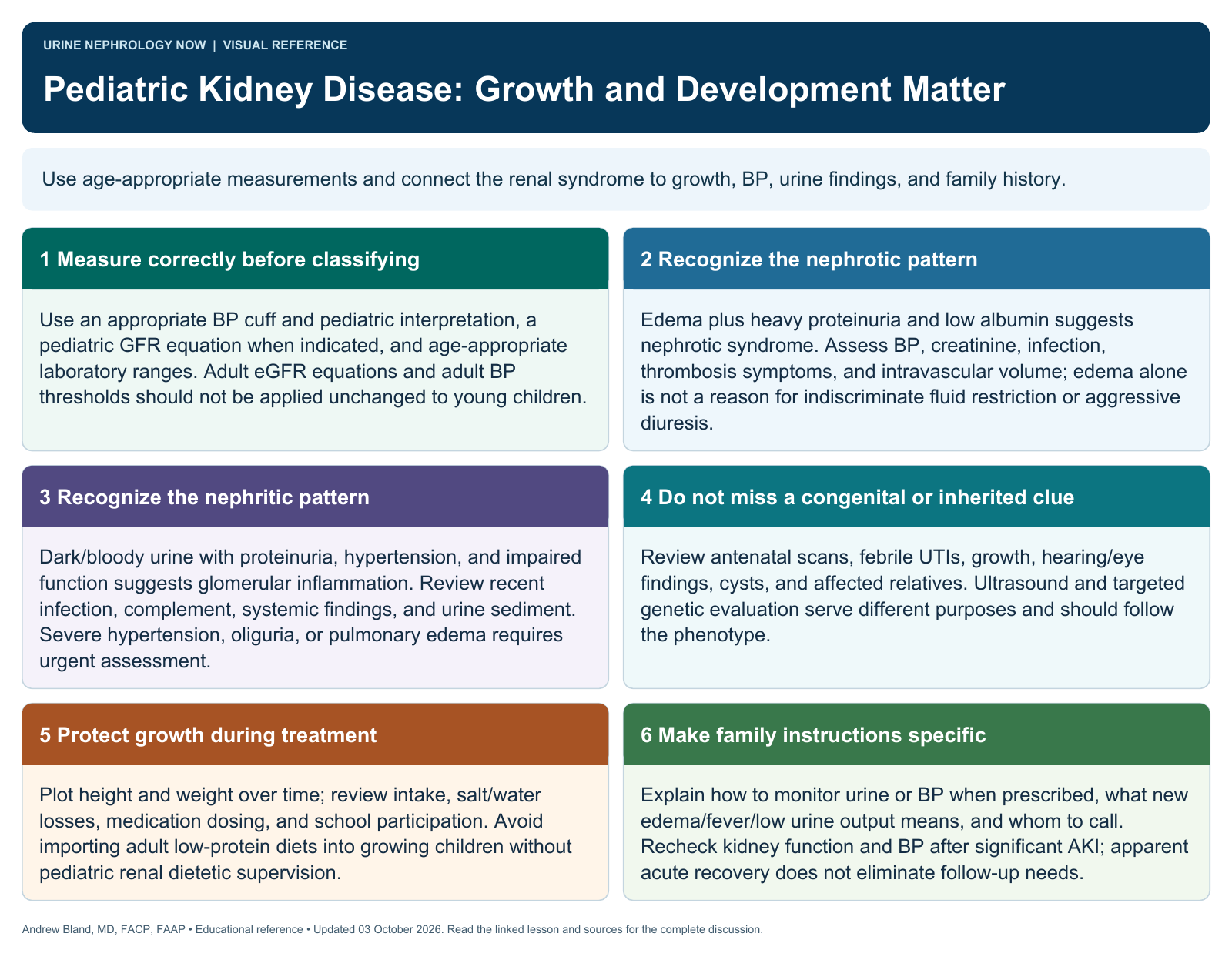
Use age-appropriate measurements and connect the renal syndrome to growth, BP, urine findings, and family history.
Text version
Measure correctly before classifying
Use an appropriate BP cuff and pediatric interpretation, a pediatric GFR equation when indicated, and age-appropriate laboratory ranges. Adult eGFR equations and adult BP thresholds should not be applied unchanged to young children.
Recognize the nephrotic pattern
Edema plus heavy proteinuria and low albumin suggests nephrotic syndrome. Assess BP, creatinine, infection, thrombosis symptoms, and intravascular volume; edema alone is not a reason for indiscriminate fluid restriction or aggressive diuresis.
Recognize the nephritic pattern
Dark/bloody urine with proteinuria, hypertension, and impaired function suggests glomerular inflammation. Review recent infection, complement, systemic findings, and urine sediment. Severe hypertension, oliguria, or pulmonary edema requires urgent assessment.
Do not miss a congenital or inherited clue
Review antenatal scans, febrile UTIs, growth, hearing/eye findings, cysts, and affected relatives. Ultrasound and targeted genetic evaluation serve different purposes and should follow the phenotype.
Protect growth during treatment
Plot height and weight over time; review intake, salt/water losses, medication dosing, and school participation. Avoid importing adult low-protein diets into growing children without pediatric renal dietetic supervision.
Make family instructions specific
Explain how to monitor urine or BP when prescribed, what new edema/fever/low urine output means, and whom to call. Recheck kidney function and BP after significant AKI; apparent acute recovery does not eliminate follow-up needs.