Visual summary
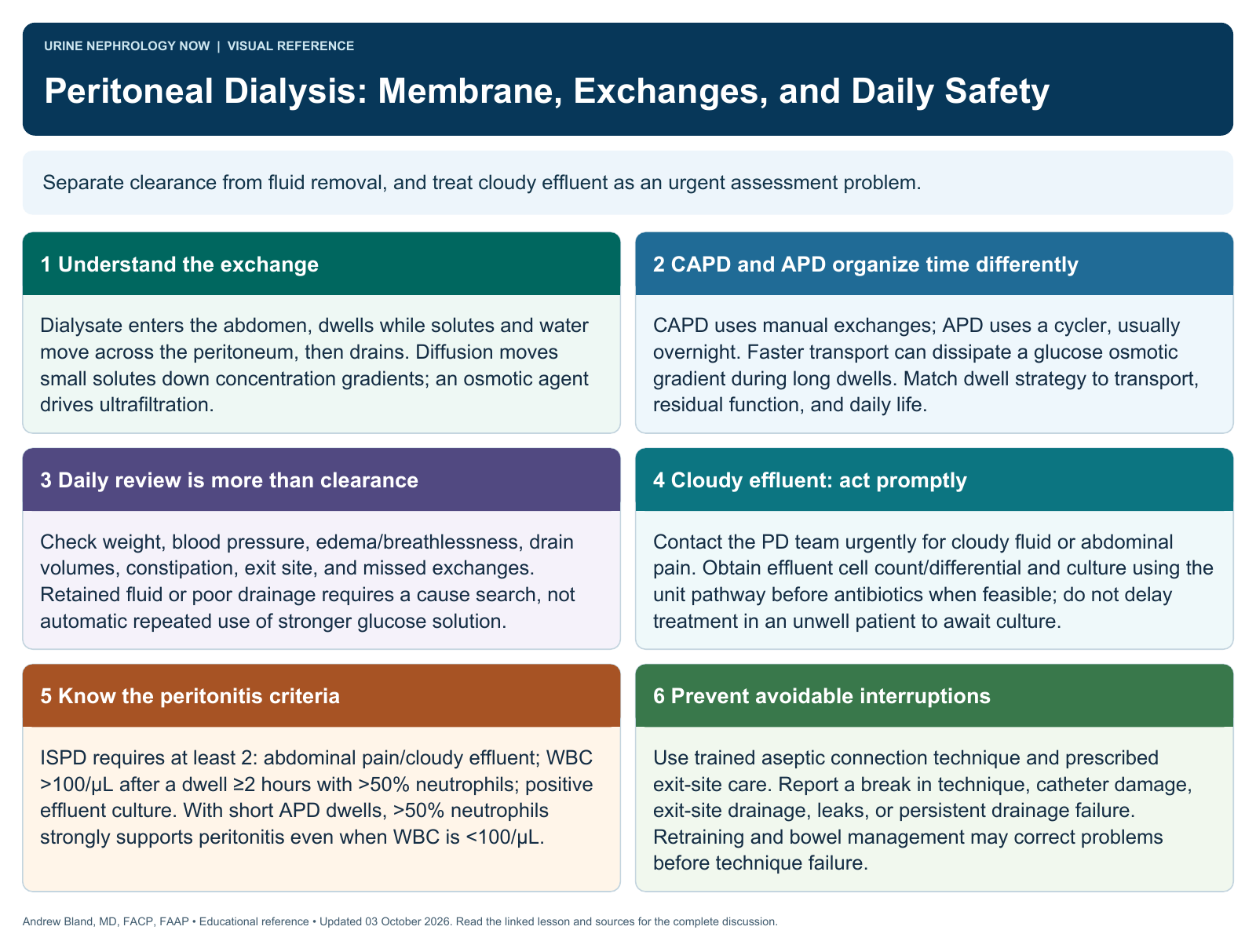
PD success combines a fitting exchange prescription with reliable technique, early complication recognition, and support for home care.
Text version
The peritoneum provides the interface
Solutes move between blood and dialysate across the peritoneal membrane, while osmotic forces support fluid removal. Dwell time, solution, exchange volume, and membrane characteristics determine the resulting clearance and ultrafiltration.
Recognize practical modality differences
Continuous ambulatory and automated schedules organize exchanges differently. The appropriate approach depends on transport characteristics, residual kidney function, lifestyle, home support, dexterity, and the patient’s priorities.
Evaluate adequacy broadly
Review symptoms, nutrition, fluid status, residual function, laboratory results, and delivered exchanges. Membrane testing can help optimize the prescription, but a clearance target alone does not establish that the patient is doing well.
Protect the access and technique
Training, hand hygiene, connection practice, exit-site care, and a clear contact plan help reduce avoidable complications. Assess barriers to home treatment and provide retraining or support when circumstances change.
Recognize peritonitis promptly
Cloudy effluent, abdominal pain, or systemic symptoms warrant urgent evaluation using the established PD pathway. Obtain appropriate samples and coordinate treatment without assuming that every abdominal symptom has the same cause.
Monitor longer-term burden
Leaks, hernias, catheter dysfunction, inadequate ultrafiltration, glucose exposure, and protein loss can affect treatment. Reassess the prescription or modality when complications or personal circumstances make the current plan unsuitable.
Continue learning
This graphic summarizes a topic. The full educational pages provide the broader discussion and references.