Visual summary
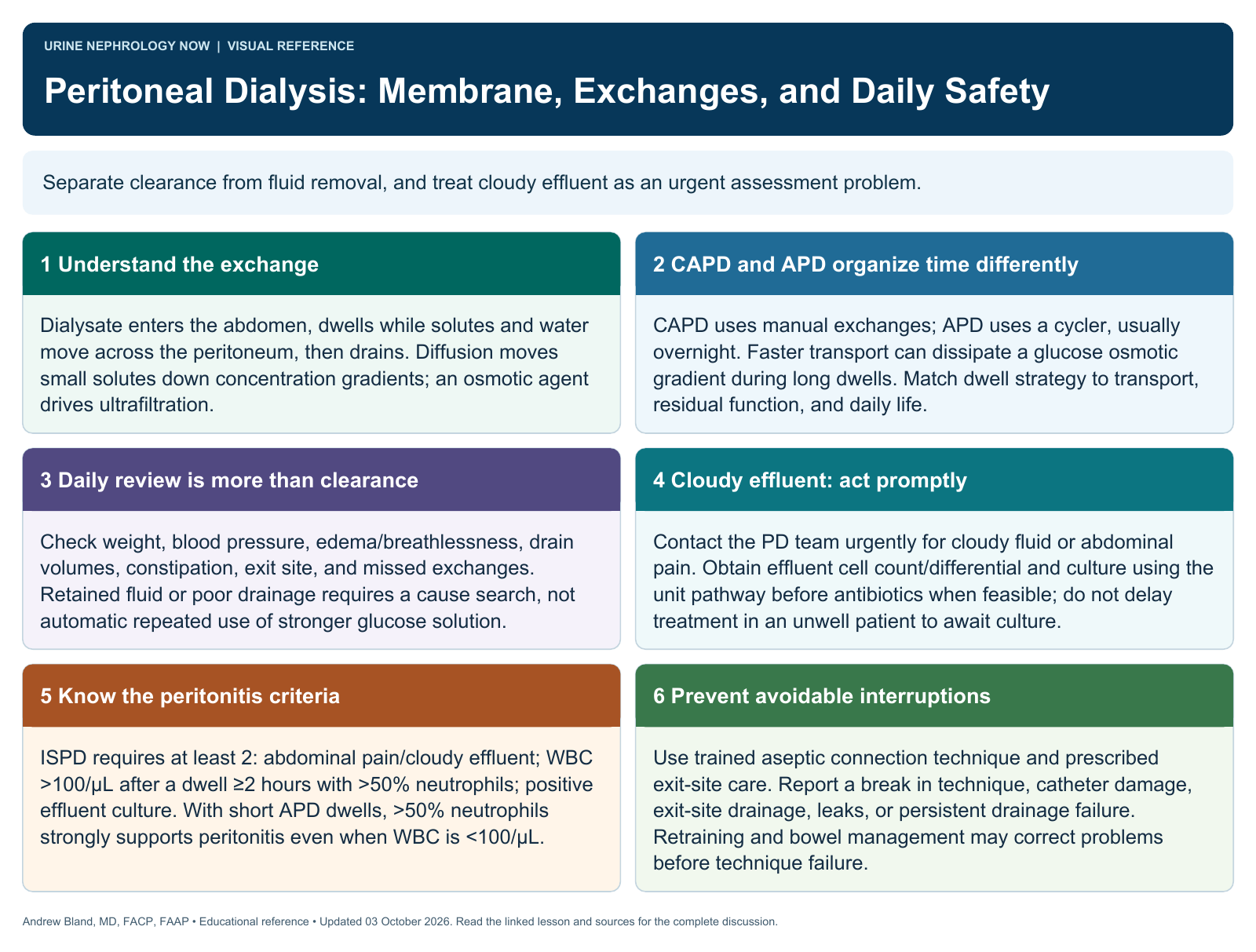
Separate clearance from fluid removal, and treat cloudy effluent as an urgent assessment problem.
Text version
Understand the exchange
Dialysate enters the abdomen, dwells while solutes and water move across the peritoneum, then drains. Diffusion moves small solutes down concentration gradients; an osmotic agent drives ultrafiltration.
CAPD and APD organize time differently
CAPD uses manual exchanges; APD uses a cycler, usually overnight. Faster transport can dissipate a glucose osmotic gradient during long dwells. Match dwell strategy to transport, residual function, and daily life.
Daily review is more than clearance
Check weight, blood pressure, edema/breathlessness, drain volumes, constipation, exit site, and missed exchanges. Retained fluid or poor drainage requires a cause search, not automatic repeated use of stronger glucose solution.
Cloudy effluent: act promptly
Contact the PD team urgently for cloudy fluid or abdominal pain. Obtain effluent cell count/differential and culture using the unit pathway before antibiotics when feasible; do not delay treatment in an unwell patient to await culture.
Know the peritonitis criteria
ISPD requires at least 2: abdominal pain/cloudy effluent; WBC >100/µL after a dwell ≥2 hours with >50% neutrophils; positive effluent culture. With short APD dwells, >50% neutrophils strongly supports peritonitis even when WBC is <100/µL.
Prevent avoidable interruptions
Use trained aseptic connection technique and prescribed exit-site care. Report a break in technique, catheter damage, exit-site drainage, leaks, or persistent drainage failure. Retraining and bowel management may correct problems before technique failure.