Visual summary
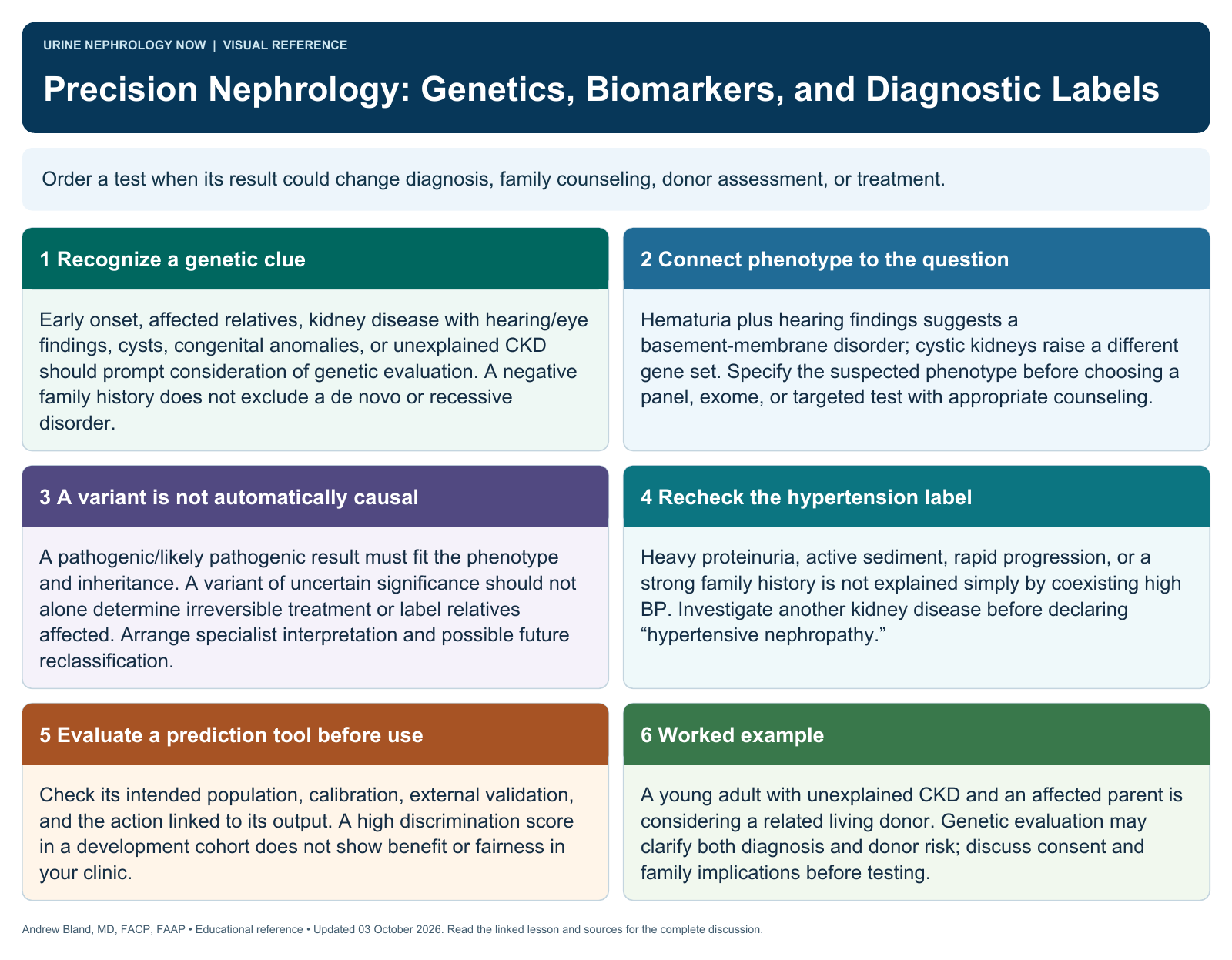
Precision tools improve care when a well-supported result changes a clearly defined decision and its uncertainty is communicated.
Text version
Precision starts with the right question
Genetic findings, biomarkers, and predictive models can clarify disease or treatment in selected settings. Their value depends on whether they improve a meaningful diagnostic or clinical decision for the individual patient.
Recognize a possible inherited pattern
Early onset, family history, syndromic findings, unexplained disease, or a phenotype suggestive of a genetic disorder may justify specialist evaluation. An apparently negative family history does not exclude inheritance.
Interpret variants responsibly
Assess the test’s scope, pathogenicity classification, phenotype fit, and uncertainty. APOL1-associated risk is not deterministic, and ancestry or a social race label should not substitute for a gene result or a clinical diagnosis.
Reconsider broad labels
Hypertension plus CKD does not prove hypertension caused the kidney disease. Heavy proteinuria, an atypical course, or genetic clues may reveal another process and change how prognosis and treatment are discussed.
Evaluate models and biomarkers
Check intended population, external validation, calibration, bias, and the action linked to a result. A high predictive accuracy in a development dataset does not guarantee useful performance or fair outcomes in routine care.
Plan counseling and follow-up
Explain potential personal and family implications before testing and arrange appropriate interpretation afterward. Do not present experimental targets or genomic associations as established therapy without current outcome and regulatory evidence.
Continue learning
This graphic summarizes a topic. The full educational pages provide the broader discussion and references.