Visual summary
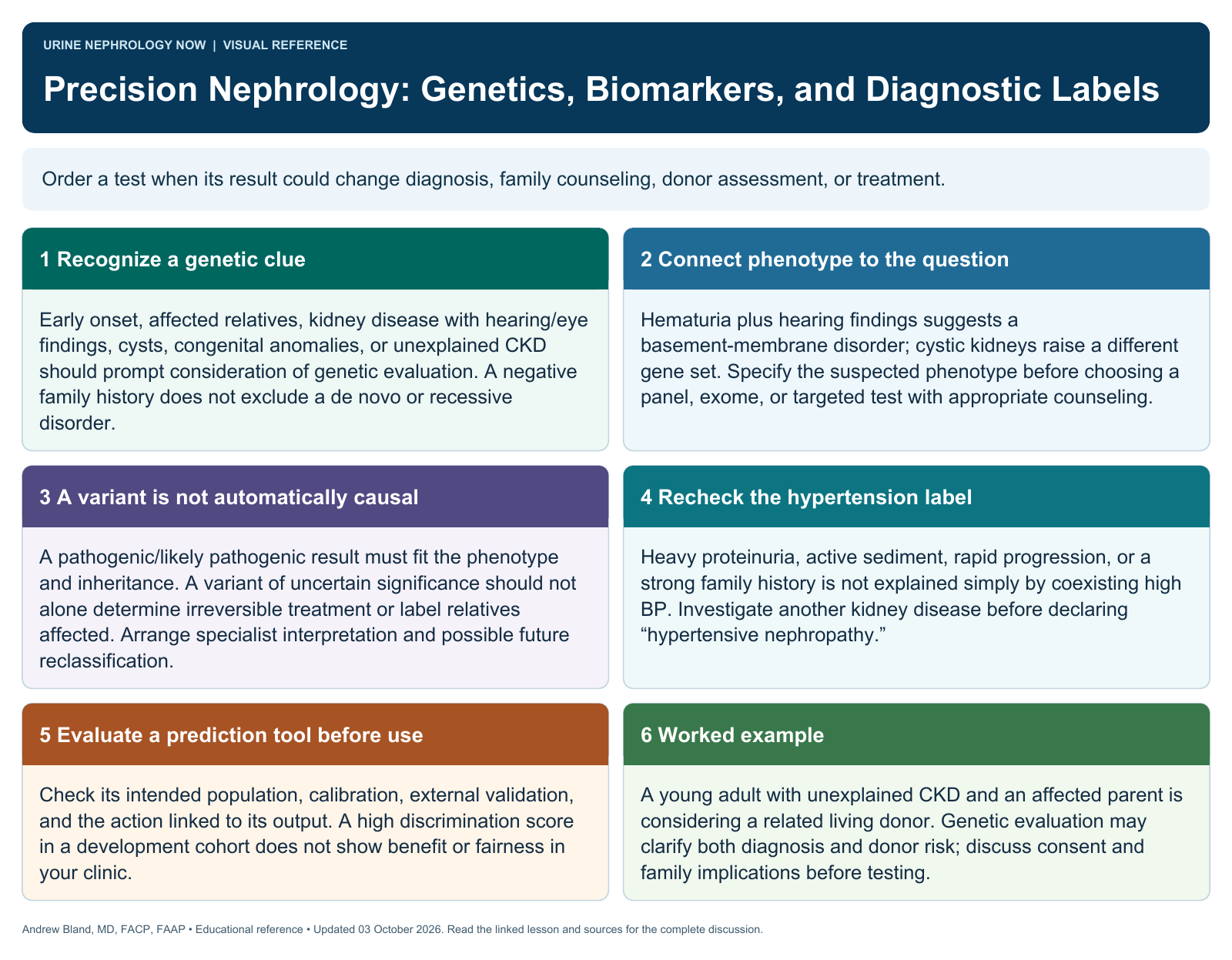
Order a test when its result could change diagnosis, family counseling, donor assessment, or treatment.
Text version
Recognize a genetic clue
Early onset, affected relatives, kidney disease with hearing/eye findings, cysts, congenital anomalies, or unexplained CKD should prompt consideration of genetic evaluation. A negative family history does not exclude a de novo or recessive disorder.
Connect phenotype to the question
Hematuria plus hearing findings suggests a basement-membrane disorder; cystic kidneys raise a different gene set. Specify the suspected phenotype before choosing a panel, exome, or targeted test with appropriate counseling.
A variant is not automatically causal
A pathogenic/likely pathogenic result must fit the phenotype and inheritance. A variant of uncertain significance should not alone determine irreversible treatment or label relatives affected. Arrange specialist interpretation and possible future reclassification.
Recheck the hypertension label
Heavy proteinuria, active sediment, rapid progression, or a strong family history is not explained simply by coexisting high BP. Investigate another kidney disease before declaring “hypertensive nephropathy.”
Evaluate a prediction tool before use
Check its intended population, calibration, external validation, and the action linked to its output. A high discrimination score in a development cohort does not show benefit or fairness in your clinic.
Worked example
A young adult with unexplained CKD and an affected parent is considering a related living donor. Genetic evaluation may clarify both diagnosis and donor risk; discuss consent and family implications before testing.