Visual summary
Follow growth in children, bone health, nephrolithiasis, potassium, and bicarbonate. A diagnostic label should explain the patient's chemistry and clinical trajectory.
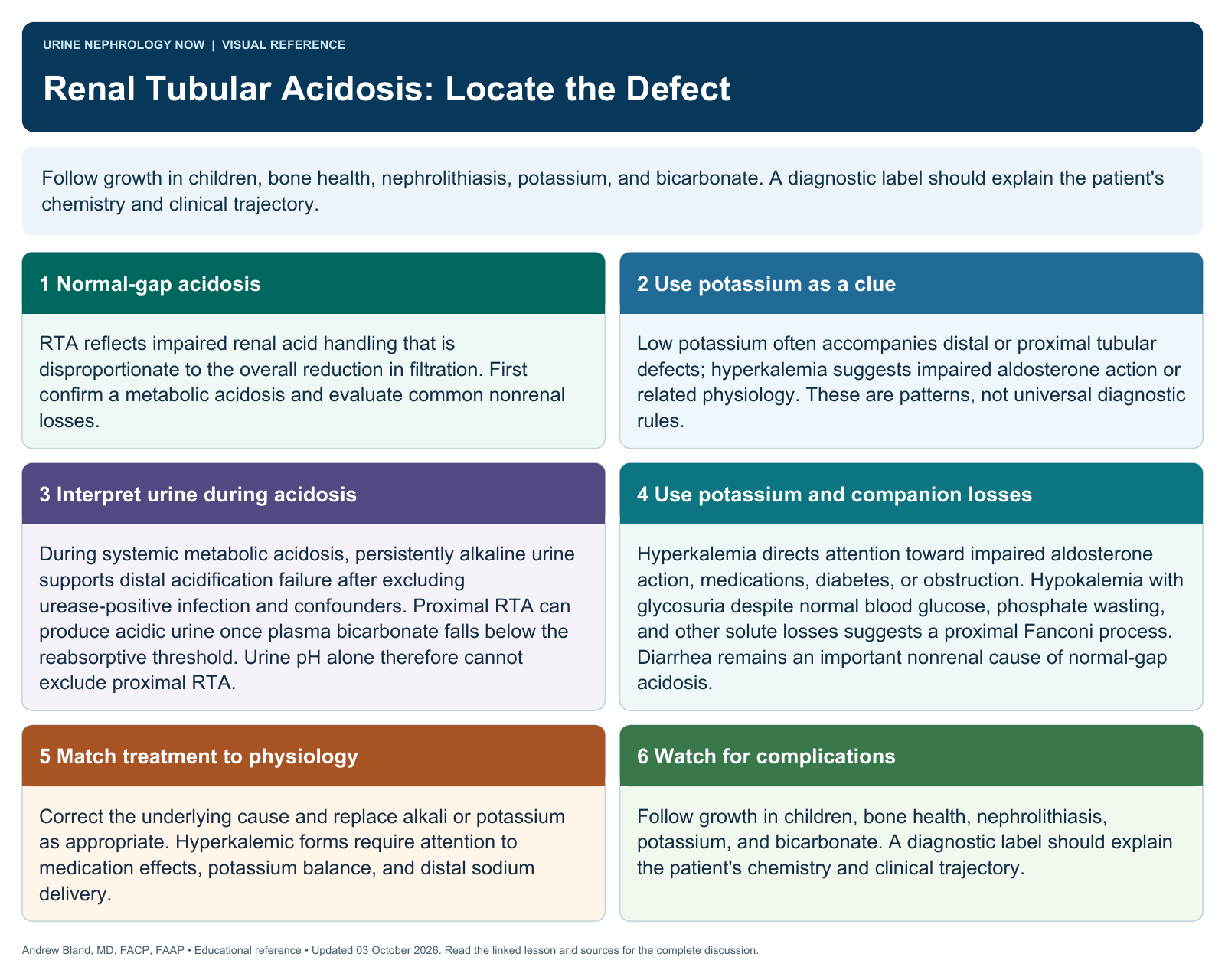
Text version
Normal-gap acidosis
RTA reflects impaired renal acid handling that is disproportionate to the overall reduction in filtration. First confirm a metabolic acidosis and evaluate common nonrenal losses.
Use potassium as a clue
Low potassium often accompanies distal or proximal tubular defects; hyperkalemia suggests impaired aldosterone action or related physiology. These are patterns, not universal diagnostic rules.
Interpret urine during acidosis
During systemic metabolic acidosis, persistently alkaline urine supports distal acidification failure after excluding urease-positive infection and confounders. Proximal RTA can produce acidic urine once plasma bicarbonate falls below the reabsorptive threshold. Urine pH alone therefore cannot exclude proximal RTA.
Use potassium and companion losses
Hyperkalemia directs attention toward impaired aldosterone action, medications, diabetes, or obstruction. Hypokalemia with glycosuria despite normal blood glucose, phosphate wasting, and other solute losses suggests a proximal Fanconi process. Diarrhea remains an important nonrenal cause of normal-gap acidosis.
Match treatment to physiology
Correct the underlying cause and replace alkali or potassium as appropriate. Hyperkalemic forms require attention to medication effects, potassium balance, and distal sodium delivery.
Watch for complications
Follow growth in children, bone health, nephrolithiasis, potassium, and bicarbonate. A diagnostic label should explain the patient's chemistry and clinical trajectory.