Visual summary
CK identifies muscle injury; perfusion, urine output, electrolytes, and congestion determine the fluid and dialysis decisions.
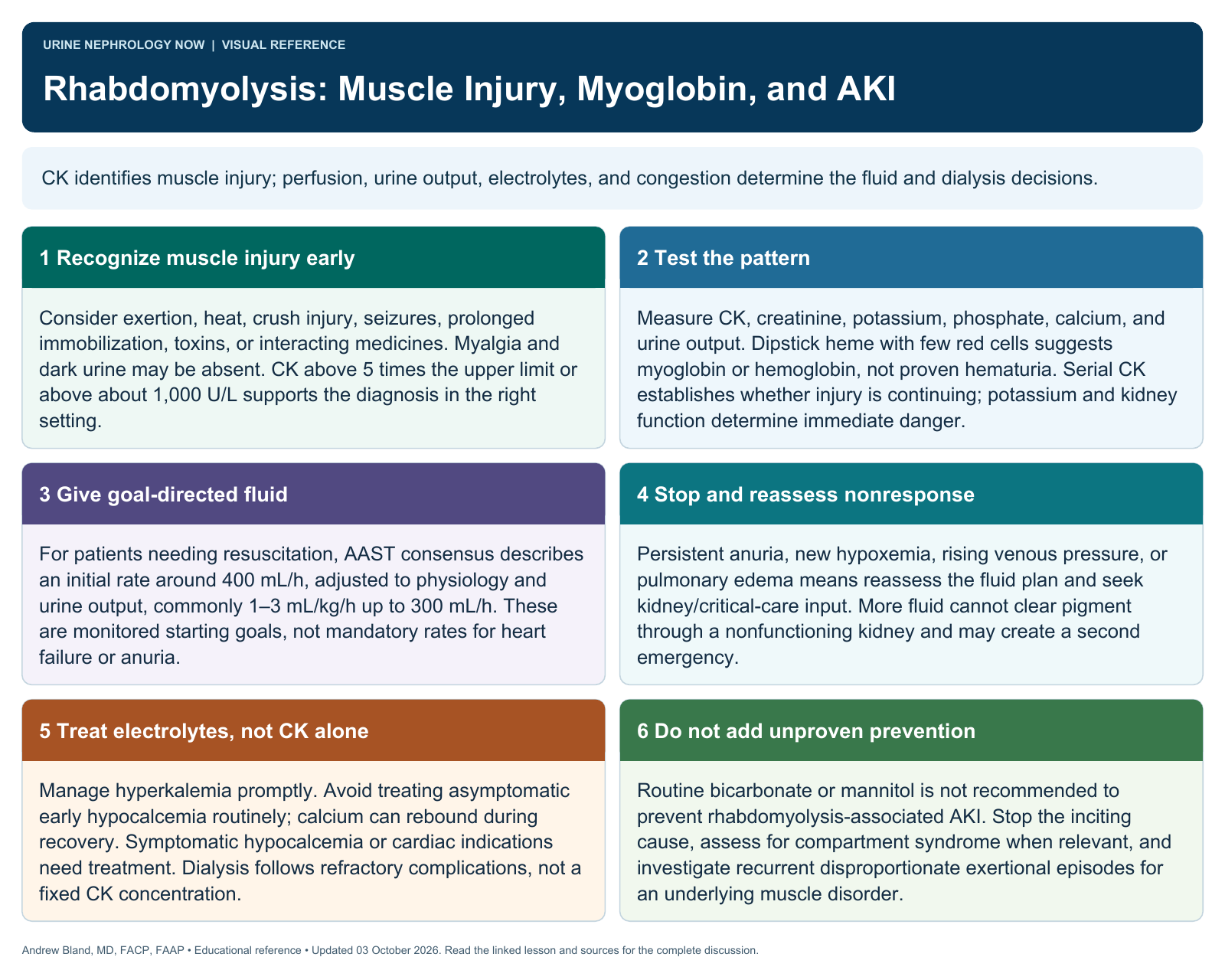
Text version
Recognize muscle injury early
Consider exertion, heat, crush injury, seizures, prolonged immobilization, toxins, or interacting medicines. Myalgia and dark urine may be absent. CK above 5 times the upper limit or above about 1,000 U/L supports the diagnosis in the right setting.
Test the pattern
Measure CK, creatinine, potassium, phosphate, calcium, and urine output. Dipstick heme with few red cells suggests myoglobin or hemoglobin, not proven hematuria. Serial CK establishes whether injury is continuing; potassium and kidney function determine immediate danger.
Give goal-directed fluid
For patients needing resuscitation, AAST consensus describes an initial rate around 400 mL/h, adjusted to physiology and urine output, commonly 1–3 mL/kg/h up to 300 mL/h. These are monitored starting goals, not mandatory rates for heart failure or anuria.
Stop and reassess nonresponse
Persistent anuria, new hypoxemia, rising venous pressure, or pulmonary edema means reassess the fluid plan and seek kidney/critical-care input. More fluid cannot clear pigment through a nonfunctioning kidney and may create a second emergency.
Treat electrolytes, not CK alone
Manage hyperkalemia promptly. Avoid treating asymptomatic early hypocalcemia routinely; calcium can rebound during recovery. Symptomatic hypocalcemia or cardiac indications need treatment. Dialysis follows refractory complications, not a fixed CK concentration.
Do not add unproven prevention
Routine bicarbonate or mannitol is not recommended to prevent rhabdomyolysis-associated AKI. Stop the inciting cause, assess for compartment syndrome when relevant, and investigate recurrent disproportionate exertional episodes for an underlying muscle disorder.