Visual summary
Transplant evaluation combines expected benefit, compatibility, modifiable risks, and a feasible long-term care plan.
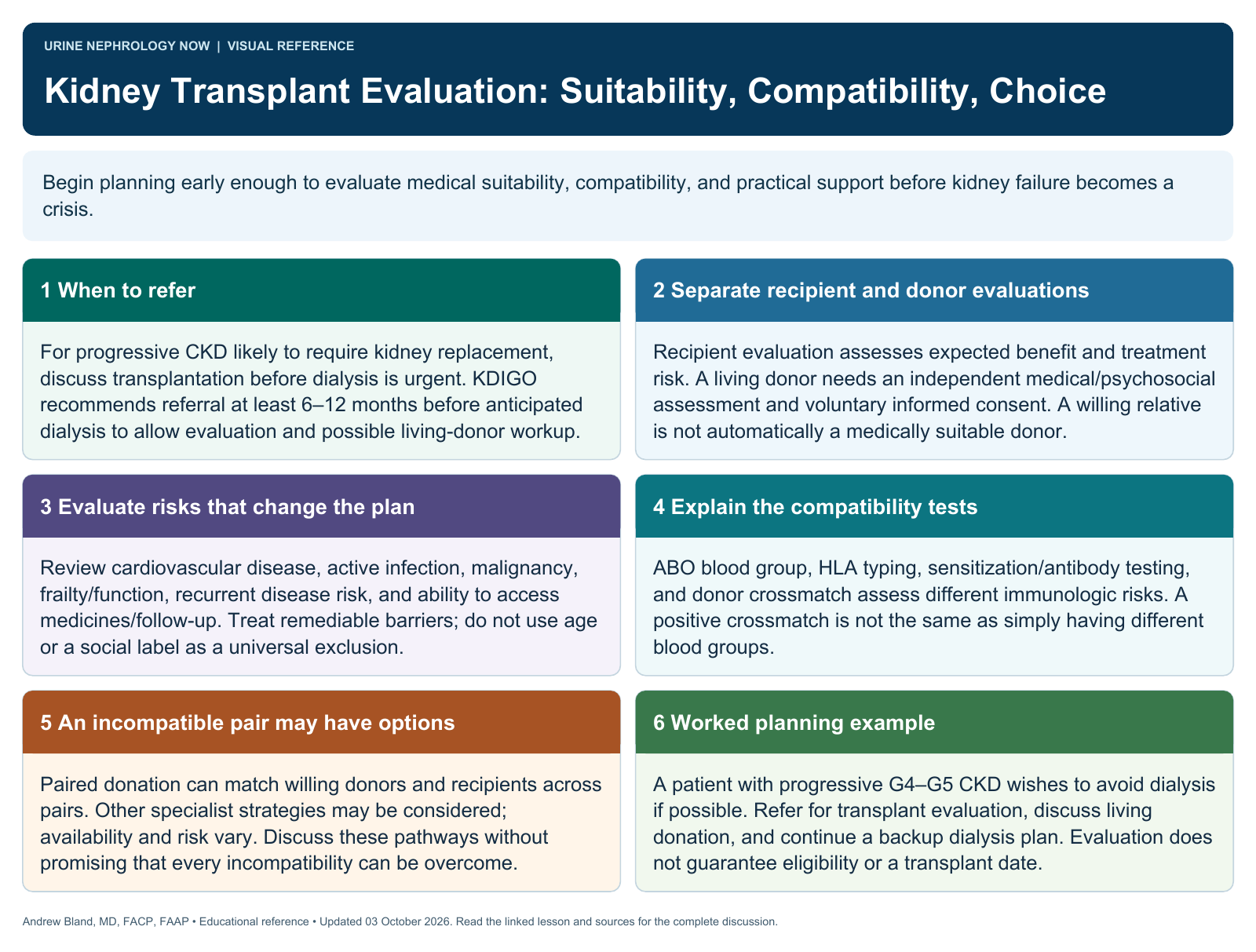
Text version
Replacement function with lifelong obligations
Kidney transplantation can offer major benefits for suitable patients while creating ongoing immunosuppression, monitoring, and complication risks. Evaluation considers whether expected benefits fit the person’s medical situation and priorities.
Recognize when planning helps
Discuss referral before a crisis when kidney trajectory and overall health make transplantation relevant. Living-donor and deceased-donor pathways differ in timing and logistics, but both require informed assessment.
Evaluate broadly and fairly
Review cardiovascular and infectious risk, malignancy history, functional status, psychosocial support, and practical treatment barriers. Apparent adherence difficulties should prompt investigation of access and support needs rather than assumptions about motivation.
Assess immunologic compatibility
Blood group, HLA information, sensitization, donor-specific antibodies, and crossmatch testing help define risk and available strategies. Paired donation and other specialist approaches may expand options for selected incompatible pairs.
Explain allocation and alternatives
Waiting time and allocation depend on current policy and patient or donor characteristics. Discuss uncertainty, donor evaluation, dialysis options, and the possibility that eligibility or preferences may change over time.
Avoid categorical promises
A single age, BMI, or comorbidity label should not be presented as a universal absolute exclusion without current center-specific context. Evaluation is a multidisciplinary process, and a transplant does not eliminate future kidney or general medical care.
Continue learning
This graphic summarizes a topic. The full educational pages provide the broader discussion and references.