Visual summary
Begin planning early enough to evaluate medical suitability, compatibility, and practical support before kidney failure becomes a crisis.
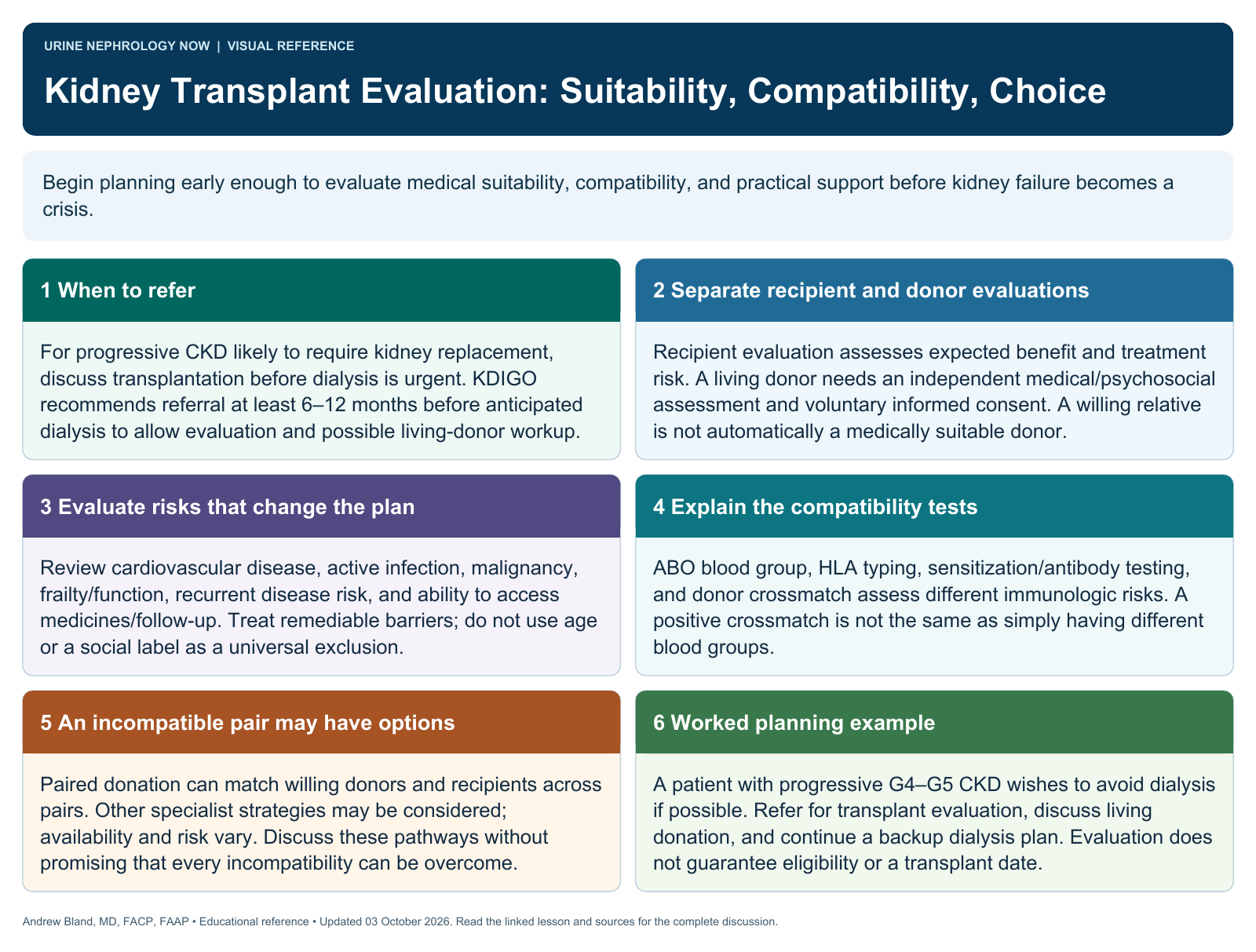
Text version
When to refer
For progressive CKD likely to require kidney replacement, discuss transplantation before dialysis is urgent. KDIGO recommends referral at least 6–12 months before anticipated dialysis to allow evaluation and possible living-donor workup.
Separate recipient and donor evaluations
Recipient evaluation assesses expected benefit and treatment risk. A living donor needs an independent medical/psychosocial assessment and voluntary informed consent. A willing relative is not automatically a medically suitable donor.
Evaluate risks that change the plan
Review cardiovascular disease, active infection, malignancy, frailty/function, recurrent disease risk, and ability to access medicines/follow-up. Treat remediable barriers; do not use age or a social label as a universal exclusion.
Explain the compatibility tests
ABO blood group, HLA typing, sensitization/antibody testing, and donor crossmatch assess different immunologic risks. A positive crossmatch is not the same as simply having different blood groups.
An incompatible pair may have options
Paired donation can match willing donors and recipients across pairs. Other specialist strategies may be considered; availability and risk vary. Discuss these pathways without promising that every incompatibility can be overcome.
Worked planning example
A patient with progressive G4–G5 CKD wishes to avoid dialysis if possible. Refer for transplant evaluation, discuss living donation, and continue a backup dialysis plan. Evaluation does not guarantee eligibility or a transplant date.