Visual summary
A tubular disorder becomes understandable when you connect the nephron segment to BP, electrolytes, acid balance, and urinary losses.
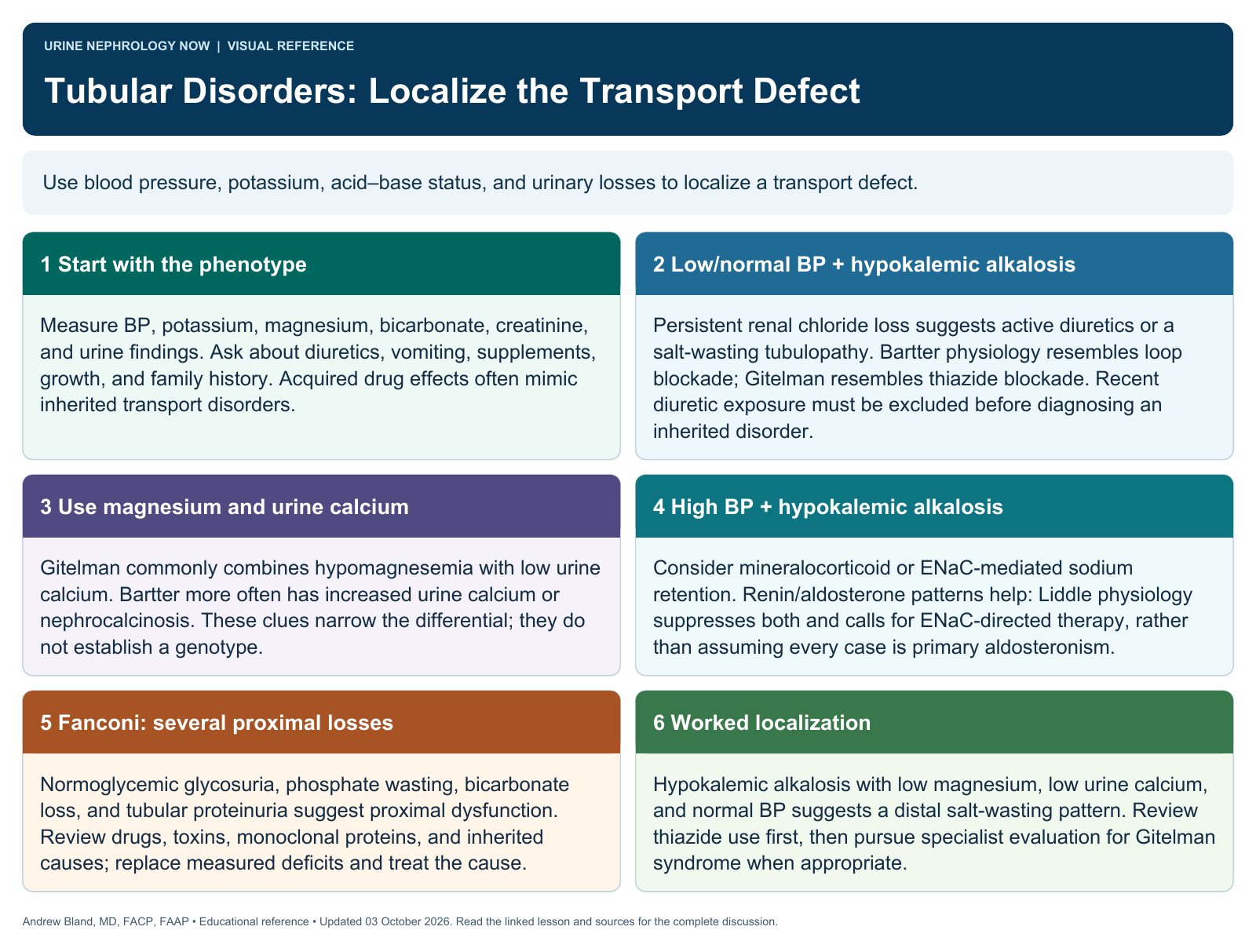
Text version
Transport defects create recognizable patterns
Inherited or acquired defects in tubular transport can cause salt wasting, potassium abnormalities, acid–base disturbance, polyuria, or loss of several proximal solutes. Localizing the affected segment helps organize the differential.
Recognize linked abnormalities
Bartter and Gitelman syndromes can produce salt-wasting alkalosis with distinguishing calcium or magnesium patterns. Fanconi syndrome causes generalized proximal losses, while Liddle-related physiology combines hypertension with altered distal sodium handling.
Investigate systematically
Review BP, growth, family history, medications, renal function, electrolytes, urine concentration, and targeted urine losses. Drug effects can mimic inherited disease, and serum values may change after replacement or diuretic exposure.
Match therapy to the mechanism
Replacement, pathway-specific medications, and treatment of acquired causes differ across syndromes. Chronic care also needs attention to growth, stones, bone health, hearing or eye findings when relevant, and adherence burden.
Consider interstitial disease
Chronic tubulointerstitial disorders can impair concentration and cause modest proteinuria before advanced filtration loss. Genetic forms, toxins, obstruction, and inflammatory disease require different counseling and monitoring strategies.
Avoid a mnemonic-only diagnosis
A pattern can guide testing but does not prove a gene defect. Confirm the diagnosis using clinical context and appropriate specialist or genetic assessment, then explain uncertainty and family implications carefully.
Continue learning
This graphic summarizes a topic. The full educational pages provide the broader discussion and references.