Visual summary
TLS prevention starts before therapy; after lysis begins, repeated chemistry and urine-output assessment determine how quickly treatment must escalate.
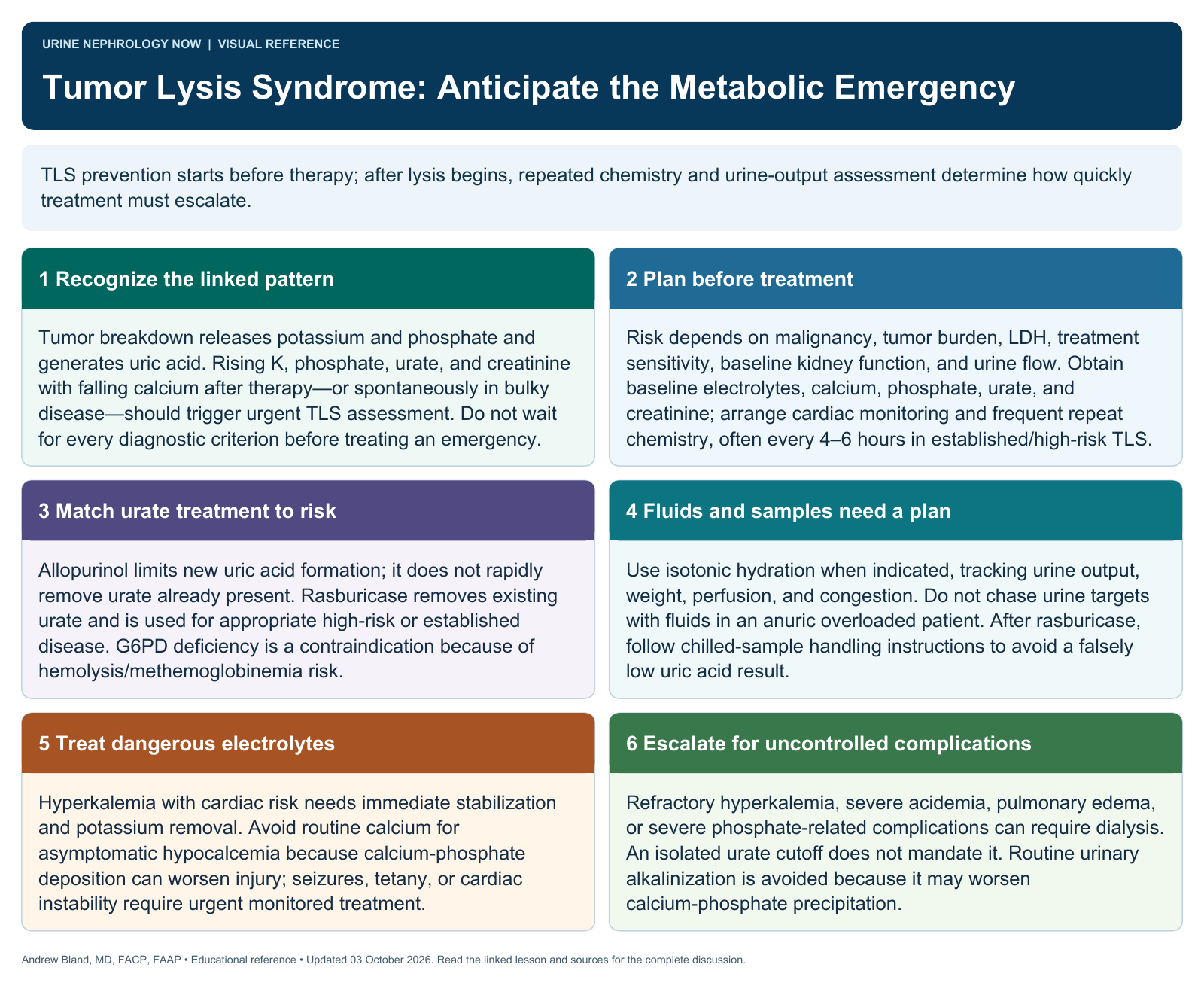
Text version
Recognize the linked pattern
Tumor breakdown releases potassium and phosphate and generates uric acid. Rising K, phosphate, urate, and creatinine with falling calcium after therapy—or spontaneously in bulky disease—should trigger urgent TLS assessment. Do not wait for every diagnostic criterion before treating an emergency.
Plan before treatment
Risk depends on malignancy, tumor burden, LDH, treatment sensitivity, baseline kidney function, and urine flow. Obtain baseline electrolytes, calcium, phosphate, urate, and creatinine; arrange cardiac monitoring and frequent repeat chemistry, often every 4–6 hours in established/high-risk TLS.
Match urate treatment to risk
Allopurinol limits new uric acid formation; it does not rapidly remove urate already present. Rasburicase removes existing urate and is used for appropriate high-risk or established disease. G6PD deficiency is a contraindication because of hemolysis/methemoglobinemia risk.
Fluids and samples need a plan
Use isotonic hydration when indicated, tracking urine output, weight, perfusion, and congestion. Do not chase urine targets with fluids in an anuric overloaded patient. After rasburicase, follow chilled-sample handling instructions to avoid a falsely low uric acid result.
Treat dangerous electrolytes
Hyperkalemia with cardiac risk needs immediate stabilization and potassium removal. Avoid routine calcium for asymptomatic hypocalcemia because calcium-phosphate deposition can worsen injury; seizures, tetany, or cardiac instability require urgent monitored treatment.
Escalate for uncontrolled complications
Refractory hyperkalemia, severe acidemia, pulmonary edema, or severe phosphate-related complications can require dialysis. An isolated urate cutoff does not mandate it. Routine urinary alkalinization is avoided because it may worsen calcium-phosphate precipitation.