Visual summary
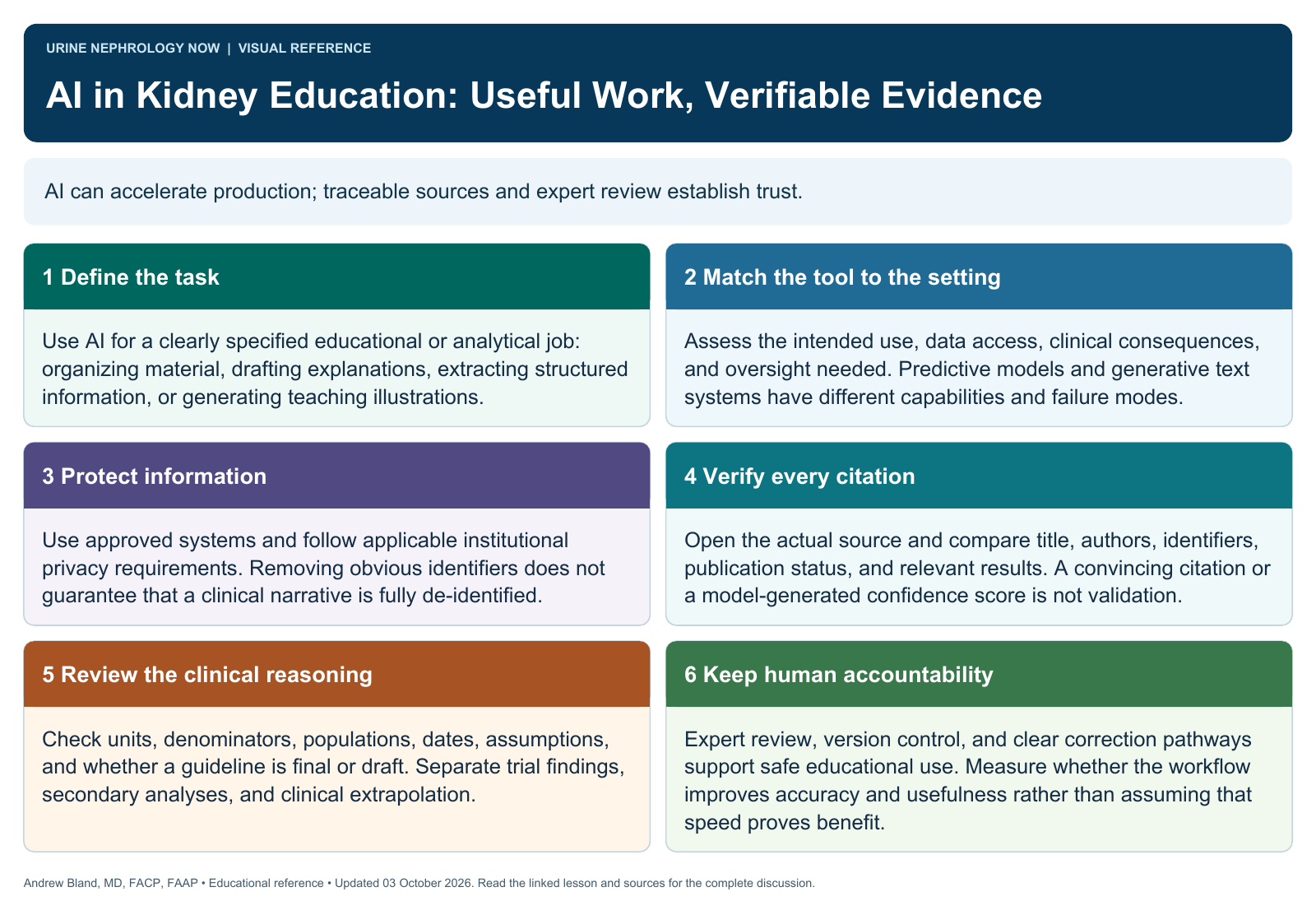
AI can accelerate production; traceable sources and expert review establish trust.
Text version
Define the task
Use AI for a clearly specified educational or analytical job: organizing material, drafting explanations, extracting structured information, or generating teaching illustrations.
Match the tool to the setting
Assess the intended use, data access, clinical consequences, and oversight needed. Predictive models and generative text systems have different capabilities and failure modes.
Protect information
Use approved systems and follow applicable institutional privacy requirements. Removing obvious identifiers does not guarantee that a clinical narrative is fully de-identified.
Verify every citation
Open the actual source and compare title, authors, identifiers, publication status, and relevant results. A convincing citation or a model-generated confidence score is not validation.
Review the clinical reasoning
Check units, denominators, populations, dates, assumptions, and whether a guideline is final or draft. Separate trial findings, secondary analyses, and clinical extrapolation.
Keep human accountability
Expert review, version control, and clear correction pathways support safe educational use. Measure whether the workflow improves accuracy and usefulness rather than assuming that speed proves benefit.
Continue learning
This graphic summarizes a topic. The full educational pages provide the broader discussion and references.