Visual summary
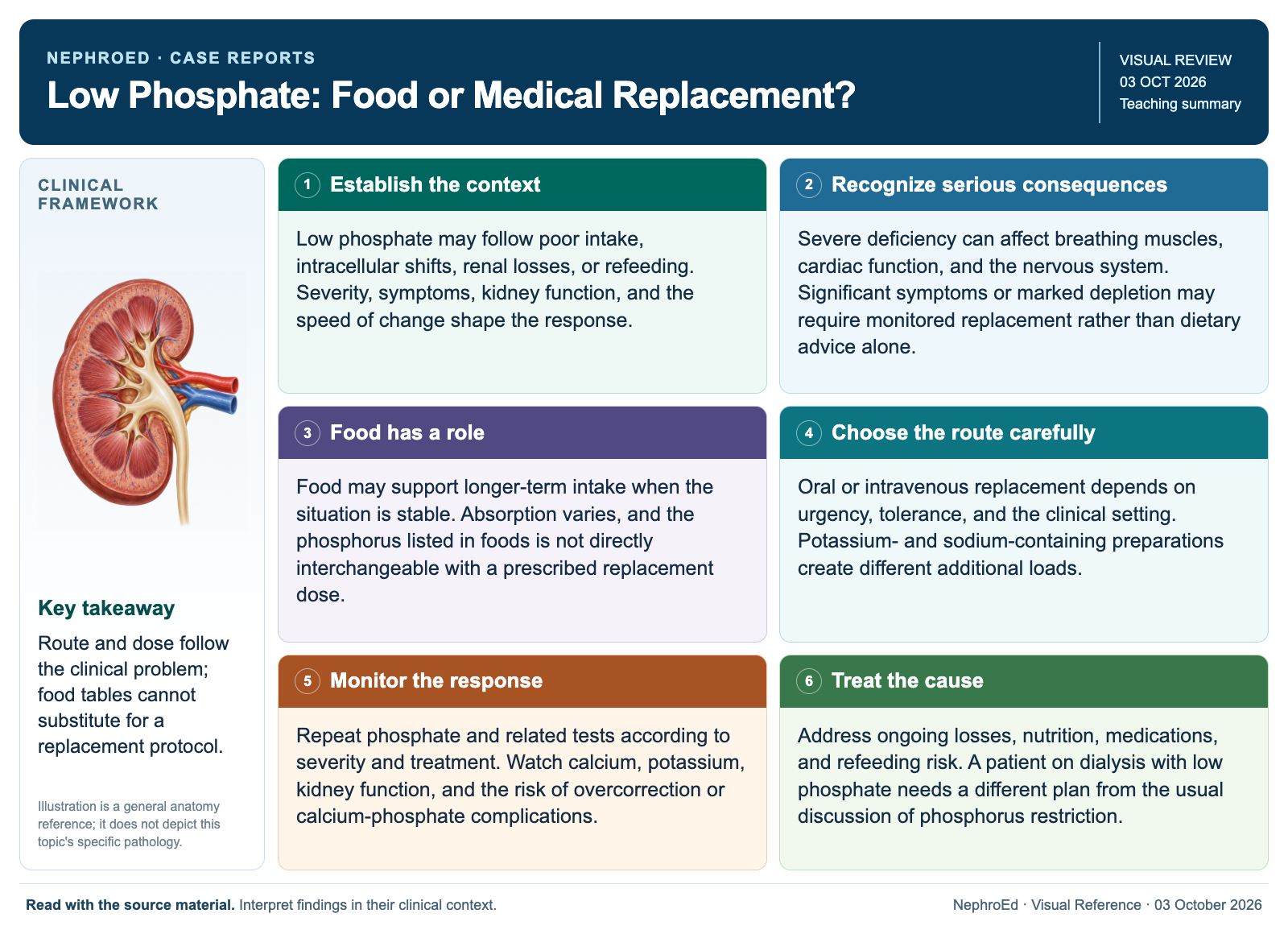
Route and dose follow the clinical problem; food tables cannot substitute for a replacement protocol.
Text version
Establish the context
Low phosphate may follow poor intake, intracellular shifts, renal losses, or refeeding. Severity, symptoms, kidney function, and the speed of change shape the response.
Recognize serious consequences
Severe deficiency can affect breathing muscles, cardiac function, and the nervous system. Significant symptoms or marked depletion may require monitored replacement rather than dietary advice alone.
Food has a role
Food may support longer-term intake when the situation is stable. Absorption varies, and the phosphorus listed in foods is not directly interchangeable with a prescribed replacement dose.
Choose the route carefully
Oral or intravenous replacement depends on urgency, tolerance, and the clinical setting. Potassium- and sodium-containing preparations create different additional loads.
Monitor the response
Repeat phosphate and related tests according to severity and treatment. Watch calcium, potassium, kidney function, and the risk of overcorrection or calcium-phosphate complications.
Treat the cause
Address ongoing losses, nutrition, medications, and refeeding risk. A patient on dialysis with low phosphate needs a different plan from the usual discussion of phosphorus restriction.
Continue learning
This graphic summarizes a topic. The full educational pages provide the broader discussion and references.