Visual summary
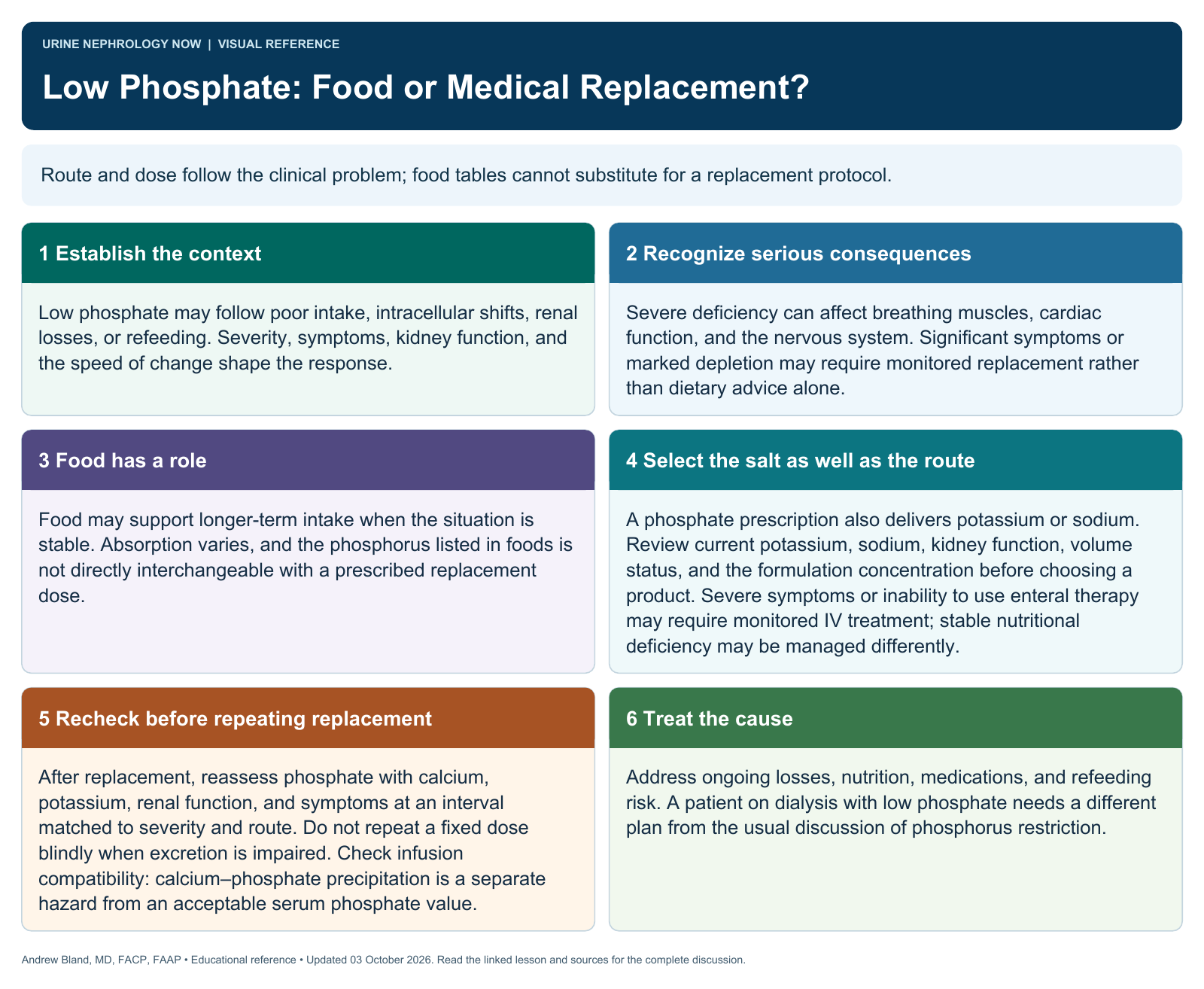
Route and dose follow the clinical problem; food tables cannot substitute for a replacement protocol.
Text version
Establish the context
Low phosphate may follow poor intake, intracellular shifts, renal losses, or refeeding. Severity, symptoms, kidney function, and the speed of change shape the response.
Recognize serious consequences
Severe deficiency can affect breathing muscles, cardiac function, and the nervous system. Significant symptoms or marked depletion may require monitored replacement rather than dietary advice alone.
Food has a role
Food may support longer-term intake when the situation is stable. Absorption varies, and the phosphorus listed in foods is not directly interchangeable with a prescribed replacement dose.
Select the salt as well as the route
A phosphate prescription also delivers potassium or sodium. Review current potassium, sodium, kidney function, volume status, and the formulation concentration before choosing a product. Severe symptoms or inability to use enteral therapy may require monitored IV treatment; stable nutritional deficiency may be managed differently.
Recheck before repeating replacement
After replacement, reassess phosphate with calcium, potassium, renal function, and symptoms at an interval matched to severity and route. Do not repeat a fixed dose blindly when excretion is impaired. Check infusion compatibility: calcium–phosphate precipitation is a separate hazard from an acceptable serum phosphate value.
Treat the cause
Address ongoing losses, nutrition, medications, and refeeding risk. A patient on dialysis with low phosphate needs a different plan from the usual discussion of phosphorus restriction.