Quick Navigation
Visual reference
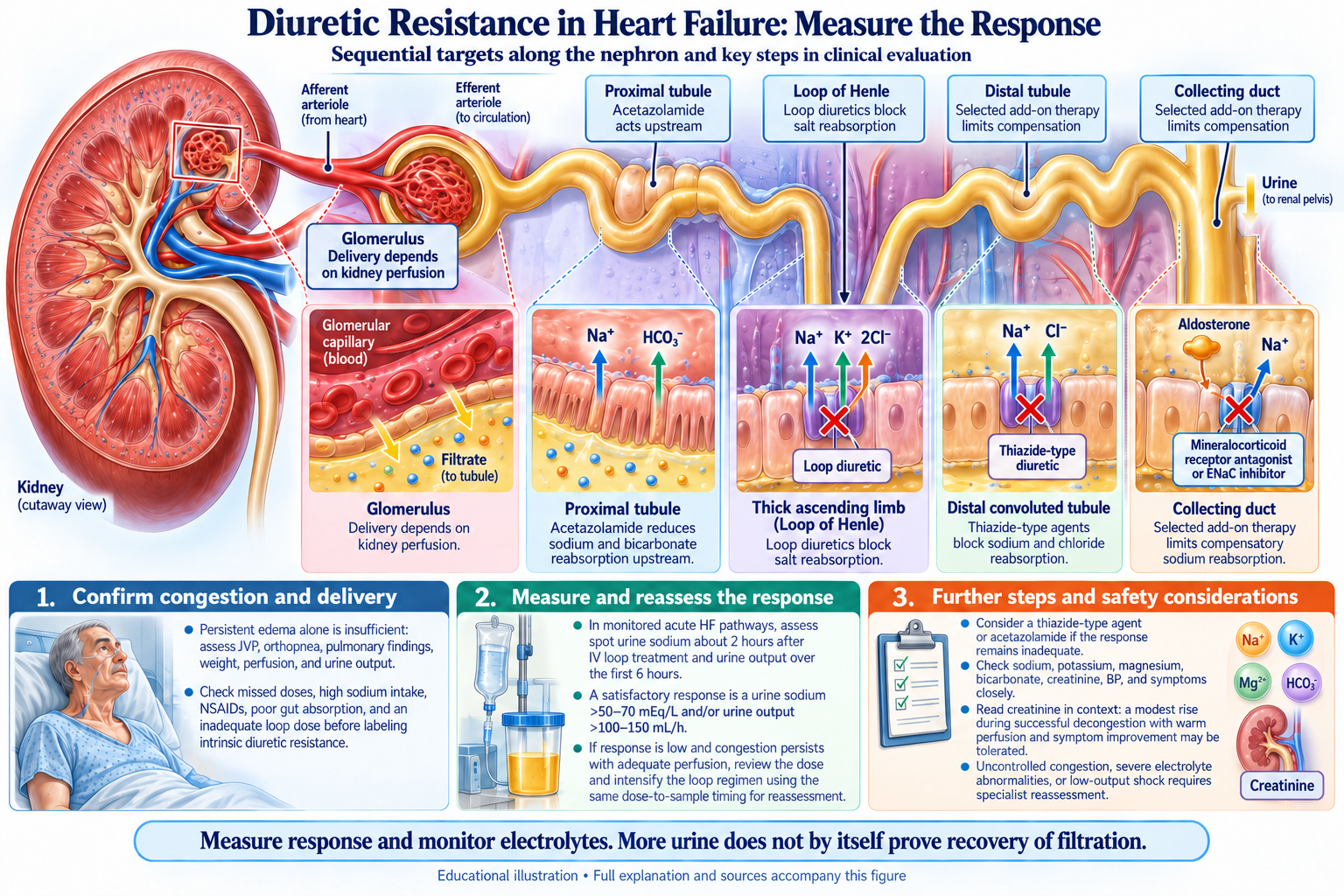
Browse the visual reference library · Download lesson Markdown
Cardiorenal Syndrome: Classification
Cardiorenal syndrome (CRS) describes the bidirectional pathophysiologic interactions between the heart and kidneys whereby acute or chronic dysfunction of one organ induces dysfunction of the other.
Acute Cardiorenal
Heart → Kidney
Acute heart failure (ADHF) causes acute kidney injury
Example: Cardiogenic shock with AKI; acute decompensated HF with rising creatinine
Chronic Cardiorenal
Heart → Kidney
Chronic heart failure causes progressive CKD
Example: Chronic low cardiac output leading to progressive renal dysfunction
Acute Renocardiac
Kidney → Heart
Acute kidney injury causes acute cardiac dysfunction
Example: AKI with hyperkalemia causing arrhythmias; volume overload causing pulmonary edema
Chronic Renocardiac
Kidney → Heart
CKD causes chronic cardiac dysfunction
Example: CKD causing LVH, accelerated atherosclerosis, cardiomyopathy
Secondary CRS
Systemic disease → Both
Systemic conditions cause simultaneous cardiac and renal dysfunction
Examples: Diabetes, sepsis, amyloidosis, sarcoidosis
Neurohormonal Activation in Heart Failure
Heart failure triggers compensatory neurohormonal responses that initially maintain perfusion but become maladaptive over time, driving disease progression.
RAAS Activation
Trigger: Reduced renal perfusion → renin release
- Angiotensin II: vasoconstriction, aldosterone secretion, sodium retention
- Aldosterone: Na/H2O retention, K wasting, cardiac fibrosis
- Creates positive feedback loop worsening congestion
Therapeutic targets: ACEi, ARB, ARNI, MRA
Sympathetic Nervous System
Trigger: Baroreceptor sensing of low CO
- Increased heart rate and contractility
- Peripheral vasoconstriction
- Renal vasoconstriction (reduced RBF)
- Stimulates renin release
- Chronic activation: myocyte toxicity, arrhythmias
Therapeutic targets: Beta-blockers
ADH / Vasopressin
Trigger: Non-osmotic release from low effective circulating volume
- V2 receptor: water reabsorption in collecting duct
- V1a receptor: vasoconstriction
- Causes dilutional hyponatremia
- Maintains effectiveness even in advanced HF
Clinical marker: Hyponatremia predicts poor prognosis
Natriuretic Peptides (BNP/ANP)
Trigger: Atrial/ventricular wall stretch
- Counter-regulatory: natriuresis, vasodilation, RAAS inhibition
- Initially protective
- Resistance develops with disease progression
- Receptor downregulation, enhanced degradation by neprilysin
Therapeutic targets: ARNI (sacubitril/valsartan)
Diuretic Resistance: Mechanisms
Definition: Failure to achieve adequate decongestion despite escalating diuretic doses. Functionally, an inadequate natriuretic response to appropriate doses of loop diuretics.
Mechanisms of Diuretic Resistance
Post-Diuretic Na Retention
After diuretic wears off, compensatory Na reabsorption occurs in distal nephron segments, negating earlier natriuresis
Braking Phenomenon
Chronic loop diuretic use causes distal tubular hypertrophy with increased Na/K-ATPase activity and NCC expression, limiting net sodium excretion
Gut Edema
Intestinal wall edema reduces oral furosemide absorption (bioavailability drops from 40–60% to <20%). Bowel wall thickness correlates with poor oral diuretic response
Hypoalbuminemia
Furosemide is >95% albumin-bound. Low albumin increases Vd, reduces delivery to proximal tubule OAT for secretion. Most significant when albumin <2.0 g/dL
Reduced Renal Perfusion
Low cardiac output and/or elevated venous congestion reduce renal blood flow and GFR, decreasing diuretic delivery to tubular site of action
RAAS Activation
Diuretics activate RAAS, which promotes sodium and water retention, partially counteracting diuretic effect
Gut Edema and Oral Diuretic Failure
Why Furosemide Fails Orally in ADHF
- Baseline oral bioavailability: only 40–60% (highly variable)
- Gut wall edema further reduces absorption
- Delayed gastric emptying and reduced splanchnic perfusion
- Colonic wall thickness ≥3 mm correlates with poor oral response
Advantages of Bumetanide and Torsemide
- Bumetanide: 80% oral bioavailability (vs. 40% furosemide); less affected by gut edema due to higher lipid solubility and passive diffusion
- Torsemide: >90% bioavailability even in HF, renal insufficiency, and cirrhosis; longest half-life; most predictable absorption
- Consider switching from furosemide if poor oral response
Spot Urine Sodium: Guiding Diuretic Response
Spot Urine Sodium After IV Furosemide
Obtain spot urine Na 1–2 hours after IV loop diuretic administration to assess natriuretic response
>70–100 mmol/L
Normal natriuretic response
Continue current regimen
50–70 mmol/L
Mild resistance
Optimize dose, consider IV
20–50 mmol/L
Moderate resistance
Combination diuretics, escalate
<20 mmol/L
Severe resistance
SNB, consider UF
Escalation Strategy for Diuretic Resistance
A stepwise approach to overcoming diuretic resistance. Each step builds on the prior if natriuretic response remains inadequate (spot UNa <50–70 mmol/L).
Step 1: Dose Optimization
- Convert oral to IV (bypasses gut edema)
- IV furosemide: 40–80 mg bolus (naive); up to 200 mg bolus (chronic diuretic use)
- Dose must exceed the diuretic threshold to achieve natriuresis
- Consider bumetanide or torsemide if furosemide response is poor
- Continuous infusion: initial bolus then 5–40 mg/hr furosemide (avoids post-dose reabsorption)
Step 2: Combination Therapy (Sequential Nephron Blockade)
- Add thiazide: Metolazone 2.5–10 mg PO or chlorothiazide 250–500 mg IV 30 min before loop diuretic
- Mechanism: Blocks compensatory Na reabsorption in distal convoluted tubule (addresses braking phenomenon)
- Add MRA: Spironolactone 25–50 mg to block aldosterone-mediated collecting duct Na retention
- Warning: Combination therapy causes profound electrolyte losses (K, Mg, Na) — monitor q6–12h
Step 3: Sequential Nephron Blockade (SNB) — Triple Therapy
- Loop diuretic + thiazide + MRA = blockade at 3 nephron segments
- Add acetazolamide (250–500 mg IV) for proximal tubule blockade (ADVOR trial: improved decongestion)
- Consider IV albumin co-administration if albumin <2.5 g/dL
Step 4: Adjunctive Strategies
- Hypertonic saline (3% NaCl): 150 mL bolus with furosemide; increases renal perfusion pressure and osmotic gradient
- Low-dose dopamine: 2–5 mcg/kg/min (renal dose); limited evidence but may improve diuretic response
- SGLT2 inhibitors: Osmotic diuresis via proximal tubule glucosuria; additive to loop diuretics
- Aquaphoresis: Tolvaptan (V2 antagonist) for hypervolemic hyponatremia; free water clearance without Na loss
Step 5: Mechanical Fluid Removal
- Ultrafiltration (UF): Extracorporeal removal of isotonic fluid; bypasses all pharmacologic resistance mechanisms
- Indicated when pharmacologic strategies fail or severe cardiorenal syndrome limits diuretic efficacy
- CARRESS-HF trial: UF not superior to pharmacologic therapy as first-line and associated with more adverse events
- Peritoneal dialysis: Consider for chronic refractory fluid overload; gentle, continuous UF
- Hemodialysis/CRRT: For refractory fluid overload with concurrent severe AKI or ESKD
Volume Assessment in Heart Failure
Accurate assessment of volume status is essential for guiding diuretic therapy. No single parameter is sufficient; integrate multiple data points.
| Assessment Tool | What It Tells You | Limitations |
|---|---|---|
| JVP (Jugular Venous Pressure) | Elevated JVP (>8 cm H2O) indicates right-sided volume overload and elevated CVP. Most specific bedside sign of congestion. | Difficult in obese patients; requires proper positioning (45 degrees); cannot assess intravascular volume directly |
| BNP / NT-proBNP Trajectory | Rising = worsening congestion/wall stress; falling = successful decongestion. More useful as a trend than single value. | Affected by obesity (lower), renal failure (higher), age, AF. BNP rises with ARNI (use NT-proBNP instead). Day-to-day variation 15–20%. |
| Daily Weights | Most practical marker of fluid balance. 1 kg = approximately 1 L fluid. Target 0.5–1 kg/day loss during active decongestion. | Scale accuracy, timing consistency, dietary Na intake affects weight independent of volume |
| Strict I&O | Net negative fluid balance target during ADHF. Monitors diuretic response quantitatively. | Nursing accuracy variable; insensible losses not captured; cannot distinguish vascular from interstitial fluid removal |
| Spot Urine Sodium | Post-diuretic UNa >70 mmol/L indicates adequate natriuretic response. Low UNa (<50) signals diuretic resistance. | Single time point; requires knowledge of when diuretic was given; dietary Na intake can confound |
| Physical Exam | Peripheral edema, lung crackles (often absent in chronic HF), hepatomegaly, ascites, S3 gallop, orthopnea | Peripheral edema is a late sign; lung crackles may be absent in chronic compensated HF due to lymphatic drainage adaptation |
| Point-of-Care Ultrasound | IVC collapsibility (>50% = likely euvolemic); lung B-lines (correlate with extravascular lung water); pleural effusions | Operator dependent; IVC less reliable with mechanical ventilation or high PEEP |
| Hemoconcentration | Rising hemoglobin/hematocrit during diuresis suggests effective intravascular volume reduction (plasma water removal exceeds RBC removal) | Confounded by anemia, transfusions, bleeding; insensitive |
Guideline-Directed Medical Therapy in Cardiorenal Disease
The four pillars of HFrEF therapy all have cardiorenal implications. GDMT should be optimized even in the setting of CKD, though dose adjustments may be needed.
ARNI / ACEi / ARB
Preferred: ARNI (sacubitril/valsartan)
20% reduction in CV death/HF hospitalization vs. enalapril (PARADIGM-HF)
CKD note: Dose-adjust for eGFR; ACEi > ARB for mortality if ARNI unavailable. Monitor K and Cr after initiation.
Beta-Blocker
Carvedilol, metoprolol succinate, bisoprolol
Counter SNS overactivation; improve survival
CKD note: No dose adjustment needed. Avoid initiation during acute decompensation.
MRA
Spironolactone (HFrEF), finerenone (HFpEF/DKD)
RALES: 30% mortality reduction; FINEARTS-HF: benefit in HFpEF
CKD note: nsMRA (finerenone) preferred with eGFR 30–60 due to lower hyperkalemia risk. Monitor K closely.
SGLT2 Inhibitor
Dapagliflozin, empagliflozin
Cardiorenal protection in HFrEF, HFpEF, and CKD
CKD note: Can initiate with eGFR ≥20; continue until dialysis. Hemodynamic benefit occurs within days. Additive diuretic effect.
Special Considerations in Cardiorenal Disease
| Scenario | Approach |
|---|---|
| Rising Cr during decongestion | Often acceptable ("permissive AKI") if the patient is clearly congested. Venous congestion relief may improve renal function. Check if Cr rise is from effective decongestion vs. true renal injury (hemoconcentration suggests the former). |
| Hyperkalemia limiting RAAS blockade | Consider nsMRA (finerenone) instead of spironolactone; add patiromer or SZC as K binders; SGLT2i may lower K. Do not withhold RAAS blockers reflexively—mortality benefit outweighs mild hyperkalemia risk. |
| Hyponatremia in HF | Dilutional (hypervolemic) from ADH excess. Restrict free water, optimize decongestion. Tolvaptan for symptomatic hyponatremia. Na <130 predicts poor prognosis. |
| eGFR <30 mL/min/1.73m² | SGLT2i can be initiated down to eGFR 20. ARNI requires dose reduction. Loop diuretics require higher doses (furosemide 80–200 mg IV). Higher doses of thiazides needed (metolazone retains efficacy in advanced CKD). |
When to Refer to Advanced HF / Mechanical Support
Recognize the patient who has exhausted medical options and may benefit from advanced therapies.
Triggers for Advanced HF Referral
- ≥2 HF hospitalizations in 12 months
- Progressive decline in eGFR with worsening HF
- Need for IV inotropes for hemodynamic support
- Persistent NYHA Class III–IV despite optimized GDMT
- Peak VO2 <14 mL/kg/min on CPET
- Rising NT-proBNP despite therapy optimization
- Recurrent ICD shocks for ventricular arrhythmias
- Diuretic-refractory congestion requiring repeated UF
Advanced Therapies
- Heart transplantation: Gold standard for eligible patients; limited by donor availability
- LVAD (Left Ventricular Assist Device): Bridge to transplant or destination therapy; improves CO and renal perfusion
- Temporary MCS: Impella, ECMO for cardiogenic shock as bridge to recovery or decision
- Cardiac resynchronization therapy (CRT): For LBBB with QRS ≥150 ms and EF ≤35%
- Palliative care / hospice: When advanced therapies are not appropriate; focus on symptom management and quality of life
References
- Ronco C, Haapio M, House AA, et al. Cardiorenal syndrome. J Am Coll Cardiol. 2008;52(19):1527-1539. PubMed
- Mullens W, Damman K, Harjola VP, et al. The use of diuretics in heart failure with congestion. Eur J Heart Fail. 2019;21(2):137-155. PubMed
- Felker GM, Ellison DH, Mullens W, et al. Diuretic therapy for patients with heart failure: JACC State-of-the-Art Review. J Am Coll Cardiol. 2020;75(10):1178-1195. PubMed
- Mullens W, Dauw J, Martens P, et al. Acetazolamide in acute decompensated heart failure with volume overload (ADVOR). N Engl J Med. 2022;387(13):1185-1195. PubMed
- Bart BA, Goldsmith SR, Lee KL, et al. Ultrafiltration in decompensated heart failure with cardiorenal syndrome (CARRESS-HF). N Engl J Med. 2012;367(24):2296-2304. PubMed
- Boorsma EM, Ter Maaten JM, Voors AA, et al. Renal compression in heart failure: the renal tamponade hypothesis. JACC Heart Fail. 2022;10(3):175-183. PubMed
- McMurray JJV, Packer M, Desai AS, et al. Angiotensin-neprilysin inhibition versus enalapril in heart failure (PARADIGM-HF). N Engl J Med. 2014;371(11):993-1004. PubMed
- Lee TH, Kuo G, Chang CH, et al. Diuretic effect of co-administration of furosemide and albumin: an updated systematic review and meta-analysis. PLoS One. 2021;16(12):e0260312. PubMed
- Ikeda Y, Ishii S, Yazaki M, et al. Association between intestinal oedema and oral loop diuretic resistance in hospitalized patients with acute heart failure. ESC Heart Fail. 2021;8(5):4059-4066. PubMed
- Heidenreich PA, Bozkurt B, Aguilar D, et al. 2022 AHA/ACC/HFSA guideline for the management of heart failure. J Am Coll Cardiol. 2022;79(17):e263-e421. PubMed
- Damman K, Testani JM. The kidney in heart failure: an update. Eur Heart J. 2015;36(23):1437-1444. PubMed
- Afsar B, Ortiz A, Covic A, et al. Focus on renal congestion in heart failure. Clin Kidney J. 2016;9(1):39-47. PubMed
Andrew Bland, MD, FACP, FAAP | University of Dubuque PA Program | Urine Nephrology Now
© 2025 | For educational purposes only