Pre-Case Assessment: Test Your Baseline Knowledge
Answer these questions before reviewing the case to assess your starting knowledge
What is the primary pathophysiologic mechanism underlying cardiorenal syndrome type 1?
Learning Point: Cardiorenal syndrome type 1 specifically refers to acute heart failure leading to acute kidney injury through reduced cardiac output, increased venous pressures, and activation of the renin-angiotensin-aldosterone system.
📚 Reference: Cardiorenal Pathophysiology
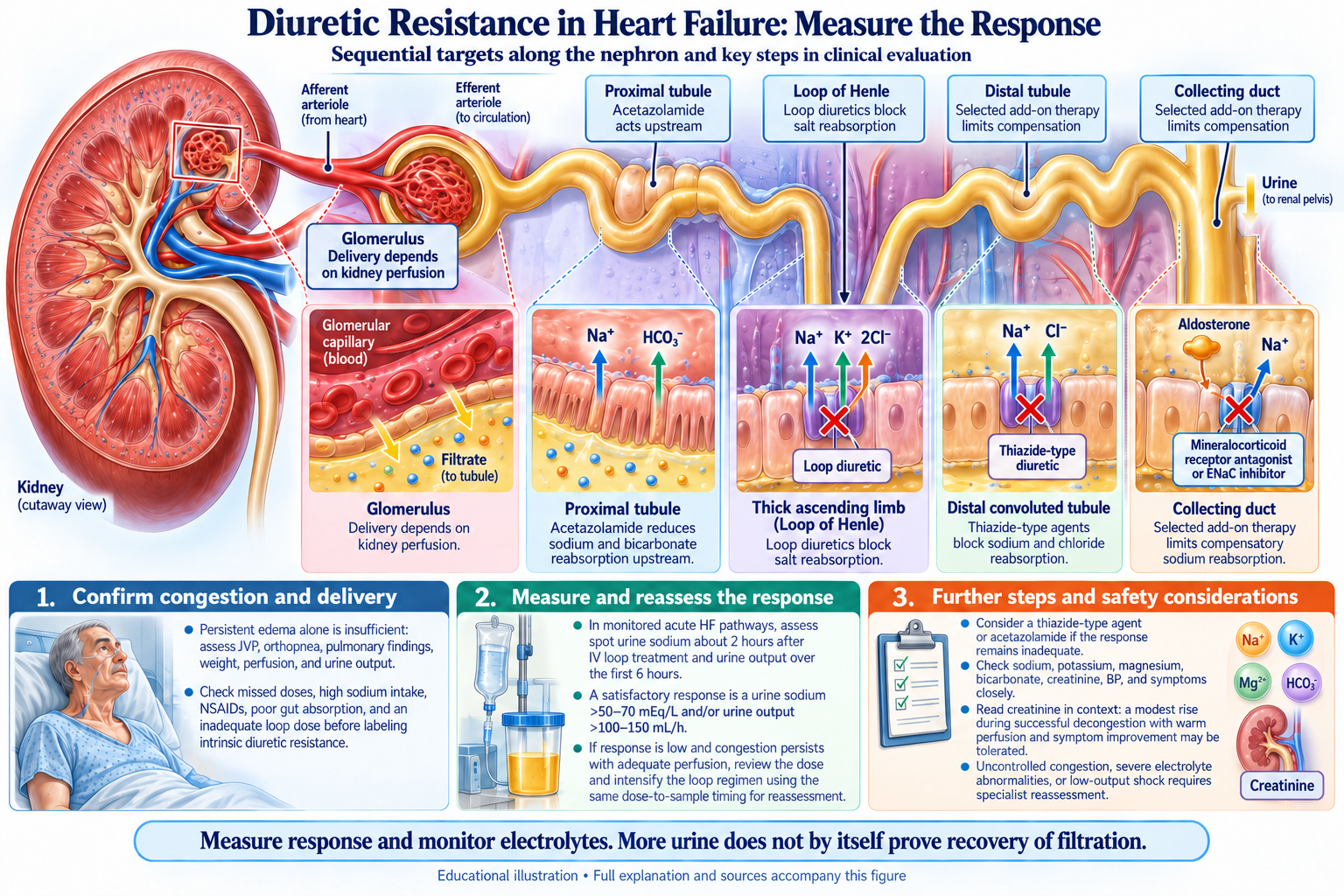
Which bedside test is the simplest evidence-based assessment of diuretic response 1–2 hours after IV loop diuretic?
Learning Point: Spot urine sodium 1–2 hours after IV loop diuretic is the simplest validated bedside marker of diuretic response (Testani 2016 PMID 26721915; ESC HF 2021; ADVOR 2022 PMID 36027559). UNa <50–70 mEq/L = poor response → intensify; >100 mEq/L = good response.
📚 Reference: Diuretic Response Assessment
Which mechanism best explains diuretic resistance in advanced heart failure?
Learning Point: Diuretic resistance in heart failure is multifactorial, involving reduced absorption, compensatory nephron hypertrophy, decreased renal perfusion, and neurohormonal activation leading to enhanced sodium retention.
📚 Reference: Diuretic Resistance Mechanisms
Case Presentation
Patient: 67-year-old male
Chief Complaint: "Severe shortness of breath and unable to lie flat for 3 days"
History: Progressive dyspnea, orthopnea, and bilateral lower extremity swelling over the past week. Patient reports 15-pound weight gain despite "following his fluid restriction." Currently on home furosemide 80 mg twice daily with minimal urine output over the past 2 days.
Past Medical History: Ischemic cardiomyopathy (EF 15%), diabetes mellitus, hypertension, chronic kidney disease stage 3b
Home Medications: Furosemide 80 mg BID, metoprolol succinate 200 mg daily, lisinopril 10 mg daily, spironolactone 25 mg daily, atorvastatin 40 mg daily
Physical Exam: Appears uncomfortable, using accessory muscles. BP 90/65, HR 110, O2 sat 88% on room air. Elevated JVP to 15 cm, bilateral rales to mid-chest, 3+ pitting edema to thighs, anasarca with scrotal and abdominal wall edema
🤔 Initial Clinical Reasoning Questions
Given this patient's presentation, what is the most likely primary problem?
Clinical Reasoning: The combination of severe heart failure (EF 15%), progressive fluid retention despite high-dose diuretics, and the development of anasarca strongly suggests acute decompensated heart failure with evolving cardiorenal syndrome and diuretic resistance.
📚 Reference: Acute Heart Failure Decompensation
What is the most concerning aspect of the fluid balance discrepancy described?
Clinical Reasoning: The discordance between significant weight gain (15 pounds) and poor urine output despite high-dose diuretics indicates severe diuretic resistance, which requires immediate assessment and intervention to prevent further deterioration.
📚 Reference: Fluid Assessment - Monitoring Challenges
Initial Laboratory Data & Analysis
Admission Laboratory Values
| Parameter | Value | Normal Range | Clinical Significance |
|---|---|---|---|
| Serum Creatinine | 2.4 mg/dL | 0.8-1.2 mg/dL | Acute on chronic kidney dysfunction |
| BUN | 65 mg/dL | 7-20 mg/dL | Prerenal azotemia pattern |
| Serum Bicarbonate | 18 mEq/L | 22-28 mEq/L | Metabolic acidosis |
| Serum Sodium | 132 mEq/L | 135-145 mEq/L | Dilutional hyponatremia |
| BNP | 4,200 pg/mL | <100 pg/mL | Severe heart failure |
📊 Laboratory Analysis Questions
The BUN/creatinine ratio of 27:1 in this patient most likely indicates:
Learning Point: A BUN/creatinine ratio >20:1 typically indicates prerenal azotemia. In heart failure, despite total body fluid overload, reduced effective circulating volume leads to enhanced urea reabsorption and prerenal physiology.
📚 Reference: AKI Module - Prerenal Diagnosis
The serum bicarbonate of 18 mEq/L in this patient is most likely due to:
Learning Point: In severe heart failure with reduced cardiac output, tissue hypoperfusion leads to anaerobic metabolism and lactate accumulation, causing metabolic acidosis. This also suggests potential benefit from bicarbonate therapy.
📚 Reference: Acid-Base Module - Metabolic Acidosis
Diuretic Assessment & Spot Urine Sodium Approach
🕐 Timeline: Diuretic Response Assessment
Time 0: IV Furosemide 160 mg bolus administered
Time +2 hours: Urine sample collected for spot urine sodium (Testani 2016 PMID 26721915)
🧮 Diuretic-Response Assessment: Spot Urine Sodium (CORRECTED 2026-05-03)
Spot urine sodium can help assess diuretic response in context. The published Natriuretic Response Prediction Equation is a multivariable model; a simple UNa × serum creatinine / urine creatinine expression is not an interchangeable substitute. Primary evaluation.
| Parameter | Value at 2 Hours Post-Diuretic | Units |
|---|---|---|
| Spot Urine Sodium | 45 | mEq/L |
| Urine Creatinine | 35 | mg/dL |
| Serum Creatinine | 2.4 | mg/dL |
Spot UNa Interpretation (Testani 2016; ESC HF 2021; ADVOR 2022):
Threshold: Spot UNa <50–70 mEq/L at 1–2 hours after IV loop diuretic = poor diuretic response → intensify therapy
Threshold: Spot UNa >100 mEq/L = good response
This patient: UNa 45 mEq/L → poor diuretic response, intensification warranted
Sources: Testani JM et al. Eur J Heart Fail 2016;18(1):54-61, PMID 26721915; Mullens W et al. ADVOR trial NEJM 2022;387(13):1185-95, PMID 36027559; ESC 2021 HF Guidelines.
📈 Diuretic Response Questions
Based on the spot urine sodium of 45 mEq/L at 2 hours after IV furosemide, what does this suggest about the patient's diuretic response?
Learning Point: Spot urine sodium <50–70 mEq/L at 1–2 hours after IV loop diuretic indicates poor natriuretic response and predicts poor clinical outcomes (Testani 2016 PMID 26721915; ESC HF 2021). This patient's UNa 45 mEq/L is in the poor-response range, warranting aggressive intensification including higher doses, continuous infusions, or combination therapy.
📚 Reference: Diuretic Response Assessment
What is the next most appropriate step in diuretic management?
Learning Point: Continuous infusion provides more sustained diuretic levels and can overcome some aspects of diuretic resistance. Typical starting dose is 5–20 mg/hour (DOSE trial; Felker NEJM 2011, PMID 21366472), with titration based on UOP and natriuresis.
📚 Reference: Diuretic Therapy - Continuous Infusion
Sequential Nephron Blockade Strategy
Which combination represents optimal sequential nephron blockade for this patient?
Learning Point: Sequential nephron blockade with loop diuretic + thiazide + carbonic anhydrase inhibitor targets multiple segments of the nephron to overcome compensatory sodium reabsorption that drives diuretic resistance. Note that ADVOR (Mullens 2022 PMID 36027559) supports adding acetazolamide to a loop diuretic for acute decongestion (not specifically tested in combination with a thiazide), and triple therapy is best framed as a refractory-rescue strategy under specialist supervision rather than routine first-line care — concurrent loop + thiazide + acetazolamide carries substantial risk of profound hypokalemia, hypomagnesemia, and metabolic acidosis. [Clarified 2026-05-03 — earlier framing presented triple therapy as standard textbook answer without ADVOR-specific caveat.]
📚 Reference: Diuretic Therapy - Sequential Nephron Blockade
What is the primary mechanism by which acetazolamide enhances diuresis in heart failure?
Learning Point: Acetazolamide works by blocking carbonic anhydrase in the proximal tubule, reducing sodium reabsorption there and creating mild metabolic acidosis that enhances the effectiveness of loop diuretics delivered to the thick ascending limb.
📚 Reference: Diuretic Therapy - Acetazolamide Mechanism
Adjunctive Therapy: Bicarbonate vs Hypertonic Saline
Given this patient's serum bicarbonate of 18 mEq/L, what is the rationale for choosing sodium bicarbonate over hypertonic saline?
Learning Point: In patients with metabolic acidosis (bicarbonate <20), sodium bicarbonate serves dual purposes: correcting acidosis and providing sodium that enhances diuretic efficacy. This makes it preferable to hypertonic saline in acidotic patients.
📚 Reference: Diuretic Therapy - Adjunctive Therapies
What is the mechanism by which sodium bicarbonate enhances loop diuretic effectiveness?
Learning Point: Sodium bicarbonate enhances diuretic effect through two mechanisms: (1) providing sodium load that increases delivery to the thick ascending limb where loop diuretics act, and (2) correcting acidosis that can impair diuretic binding to the NKCC2 transporter.
📚 Reference: Diuretic Therapy - Bicarbonate Synergy
Interactive Timeline: Treatment Response
📊 Day 2 Response to Treatment
Interventions: Furosemide drip titrated 10 → 20 mg/hr + HCTZ 25 mg BID + Acetazolamide 250 mg BID + NaHCO3 150 mEq/day
Results: Urine output increased to 2.5 L/day, weight loss of 3 kg, repeat spot UNa improved to >100 mEq/L (good response range)
The improvement in spot urine sodium from 45 to >100 mEq/L indicates:
Learning Point: Spot UNa >100 mEq/L indicates adequate natriuretic response. The improvement from 45 to >100 mEq/L, along with clinical improvement (increased UOP, weight loss), demonstrates effective reversal of diuretic resistance.
📚 Reference: Diuretic Response Monitoring
At this point in treatment, what is the most important monitoring parameter?
Learning Point: Aggressive diuretic therapy requires comprehensive monitoring for hypokalemia, hypomagnesemia, and worsening kidney function. Sequential nephron blockade particularly increases the risk of electrolyte disturbances and volume depletion.
📚 Reference: Diuretic Therapy - Safety Monitoring
Module-Specific Deep Dive: Advanced Concepts
In cardiorenal syndrome, which neurohormonal pathway most significantly contributes to diuretic resistance?
Learning Point: RAAS activation in heart failure leads to increased aldosterone levels, which enhances sodium reabsorption in the collecting duct downstream from loop diuretic action, effectively negating their effect. This is why aldosterone antagonists are particularly beneficial in heart failure.
📚 Reference: Neurohormonal Pathways in Heart Failure
Which factor most limits the accuracy of daily weights in assessing fluid balance in advanced heart failure patients?
Learning Point: In advanced heart failure, the relationship between weight and intravascular volume becomes complex due to fluid shifts between compartments. Patients may have unchanged weight despite worsening intravascular depletion or, conversely, weight loss without improved hemodynamics.
📚 Reference: Fluid Assessment - Weight Monitoring Limitations
Learning Objectives Assessment
Evaluate your mastery of the key learning objectives from this complex case
🎯 Learning Objective 1: Cardiorenal Syndrome Recognition and Pathophysiology
Objective: Recognize cardiorenal syndrome and understand the complex pathophysiology linking heart failure and kidney dysfunction
Which pathophysiologic mechanism best explains why this patient developed worsening kidney function despite fluid overload?
Competency Demonstration: Understanding that cardiorenal syndrome involves the paradox of fluid overload with reduced effective circulating volume demonstrates mastery of the complex hemodynamic interactions in heart failure.
📚 Master This: Advanced Cardiorenal Syndrome Concepts
🎯 Learning Objective 2: Advanced Diuretic Management and Resistance
Objective: Implement sophisticated diuretic strategies including spot urine sodium response assessment (Testani 2016) and sequential nephron blockade
A patient on furosemide 80 mg IV BID has spot UNa 35 mEq/L at 2 hours post-dose. What is the most evidence-based next step?
Competency Demonstration: Spot UNa <50 mEq/L after IV diuretic predicts poor outcomes (Testani 2016, ESC HF 2021) and requires aggressive intervention. Continuous infusion + sequential nephron blockade (loop + thiazide / acetazolamide per ADVOR) is evidence-based escalation.
📚 Master This: Evidence-Based Diuretic Management
🎯 Learning Objective 3: Critical Care Nephrology Integration
Objective: Integrate critical care principles with nephrology expertise in managing complex cardiorenal patients
In this patient with EF 15% and aggressive diuresis, which combination of monitoring parameters best predicts safe and effective decongestion?
Competency Demonstration: Safe aggressive diuresis requires comprehensive monitoring integrating biochemical markers (spot UNa response per Testani 2016), organ function (kidney), metabolic status (electrolytes), and clinical assessment.
📚 Master This: Advanced Critical Care Monitoring
Integration Challenge: Complex Clinical Scenarios
After 48 hours of aggressive therapy, the patient's creatinine increases from 2.4 to 3.1 mg/dL despite continued diuresis and clinical improvement. What is the most appropriate interpretation and management?
Integration Concept: Pseudoworsening of kidney function during heart failure treatment can occur when reducing venous congestion unmasks underlying kidney disease or when improved forward flow redistributes creatinine. Clinical improvement suggests continued benefit despite creatinine rise.
📚 Master This: Pseudoworsening in Heart Failure
This patient's case integrates concepts from multiple subspecialties. Which combination of factors made bicarbonate therapy particularly beneficial in this specific case?
Integration Concept: This case demonstrates how multiple pathophysiologic derangements (acidosis, diuretic resistance, need for enhanced natriuresis) can be addressed by a single intervention (bicarbonate) when chosen based on comprehensive understanding of the underlying mechanisms.
📚 Master This: Multisystem Therapeutic Approaches
Case Reflection & Multi-Module Integration
💔 Heart Failure Module Integration
- Cardiorenal syndrome pathophysiology and classification
- Neurohormonal activation in advanced heart failure
- Hemodynamic monitoring and optimization
- Critical care management of decompensated heart failure
💊 Diuretic Therapy Integration
- Mechanisms of diuretic resistance in heart failure
- Sequential nephron blockade strategies
- Continuous vs. bolus diuretic administration
- Adjunctive therapies: bicarbonate and hypertonic saline
🔬 Fluid Assessment Integration
- Spot urine sodium response interpretation (Testani 2016, ESC HF 2021)
- Limitations of traditional volume assessment
- Advanced biomarkers for volume status
- Integration of multiple assessment modalities
⚡ Critical Care Integration
- ICU management of cardiorenal syndrome
- Advanced hemodynamic monitoring
- Multiorgan system considerations
- When to consider renal replacement therapy
🎯 Key Integration Concepts
This case demonstrates the complexity of cardiorenal syndrome management, requiring integration of advanced heart failure concepts, sophisticated diuretic strategies, validated assessment tools (spot urine sodium response per Testani 2016 / ESC HF 2021), and critical care principles. The successful management required understanding multiple pathophysiologic pathways and selecting therapies that address multiple derangements simultaneously. The choice of bicarbonate over hypertonic saline exemplifies how comprehensive understanding of underlying mechanisms guides optimal therapeutic decisions in complex patients.
📝 Case Summary & Clinical Pearls
This case illustrates the management of severe cardiorenal syndrome with advanced diuretic resistance requiring sophisticated therapeutic approaches including spot urine sodium-guided diuretic titration (Testani 2016, ESC HF 2021), sequential nephron blockade, and strategic use of adjunctive therapies.
🔑 Key Clinical Pearls from This Case:
- Diuretic Response Assessment: Spot urine sodium <50–70 mEq/L at 1–2 hours after IV loop diuretic predicts poor diuretic response and clinical outcomes (Testani 2016, ESC HF 2021), requiring aggressive intervention
- Sequential Nephron Blockade: Triple therapy (loop + thiazide + acetazolamide) can overcome severe diuretic resistance when traditional approaches fail
- Adjunctive Therapy Selection: Choose bicarbonate over hypertonic saline in acidotic patients to address multiple pathophysiologic derangements
- Monitoring Complexity: Aggressive diuresis requires comprehensive monitoring including kidney function trends, electrolytes, and perfusion markers
- Pseudoworsening Recognition: Modest creatinine rise during successful heart failure treatment may represent improved hemodynamics rather than true kidney injury