Pre-Case Assessment: Test Your Baseline Knowledge
Answer these questions before reviewing the case to assess your starting knowledge
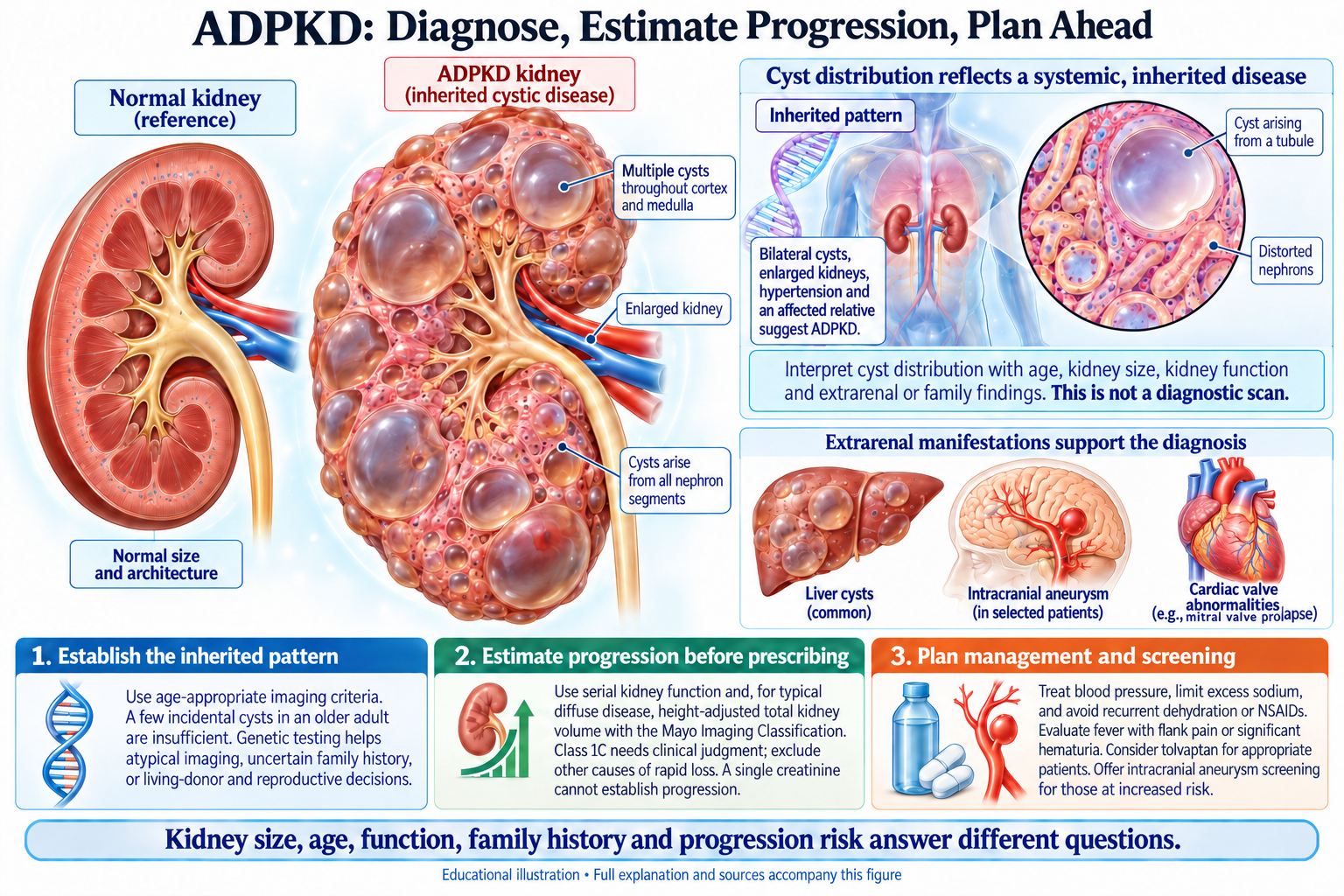
What is the most common extrarenal manifestation of ADPKD that requires screening?
Learning Point: Intracranial aneurysms occur in 8-10% of ADPKD patients and require screening, especially with family history or symptoms. They are the most clinically significant extrarenal manifestation.
📚 Reference: Extrarenal Manifestations Module
Which gene mutation is associated with more severe disease progression in ADPKD?
Learning Point: PKD1 mutations cause more severe disease with earlier onset of ESRD (average age 54) compared to PKD2 (average age 74). This affects treatment decisions and monitoring frequency.
📚 Reference: ADPKD Genetics Module
What is the target blood pressure for ADPKD patients under age 50?
Learning Point: Aggressive blood pressure control (<110/75 mmHg) in young ADPKD patients may slow kidney enlargement and preserve function. This is more aggressive than standard CKD targets, and it is population-specific: it comes from HALT-PKD Study A (PMID 25399733), which enrolled ADPKD patients aged 15-49 with eGFR >60 and showed slower total kidney volume growth (5.6% vs 6.6%/year, p=0.006).
What "standard" means here: for adults who fall outside that HALT-PKD Study A profile, the target is <130/80 mmHg (2025 AHA/ACC, ADA Standards of Care); KDIGO 2021 (Blood Pressure in CKD) suggests systolic <120 mmHg when tolerated on standardized office measurement (grade 2B, driven by the CKD subgroup of SPRINT), excluding transplant recipients and dialysis patients. Much of the gap between those two numbers is measurement technique rather than disagreement about physiology — KDIGO's lower number presumes a standardized or unattended reading that most routine clinic cuffs do not meet. Note that <110/75 is lower than all of these, so do not apply it outside the young, preserved-eGFR ADPKD group it was tested in.
📚 Reference: ADPKD Hypertension Management
Case Presentation
Patient: 40-year-old man
Chief Complaint: "I've been having headaches and my doctor said I might have the same kidney disease my grandfather had"
History: Recently diagnosed hypertension during routine physical. Progressive headaches over 6 months, initially attributed to work stress. Family history significant for grandfather who required kidney transplant at age 65 due to "polycystic kidney disease." Patient's father died in car accident at age 35 before developing kidney problems. Has a 15-year-old son and is concerned about screening.
Past Medical History: Hypertension (newly diagnosed), no other significant medical history
Home Medications: Lisinopril 10mg daily (started 2 weeks ago)
Social History: Software engineer, drinks 2-3 glasses of water daily, occasionally drinks alcohol socially, non-smoker
Review of Systems: Intermittent flank discomfort, no hematuria, no UTI symptoms, no visual changes
🤔 Initial Clinical Reasoning Questions
Based on this family history, what is the most likely inheritance pattern and risk to the patient's son?
Clinical Reasoning: ADPKD follows autosomal dominant inheritance. If this patient has ADPKD, his son has a 50% chance of inheriting the condition. The missing generation (father's early death) doesn't rule out inheritance.
📚 Reference: ADPKD Genetics
Given the patient's headaches and family history, what is the most important immediate concern?
Clinical Reasoning: New-onset headaches in a patient with suspected ADPKD requires screening for intracranial aneurysms, which occur in 8-10% of ADPKD patients and can be life-threatening.
📚 Reference: Aneurysm Screening Protocol
Physical Examination & Initial Workup
Vital Signs
- Blood Pressure: 145/92 mmHg
- Heart Rate: 78 bpm
- Temperature: 98.6°F (37°C)
- Weight: 85 kg
- Height: 180 cm
General Examination
- General: Well-appearing, alert
- HEENT: Normal, no papilledema
- Cardiovascular: Regular rhythm, no murmurs
- Pulmonary: Clear bilaterally
Abdominal Examination
- Inspection: No distension
- Palpation: Bilateral flank fullness
- Percussion: Dullness in flanks
- Organomegaly: Possible bilateral kidney enlargement
Neurological
- Mental status: Alert and oriented
- Cranial nerves: Intact
- Motor/sensory: Normal
- Reflexes: Normal and symmetric
Laboratory Results & Imaging
📊 Laboratory Values
| Parameter | Value | Normal Range | Clinical Significance |
|---|---|---|---|
| Serum Creatinine | 1.2 mg/dL | 0.8-1.3 mg/dL | Normal, preserved kidney function |
| eGFR | 78 mL/min/1.73m² | >90 mL/min/1.73m² | Mildly decreased |
| BUN | 18 mg/dL | 8-20 mg/dL | Normal |
| Urinalysis | Protein trace, no RBC | Negative | Minimal proteinuria |
| 24-hr urine protein | 0.8 g | <0.15 g | Mild proteinuria |
📸 Imaging Studies
Renal Ultrasound
- Right kidney: 14.2 cm length, multiple cysts
- Left kidney: 13.8 cm length, multiple cysts
- Cyst count: >10 cysts per kidney
- Echogenicity: Normal cortical echogenicity
- Liver: Multiple hepatic cysts noted
MRI Kidneys (recommended)
- Total kidney volume: To be calculated
- Height-adjusted TKV: Critical for Tolvaptan eligibility
- Cyst characteristics: Simple cysts, no complexity
- Benefits: Better volume assessment than ultrasound
📊 Imaging & Laboratory Analysis Questions
Based on the ultrasound findings, does this patient meet the diagnostic criteria for ADPKD at age 40?
Learning Point: Pei unified ultrasonographic criteria (Pei 2009 PMID 18945943): Age 40-59 with positive family history requires ≥2 cysts in EACH kidney (not "≥3 per kidney"). This patient far exceeds criteria with >10 cysts per kidney plus positive family history.
📚 Reference: ADPKD Diagnostic Criteria
What is the best next imaging study for this patient and why?
Learning Point: MRI is superior to volumetric CT for total kidney volume measurement in ADPKD. MRI provides more accurate TKV measurements, better soft tissue contrast, and no radiation exposure. Height-adjusted TKV >600 mL/m indicates rapid progression and Tolvaptan eligibility.
📚 Reference: Total Kidney Volume Assessment
ADPKD Progression Risk Assessment
Intracranial Aneurysm Screening
Given this patient's headaches and ADPKD diagnosis, what aneurysm screening approach is most appropriate?
Clinical Reasoning: MRA (Magnetic Resonance Angiography) is the test of choice for intracranial aneurysm screening, NOT standard MRI. MRA specifically images blood vessels and can detect aneurysms ≥3mm. Standard brain MRI does not adequately visualize cerebral vasculature. ADPKD patients with symptoms (headaches) should have MRA screening.
📚 Reference: Aneurysm Screening Guidelines
Which features would indicate HIGH-RISK aneurysms requiring immediate intervention?
Clinical Management: Aneurysms >7mm, irregular/multilobulated shape, or symptomatic aneurysms require neurosurgical evaluation. Size >10mm has very high rupture risk and typically requires intervention.
📚 Reference: Aneurysm Management
Family Screening & Genetic Counseling
For screening the patient's 15-year-old son, what findings would suggest ADPKD?
Learning Point: For age 15-39 with positive family history, ≥3 cysts (unilateral or bilateral) indicates ADPKD per Pei 2009 unified criteria (PMID 18945943). For ages 15-19, even 1-2 cysts may warrant follow-up. Genetic testing may be considered for family planning.
📚 Reference: Pediatric ADPKD Screening
When should the 15-year-old son begin regular screening if initial ultrasound is negative?
Clinical Guidance: Negative screening in teenagers doesn't rule out ADPKD. Repeat at age 18, then every 3-5 years through age 30. After 30, if consistently negative, ADPKD is very unlikely.
📚 Reference: ADPKD Screening Protocols
Tolvaptan Therapy Evaluation
What criteria must be met for Tolvaptan therapy in ADPKD?
Treatment Rationale: KDIGO 2025 recommends tolvaptan for adults with ADPKD, eGFR at least 25 mL/min/1.73 m², and risk of rapid progression. Mayo class 1C-1E in typical disease or a historical eGFR decline at least 3 mL/min/1.73 m²/year can support assessment; class 1C needs particular judgment and alternative causes of decline must be excluded. This includes some G4 patients and is not limited to G1-G3. Discuss aquaresis, liver monitoring, contraindications, and the individual burden.
📚 Reference: Tolvaptan Treatment Guidelines
What is the most important monitoring requirement for Tolvaptan therapy?
Safety Monitoring: Tolvaptan can cause idiosyncratic liver injury (ALT >3x ULN in 4.4% of patients). Monthly LFTs are required for first 18 months, then every 3 months. Drug must be stopped if ALT >3x ULN.
📚 Reference: Tolvaptan Safety Monitoring
Blood Pressure Management & Medications
What is the optimal first-line antihypertensive for this 40-year-old ADPKD patient?
Treatment Choice: ACE inhibitors are first-line for ADPKD patients. They provide renoprotection, may slow cyst growth, and have cardiovascular benefits. Target <110/75 mmHg in young patients with preserved kidney function.
📚 Reference: ADPKD Hypertension Treatment
Current BP is 145/92 on lisinopril 10mg. What is the next best step?
Dose Optimization: Maximize ACE inhibitor dose first (up to 40mg lisinopril daily if tolerated). Target <110/75 mmHg in young ADPKD patients. If maximum dose insufficient, then add calcium channel blocker or ARB.
📚 Reference: Antihypertensive Titration
Water Intake & Lifestyle Modifications
What is the evidence for increased water intake in slowing ADPKD progression?
Evidence Review: Theoretical benefit of suppressing vasopressin through high water intake. Small studies suggest possible benefit, but large RCTs are lacking. Generally recommended as low-risk intervention targeting 3-4L daily.
📚 Reference: Water Intake Research
What water intake recommendation should be given to this patient?
Practical Guidance: Target 3-4L daily water intake to suppress vasopressin. Monitor for hyponatremia, especially if on Tolvaptan. Current intake of 2-3 glasses is insufficient - needs significant increase.
📚 Reference: ADPKD Lifestyle Modifications
Cyst Complications Recognition & Management
What clinical features would suggest cyst hemorrhage in an ADPKD patient?
Clinical Recognition: Cyst hemorrhage presents with acute severe flank pain and gross hematuria. Usually self-limited. Hemoglobin may remain stable as bleeding is into cyst, not urinary tract. Conservative management unless massive bleeding.
📚 Reference: Cyst Complications
For suspected cyst infection, which antibiotic has the best cyst penetration?
Antibiotic Selection: Fluoroquinolones (ciprofloxacin, levofloxacin) have excellent cyst penetration. Trimethoprim-sulfamethoxazole is alternative. Beta-lactams and nitrofurantoin have poor cyst penetration. Duration: 4-6 weeks typically needed.
📚 Reference: Cyst Infection Management
What findings would suggest cyst rupture rather than infection or hemorrhage?
Clinical Pattern: Cyst rupture causes sudden, severe pain as cyst contents leak into surrounding tissue, followed by rapid pain improvement as pressure is relieved. May have brief hematuria. Usually self-resolves without specific treatment.
📚 Reference: Cyst Rupture Management
Transplant Evaluation & Planning
When should this patient be referred for transplant evaluation?
Timing Strategy: Transplant evaluation should begin when eGFR reaches 20-25 mL/min/1.73m² to allow time for workup and identify living donors. Current eGFR of 78 is too early for formal evaluation but patient education is appropriate.
📚 Reference: Transplant Referral Guidelines
What unique consideration applies to kidney transplantation in ADPKD patients?
Surgical Considerations: Large polycystic kidneys may need removal before transplant if causing mass effect, recurrent infections, or preventing transplant kidney placement. Usually UNILATERAL nephrectomy is performed to create space for transplant. Bilateral nephrectomy is rare and carries significant risk of severe hypotension requiring immediate transplantation.
📚 Reference: Pre-transplant Nephrectomy
Learning Objectives Assessment
Evaluate your mastery of the key learning objectives from this case
🎯 Learning Objective 1: ADPKD Diagnosis and Screening
Objective: Apply diagnostic criteria and implement family screening protocols for ADPKD
A 35-year-old woman with family history of ADPKD has 2 kidney cysts on ultrasound. What is the appropriate management?
Competency Demonstration: At age 30-39, need ≥3 cysts to diagnose ADPKD. With only 2 cysts, diagnosis is indeterminate. Options include repeat imaging in 3-5 years or genetic testing for family planning purposes.
📚 Master This: ADPKD Diagnostic Criteria
🎯 Learning Objective 2: Treatment Decision-Making
Objective: Evaluate patients for Tolvaptan therapy and other interventions
Which patient would be the BEST candidate for Tolvaptan therapy?
Treatment Selection: Ideal Tolvaptan candidate: CKD stages 1-3, evidence of rapid progression (>5% TKV growth annually), younger age. Patient A has too advanced CKD, Patient C is stable, Patient D doesn't have ADPKD.
📚 Master This: Tolvaptan Patient Selection
Integration Challenge: Complex Case Synthesis
A 42-year-old ADPKD patient develops sudden severe headache and is found to have a 9mm intracranial aneurysm. He is also a candidate for Tolvaptan. What is the best management approach?
Priority Management: 9mm aneurysm with symptoms requires immediate neurosurgical evaluation and likely intervention. This is life-threatening and takes priority over ADPKD progression treatment. Tolvaptan can be started after aneurysm is secured.
📚 Integration: Complex ADPKD Management
Case Reflection & Multi-Module Integration
🫘 Kidney Cysts & Masses Integration
- ADPKD pathophysiology and genetics
- Diagnostic criteria and imaging
- Complication management (infection, hemorrhage, rupture)
- Tolvaptan therapy indications and monitoring
🔬 Renal Imaging Integration
- Ultrasound screening protocols
- MRI for total kidney volume measurement
- Imaging criteria for diagnosis
- Aneurysm screening techniques
🩺 Hypertension Integration
- ADPKD-specific blood pressure targets
- ACE inhibitor optimization
- Cardiovascular risk reduction
- Renoprotective strategies
🫀 CKD Management Integration
- Progression monitoring and prediction
- Transplant referral timing
- Pre-transplant nephrectomy planning
- Family screening protocols
🎯 Key Integration Concepts
This case demonstrates the complexity of ADPKD management, requiring integration of genetics (family screening), imaging (diagnosis and monitoring), pharmacology (Tolvaptan and antihypertensives), surgery (aneurysm and transplant planning), and long-term care coordination. Successful management requires understanding how each intervention affects overall patient outcomes and quality of life.
📝 Case Summary & Clinical Pearls
This 40-year-old man with newly diagnosed ADPKD and hypertension represents a classic case requiring comprehensive evaluation including aneurysm screening, family counseling, treatment optimization, and long-term planning. His case illustrates the importance of early recognition, appropriate monitoring, and timely intervention in ADPKD management.
🔑 Key Clinical Pearls from This Case:
- Aneurysm Screening is Critical: New headaches in ADPKD require urgent MRA brain screening
- Aggressive BP Control: Target <110/75 mmHg in young ADPKD patients with preserved function
- Family Screening Protocols: Age-specific criteria for diagnosis; genetic counseling important
- Tolvaptan Requires Selection: Only for CKD stages 1-3 with rapid progression evidence
- Water Intake May Help: 3-4L daily recommended despite limited evidence
- Cyst Complications Need Recognition: Different presentations for infection, hemorrhage, rupture
- Early Transplant Planning: Referral at eGFR 20-25; may need native nephrectomy