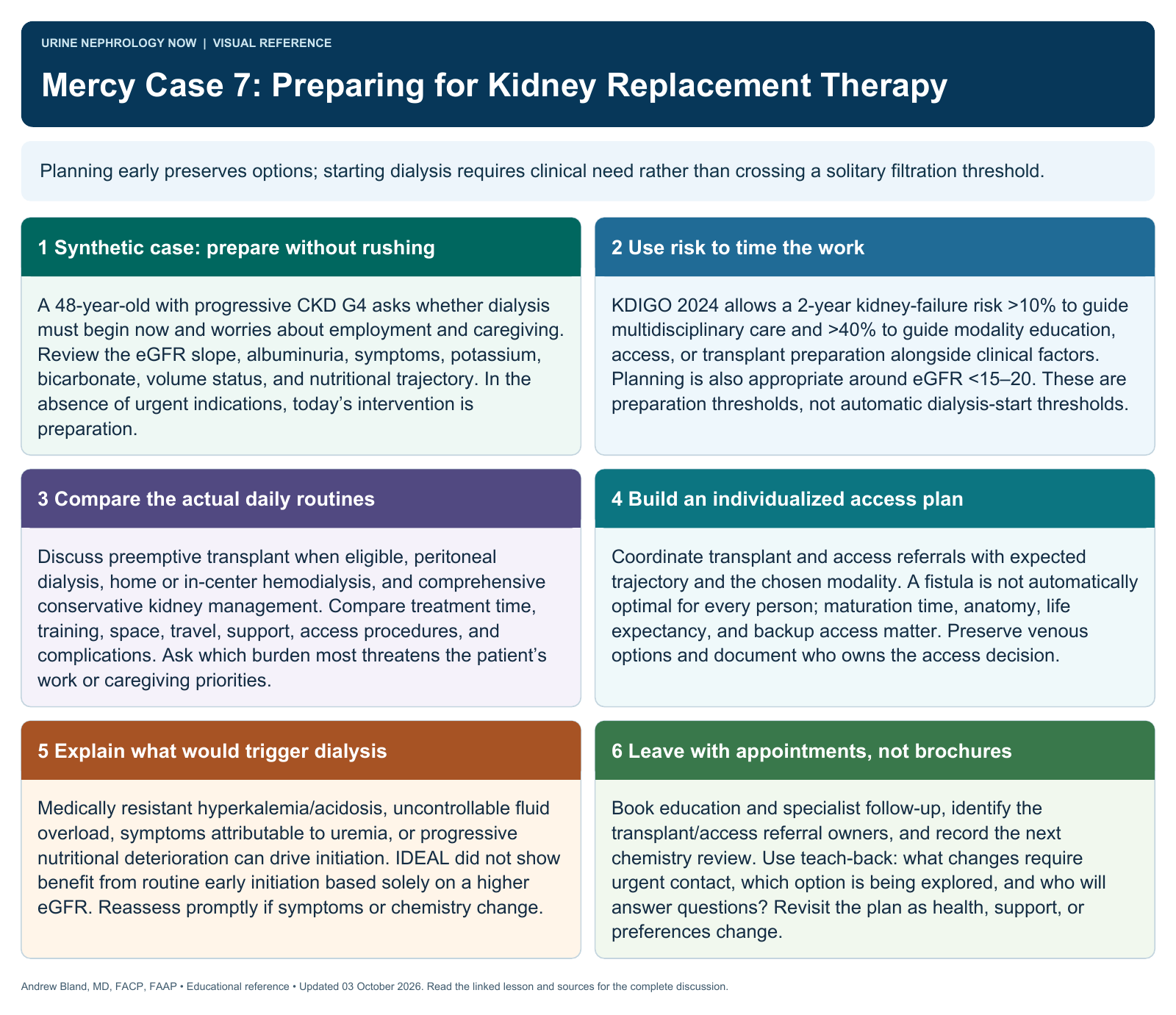
Synthetic teaching case: a 48-year-old adult with progressive CKD G4 asks whether dialysis must start now and worries about employment and caregiving. Kidney function has declined over the past year, but there are no current urgent indications. The fictional scenario emphasizes early planning and shared decisions.
Learning goal: Connect assessment, evidence, and a clear next clinical decision. Educational use; individual care requires the treating team’s assessment and applicable protocols.
Visual reference
Open the visual review after completing the case
Browse the visual reference library · Download lesson Markdown
Separate planning from starting
Review the trajectory, albuminuria, symptoms, biochemical complications, and an appropriate kidney-failure risk estimate. Early education and referral create options; they do not mean dialysis must begin at a particular eGFR. Clarify which findings would require urgent reassessment and which can be monitored.
Elicit goals and circumstances
Ask about work, caregiving, independence, travel, home circumstances, support, health literacy, and treatment worries. Explore what a good day looks like and what burdens feel unacceptable. Include the person the patient wants involved, and use teach-back rather than assuming an information packet was understood.
Explain the options
Discuss transplantation, home or in-center dialysis options, and comprehensive conservative kidney management where appropriate. Explain expected routines, access needs, training, complications, and support. Suitability depends on the individual assessment; do not promise that one modality universally provides better survival or solves a social barrier.
Create an access life-plan
Coordinate nephrology, transplant, and access referrals with the likely timeline and chosen options. Preserve future access opportunities where feasible. KDOQI emphasizes an individualized ESKD Life-Plan; a fistula is not automatically the best choice for every person, and maturation or procedural success cannot be guaranteed.
Know when treatment is needed
Dialysis initiation considers symptoms attributable to kidney failure, medically resistant electrolyte or acid–base problems, volume control, nutritional deterioration, and the whole clinical picture. The IDEAL trial did not demonstrate benefit from routine planned early initiation based only on a higher filtration threshold.
Make preparation concrete
Document the agreed decision or remaining questions, referral owners, education appointments, access planning, transplant evaluation, and follow-up. Revisit choices as health and circumstances change. Give clear advice for urgent symptoms and ensure the patient knows whom to contact before a crisis removes options.
Apply the framework
What should happen today if there is no urgent indication for dialysis?
Show the reasoning
Discuss goals, explain options, assess progression risk, and arrange the next planning steps. A shared, documented plan is an active intervention even when dialysis has not started.
References and evidence
These sources support the teaching framework. Trial populations, endpoints, and limitations should be checked before applying a result to an individual patient.
- Kidney Disease: Improving Global Outcomes (KDIGO) CKD Work Group. KDIGO 2024 Clinical Practice Guideline for the Evaluation and Management of Chronic Kidney Disease. Kidney Int. 2024;105(4S):S117-S314. PubMed 38490803
- Cooper BA, Branley P, Bulfone L et al.. A randomized, controlled trial of early versus late initiation of dialysis. N Engl J Med. 2010;363(7):609-19. PubMed 20581422
- Lok CE, Huber TS, Lee T et al.. KDOQI Clinical Practice Guideline for Vascular Access: 2019 Update. Am J Kidney Dis. 2020;75(4 Suppl 2):S1-S164. PubMed 32778223