Visual reference
Browse the visual reference library · Download lesson Markdown
🎯 The Big Picture
For decades we told every hemodialysis patient the same thing: get a fistula. That instruction was built entirely on observational data — no randomized trial ever proved a fistula saves lives compared with a catheter.
The uncomfortable truth: much of the fistula's apparent survival advantage is the healthier patient, not the access. Sicker patients with poor vessels and short survival end up on catheters — so comparing catheter patients to fistula patients partly compares sick people to well people and credits a piece of hardware.
✅ Where the Fistula Still Wins
- The robust older patient with good vessels and a long horizon
- Back-loaded benefits (low infection, good patency) are real if the patient lives to collect them
⚠️ Where Reflexive "Fistula First" Fails
- The frail, catheter-dependent older starter with high competing mortality
- A short time horizon means the patient may never reach the payoff
💡 The Reframing That Runs the Whole Lecture
The question is never "fistula or catheter?" in the abstract. It is: does this patient live long enough, with vessels good enough, to convert the front-loaded cost of a fistula into a back-loaded benefit?
🩸 The Three Options
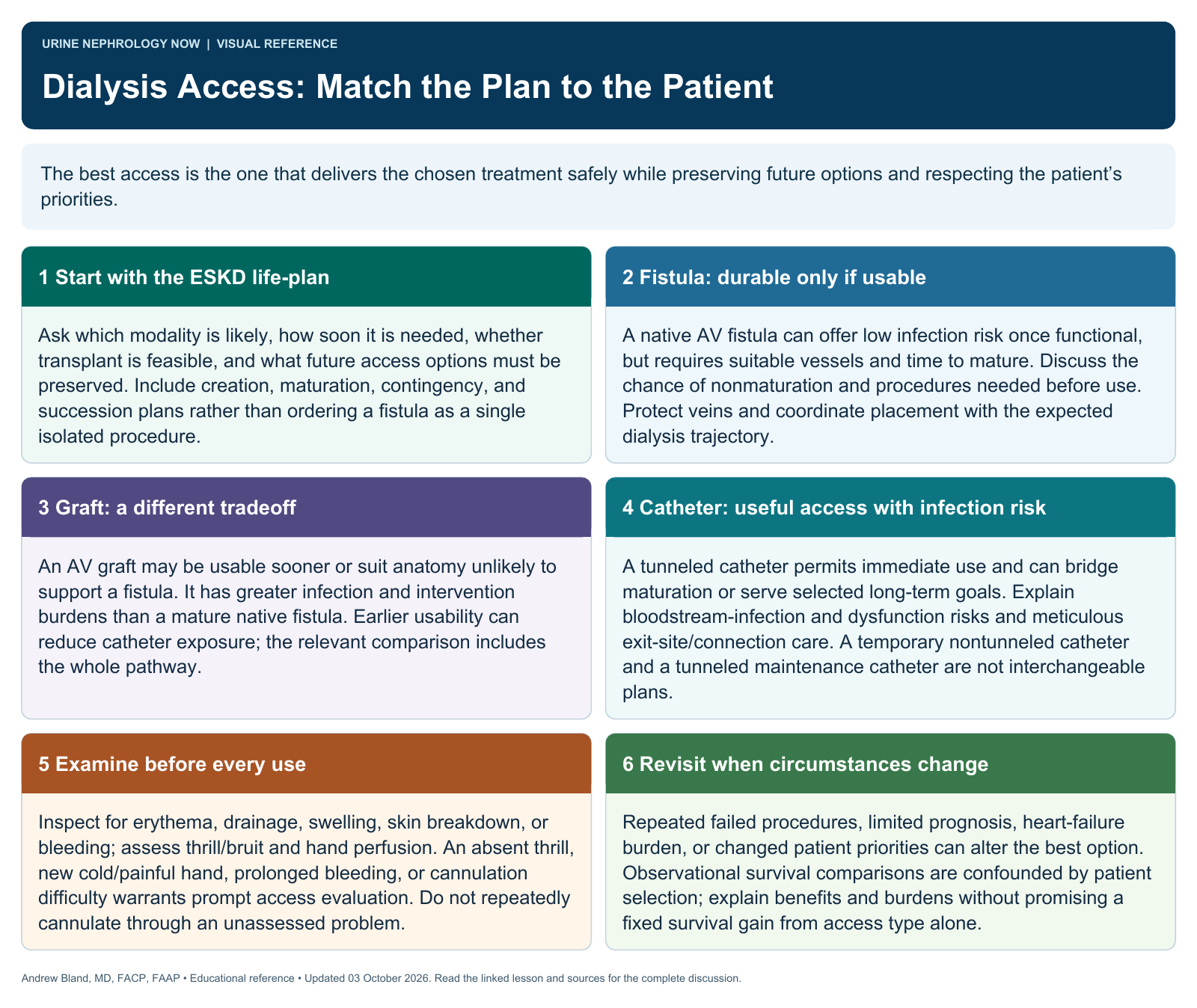
Three access types exist, each with an honest trade-off. For a fit 50-year-old with good veins, the fistula is close to unarguable. The calculus bends once the patient is 75, frail, multimorbid, and already dialyzing through a catheter.
🧪 A Fistula Is a Program, Not a One-Time Procedure
The NIH Hemodialysis Fistula Maturation Study found unassisted maturation of only 29% at 3 months, 67% at 6 months, and 76% at 12 months (median 115 days). Over one-third needed a procedure just to mature, and 47.5% of matured fistulas needed further intervention to stay open. A fistula is not "place it and forget it" — it is a schedule of procedures.
🧩 Why "Fistula First" Is Weaker Than It Looks
The observational survival gap is real and large — a systematic review of 62 cohort studies (586,337 patients) found catheters carried roughly 1.5× the mortality of fistulas. But the authors themselves graded the underlying studies as high risk of bias, especially selection bias. The association is real; the causal reading is where it breaks. Three studies dismantle it.
🔬 Brown 2017 — the smoking gun
In 115,425 Medicare patients aged 67+, the group that attempted a fistula, had it fail, and dialyzed through a catheter anyway still beat catheter-first patients (HR 0.66). If a failed fistula still helps, the benefit cannot live in the fistula. Authors: approximately two-thirds patient factors, one-third access.
⚰️ Quinn 2017 — cause of death
Every death in 2,300 patients was independently adjudicated. If catheters killed via line sepsis, access-related deaths should be common. They weren't — only approximately 2% of deaths were access-related. The excess catheter mortality "does not appear to be due to direct, access-related complications."
📐 Lyu 2021 — instrumental variable
Using a target-trial-emulation design that addresses unmeasured confounding, the instrumental-variable analysis found no association between creating a fistula versus a graft and mortality, sepsis, or hospitalization in elderly patients who all started hemodialysis on a catheter. It did not compare fistula versus staying on a catheter.
⚠️ The Confounding Tell
When a "failed fistula attempt" group that dialyzes through a catheter still beats the catheter-first group, the benefit cannot be living in the fistula. It is living in whatever made those patients candidates in the first place — good vessels, longer survival, fewer comorbidities. That is the single most useful mental model to carry into an access conversation.
⚖️ ACCESS HD — The Trial That Couldn't Recruit
Everything above is observational. The obvious fix is a randomized trial — and that is exactly what ACCESS HD attempted (12 centers, Canada + Australia, 2014–2021): older catheter-dependent starters randomized to a fistula strategy versus continued catheter strategy.
🔑 The Primary Endpoint Was Feasibility — Not a Clinical Outcome
This is the key to reading the whole trial. Of 268 eligible patients, 201 declined and only 67 were randomized. Among those who said no, 37% preferred to keep their catheter (only 23% preferred a fistula). Patient preference — not surgical capacity — was the dominant barrier to running the trial at all.
The clinical secondaries (n=67, underpowered, no multiplicity adjustment) mostly favored the catheter arm: fewer procedures, fewer hospital days, less bacteremia, numerically fewer deaths — and the only adjudicated access-related death occurred in the fistula arm. The one outcome favoring the fistula was tPA use, because catheters clot.
✅ What ACCESS HD Proves
Two solid things: (1) a definitive fistula-vs-catheter RCT is not feasible today, blocked by structural incentives and patient preference; and (2) there is no signal of harm from a catheter strategy in older starters — in units whose catheter infection rate was about one-ninth the US national rate, so the lower bacteremia in the catheter arm depends on catheter-care quality.
🚫 What It Does NOT Prove
With only 67 patients and no multiplicity adjustment, it cannot establish that catheters are superior — and it does not claim to. The clinical signals are hypothesis-generating, not a mandate.
💡 Why the Fistula Arm Still Had Line Infections
Patients randomized to a fistula strategy still had catheters during maturation. You do not escape the catheter by attempting a fistula — you often add a surgery on top of it and keep the line until (and if) the fistula works. That is why the fistula arm's bacteremia was predominantly catheter-related.
👤 The Patient-Centered Framework: The ESKD Life-Plan
The 2019 KDOQI guideline retired the rigid slogan and replaced it with the End-Stage Kidney Disease (ESKD) Life-Plan and the principle of "the right access, in the right patient, at the right time, for the right reasons." The decision rests on three questions:
1️⃣ Survival & Trajectory
A robust patient with years ahead earns the fistula's back-loaded benefit. A frail patient with a short horizon may never reach it.
2️⃣ Vessels & Timeline
Poor veins push toward a graft. An urgent need with no mature option may mean a bridging catheter regardless.
3️⃣ Patient Preference
ACCESS HD showed this is not a footnote — it is often the deciding factor. More than a third of eligible older patients preferred their catheter.
Honor preference; avoid futile surgery
Fistula: accept the maturation program + reinterventions
Graft: reliable maturation, more thrombosis
💡 Don't Forget the Heart
In an older patient with reduced ejection fraction or pulmonary hypertension, a high-flow upper-arm fistula can worsen high-output physiology. In that patient the "gold standard" access can be the wrong one on hemodynamic grounds alone — one more reason the hierarchy has to yield to the individual.
🔑 Key Takeaways
- Abandon reflexive Fistula-First for the frail, older, catheter-dependent starter — the randomized data do not support it.
- The fistula survival benefit is roughly two-thirds patient, one-third access, and access-related complications cause only about 2% of deaths.
- ACCESS HD shows a definitive trial is not feasible and finds no harm from a catheter strategy — but cannot prove catheters are superior.
- Still favor a fistula in the robust older patient with good vessels and a long horizon; the back-loaded benefits are real if the patient lives to collect them.
- A graft is a legitimate middle path when veins are poor or the timeline is short.
- Anchor every decision in the ESKD Life-Plan and shared decision-making. "Right access, right patient, right time, right reason."