Visual reference
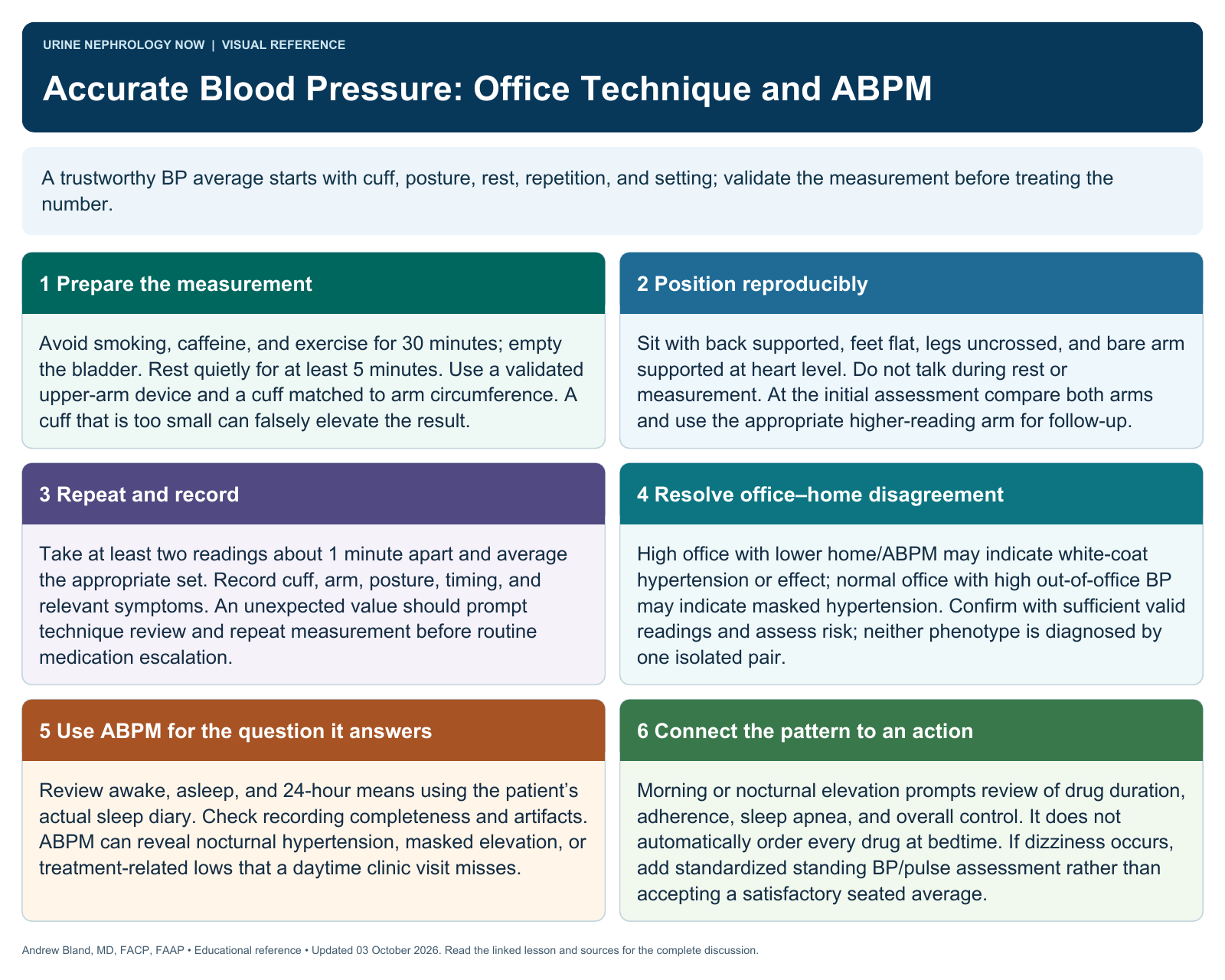
Browse the visual reference library · Download lesson Markdown
🎯 ABPM Gold Standard Applications
1
Superior Prognostic Value: 25% better cardiovascular risk prediction vs office BP
2
White Coat Detection: 37.5% of office hypertension patients have normal ABPM
3
Masked Hypertension: 31.1% with normal office BP have elevated ABPM
4
Sleep Disorder Screening: Identifies OSA patterns via nocturnal BP patterns
📊 ABPM Diagnostic Thresholds
| Measurement Type | Normal | Elevated/High Normal | Hypertension | Severe Hypertension |
|---|---|---|---|---|
| 24-Hour Average | <125/75 mmHg | 125-129/75-79 mmHg | ≥130/80 mmHg | ≥145/90 mmHg |
| Daytime Average | <130/80 mmHg | 130-134/80-84 mmHg | ≥135/85 mmHg | ≥150/95 mmHg |
| Nighttime Average | <115/65 mmHg | 115-119/65-69 mmHg | ≥120/70 mmHg | ≥135/85 mmHg |
| Office BP Equivalent | <130/80 mmHg | 130-139/80-89 mmHg | ≥140/90 mmHg | ≥180/110 mmHg |
🎯 Clinical Indications for ABPM
🔍 Primary Diagnostic Applications
- White Coat Hypertension: Office BP 140-179/90-109 mmHg
- Masked Hypertension: Normal office BP with target organ damage
- Borderline Hypertension: Office BP 130-139/80-89 mmHg
- Episodic Hypertension: Suspected pheochromocytoma
- Pregnancy: Suspected gestational hypertension or preeclampsia
- Pediatric Hypertension: Confirmation in children and adolescents
💊 Treatment Assessment Applications
- Apparent Resistant Hypertension: BP ≥140/90 despite 3 drugs
- Medication Timing: Optimize dosing schedule
- Drug Efficacy: 24-hour coverage assessment
- Hypotensive Symptoms: Evaluate treatment-related hypotension
- BP Variability: Excessive office BP fluctuations
- Nocturnal Dosing: Chronotherapy effectiveness
🧠 Special Population Applications
- Elderly Patients: Higher white coat hypertension prevalence
- Diabetes Mellitus: Higher masked hypertension risk
- Chronic Kidney Disease: Nocturnal hypertension common
- Autonomic Dysfunction: Excessive BP variability
- Sleep Disorders: OSA-related nocturnal hypertension
- Shift Workers: Disrupted circadian rhythm assessment
🌙 Circadian Blood Pressure Patterns
📈 Normal Dipping Pattern
- Definition: 10-20% decrease in nighttime BP vs daytime
- Calculation: (Daytime - Nighttime) / Daytime × 100%
- Prevalence: 60-70% of normotensive individuals
- Physiologic Basis: Circadian rhythm of sympathetic activity
- Prognostic Value: Associated with lowest cardiovascular risk
- Sleep Quality: Correlates with restorative sleep
⚠️ Non-Dipping Pattern
- Definition: <10% decrease in nighttime BP
- Prevalence: 25-30% of hypertensive patients
- Risk Increase: 29% higher cardiovascular events
- Target Organ Damage: Increased left ventricular hypertrophy
- Associated Conditions: CKD, diabetes, OSA, autonomic dysfunction
- Treatment: Consider evening antihypertensive dosing
🔄 Reverse Dipping Pattern
- Definition: Nighttime BP higher than daytime
- Prevalence: 5-10% of hypertensive patients
- Highest Risk: Greatest cardiovascular and renal risk
- Common Causes: Severe OSA, autonomic neuropathy, heart failure
- Stroke Risk: Particularly elevated cerebrovascular risk
- Management: Aggressive treatment of underlying conditions
📊 Extreme Dipping Pattern
- Definition: >20% decrease in nighttime BP
- Prevalence: 10-15% of patients
- Stroke Risk: Increased risk of lacunar infarcts
- Mechanism: Cerebral hypoperfusion during sleep
- Elderly Risk: Particularly concerning in older adults
- Management: Avoid excessive nighttime BP reduction
😴 ABPM for Sleep Disorder Screening
🛌 Obstructive Sleep Apnea Detection
OSA affects 30-50% of hypertensive patients
- Non-Dipping Pattern: 78% sensitivity, 63% specificity
- Nocturnal Hypertension: 75% sensitivity, 70% specificity
- High Nocturnal Variability: SD ≥12 mmHg (72% sensitivity)
- Morning Surge: >35 mmHg rise (65% sensitivity)
- Multiple Patterns: 83% positive predictive value
- Cost-Effective Screening: Reduces unnecessary polysomnography by 67%
📈 OSA-Related BP Patterns
- Apnea-Related Surges: Repetitive BP spikes during events
- Sympathetic Activation: Sustained elevation from hypoxemia
- Morning Hypertension: Pronounced early morning BP elevation
- Heart Rate Patterns: Elevated nocturnal HR may suggest OSA
- BP Load: Percentage of readings above threshold elevated
- Treatment Response: CPAP normalizes patterns in 41-68%
🏥 Clinical Outcomes and Prognostic Value
📊 Superior Outcome Prediction
Qualitative principle: ABPM and home BP outperform office BP for predicting cardiovascular outcomes; nighttime BP is the strongest single predictor.
- 24-Hour ABPM and home BP retain independent predictive value after adjustment for office BP (multiple meta-analyses)
- Nighttime BP is the strongest predictor of CV outcomes (Hansen 2011, Yang 2019, IDACO consortium)
- Clinical Advantage: Better targeting of intensive therapy in patients with masked HTN or non-dipping
⚖️ White Coat vs Masked Hypertension Outcomes
Source: ABC-H meta-analysis (Salles GF et al. Hypertension 2016;67(6):951-961, PMID 26902495, n=17,312 across 11 studies)
- White Coat HTN: No significant excess CV risk vs true normotension in untreated patients
- Masked HTN: Adjusted HR approximately 2.0 for CV events vs true normotension — comparable to or higher than sustained HTN risk
- Sustained HTN: Highest CV event rate; reference for risk comparisons
- Treatment Implications: Masked HTN requires therapy (often missed clinically)
- Monitoring Strategy: White coat HTN needs annual ABPM/home BP follow-up — risk emerges if it converts to sustained HTN
🧮 ABPM Pattern Interpreter
Analyze 24-hour blood pressure patterns and clinical significance
ABPM interpretation will appear here
💊 ABPM-Guided Therapy Optimization
🕐 Chronotherapy Applications — CONTESTED EVIDENCE
- Hygia/MAPEC (Hermida group): Reported large CV benefit from bedtime dosing (HR approximately 0.55, "45% reduction"). These trials are under data-integrity scrutiny by the journals that published them.
- TIME 2022 (Mackenzie IS et al. Lancet 2022;400(10361):1417-1425, PMID 36240838, n=21,104): Pragmatic RCT found NO benefit of evening vs morning dosing for the primary CV outcome (HR 0.95, 95% CI 0.83–1.10). Currently the most rigorous evidence on chronotherapy.
- Current guidance: Routine bedtime dosing for chronotherapy is NOT supported by the highest-quality evidence. Consider individualized timing only when ABPM shows clearly inadequate nocturnal control on morning regimens.
- Optimal Candidates (if attempted): Non-dippers with documented inadequate nocturnal control
- Safety Considerations: Avoid excessive nocturnal reduction
ABPM-Guided Treatment: What a Trial Established
- Staessen and colleagues randomized 419 patients to treatment adjustment using conventional office or daytime ambulatory blood pressure. Over about six months, the ambulatory-guided group received less intensive medication while preserving ambulatory control and similar left-ventricular mass and reported symptoms.
- This study did not establish the large cardiovascular-event or mortality reductions sometimes attributed to ABPM-guided care. Prognostic value of ambulatory readings and clinical benefit from a monitoring-guided treatment strategy are different questions.
- Staessen JA et al. Antihypertensive treatment based on conventional or ambulatory blood pressure measurement. JAMA1997;278:1065–1072.
🔧 Technical Requirements and Quality Assurance
📋 ABPM Protocol Requirements
- Duration: Minimum 24 hours, ideally 48 hours
- Measurement Frequency: Every 15-30 min (day), 30-60 min (night)
- Valid Readings: ≥70% successful measurements required
- Cuff Sizing: Critical for accuracy - validate before deployment
- Patient Diary: Sleep/wake times, symptoms, medications
- Activity Log: Document unusual activities or stress
🎯 Interpretation Parameters
- 24-Hour Mean: Primary prognostic parameter
- Dipping Ratio: (Day-Night)/Day × 100%
- Morning Surge: Peak morning rise within 2 hours
- BP Variability: Standard deviation of readings
- BP Load: Percentage above threshold values
- Heart Rate Patterns: Circadian rhythm assessment
💰 Cost-Effectiveness and Implementation
📈 Healthcare Economics
- Initial Cost: $200-400 per ABPM study
- Diagnostic Accuracy: Reduces misdiagnosis by 30-40%
- Treatment Optimization: Better drug selection and timing
- Prevented Events: Cost savings from avoided complications
- Quality of Life: Reduced anxiety from accurate diagnosis
- Healthcare Utilization: Fewer unnecessary office visits
🏥 Implementation Strategies
- Equipment Investment: Validated devices with software
- Staff Training: Proper cuff fitting and patient education
- Workflow Integration: Scheduling and data interpretation
- Insurance Coverage: Most payers cover appropriate indications
- Quality Metrics: Track successful study completion rates
- Patient Education: Expectations and activity modifications
📚 Sources
- Muntner P, Shimbo D, Carey RM, et al. Measurement of Blood Pressure in Humans: A Scientific Statement From the American Heart Association. Hypertension. 2019;73(5):e35-e66. PMID: 30827125. [Source for: ABPM as reference standard for out-of-office BP; thresholds 24h ≥130/80, daytime ≥135/85, nighttime ≥120/70.]
- Whelton PK, Carey RM, Aronow WS, et al. 2017 ACC/AHA Guideline for High Blood Pressure in Adults. Hypertension. 2018;71(6):e13-e115. PMID: 29133356. [Source for: ABPM Class 1 recommendation, ABPM/HBPM thresholds, white-coat and masked HTN definitions.]
- Salles GF, Reboldi G, Fagard RH, et al; ABC-H Investigators. Prognostic Effect of the Nocturnal Blood Pressure Fall in Hypertensive Patients (ABC-H Meta-Analysis). Hypertension. 2016;67(4):693-700. PMID: 26902495. [Source for: nocturnal dipping pattern prognostic value; n=17,312; non-dipping increases CV risk.]
- Stergiou GS, Bliziotis IA. Home blood pressure monitoring in the diagnosis and treatment of hypertension: a systematic review. Am J Hypertens. 2011;24(2):123-134. PMID: 20940712. [Source for: HBPM diagnostic and prognostic equivalence to ABPM in many clinical contexts.]
- Hoshide S, Kario K; JAMP Study Group. Morning home blood pressure surge and cardiovascular events. Hypertension. 2021;78(2):497-506. PMID: 34304583. [Source for: morning surge prognostic value in JAMP cohort.]
- Sega R, Facchetti R, Bombelli M, et al; PAMELA Study. Prognostic value of ambulatory and home blood pressures vs office blood pressure in the general population. Circulation. 2005;111(14):1777-1783. PMID: 15809377. [Source for: out-of-office BP prognostic superiority over office BP in general population.]
- Bobrie G, Chatellier G, Genes N, et al. Cardiovascular prognosis of "masked hypertension" detected by BP self-measurement. JAMA. 2004;291(11):1342-1349. PMID: 15026401. [Source for: masked HTN HR 2.06 vs sustained normotension; n=4,939.]
- RETRACTED — Banegas JR, Ruilope LM, de la Sierra A, et al. Relationship between Clinic and Ambulatory Blood-Pressure Measurements and Mortality. N Engl J Med. 2018;378(16):1509-1520. PMID: 29669232. This paper has been RETRACTED. Listed as a citation-trail anchor only; do not quote the published HRs. Use Bobrie 2004 and PAMELA above as primary sources for the masked-HTN risk teaching.
🎯 Key Learning Points
🏆 Gold Standard: ABPM provides 25% better cardiovascular risk prediction than office BP
🎭 Phenotype Detection: 37.5% white coat HTN, 31.1% masked HTN in respective populations
🌙 Nocturnal Patterns: Non-dipping increases CV events by 29% - consider chronotherapy
😴 OSA Screening: Multiple abnormal ABPM patterns have 83% positive predictive value for OSA