Visual reference
Browse the visual reference library · Download lesson Markdown
🎯 Comprehensive Clinical Integration
Master the practical application of 2025 hypertension guidelines through evidence-based case studies, PREVENT calculator implementation, and real-world clinical scenarios that challenge decision-making skills.
🧮 PREVENT Calculator Clinical Applications
Case 1: Standard PREVENT Application
55-year-old with newly diagnosed Stage 1 hypertension
Demographics & Vitals
Age: 55 years, Male
BP: 136/88 mmHg (repeated visits)
BMI: 28.5 kg/m²
Smoking: Former (quit 2 years ago)
Laboratory Results
Total Cholesterol: 195 mg/dL
HDL: 42 mg/dL
eGFR: 85 mL/min/1.73m²
HbA1c: 5.9%
Medical History
Family History: Father with MI at 62
Medications: None
Exercise: Sedentary lifestyle
Diet: High sodium intake
Clinical Decision Point
Using the PREVENT calculator, this patient's 10-year cardiovascular risk is 8.2%. How should you proceed with management?
✅ Correct Answer: B - Immediate medication + lifestyle
Rationale: With PREVENT risk >7.5%, this patient qualifies for immediate pharmacologic intervention per 2025 guidelines. The Class 1 recommendation supports medication initiation for Stage 1 hypertension when cardiovascular risk exceeds the treatment threshold.
First-line choice: ACE inhibitor, ARB, CCB, or thiazide-type diuretic. Given his profile, lisinopril 10mg daily or amlodipine 5mg daily would be appropriate starting options.
Lifestyle emphasis: DASH diet, sodium restriction (<2300mg daily), weight loss goal of 15-20 pounds, and regular aerobic exercise remain crucial adjuncts.
Case 2: Borderline PREVENT Risk
42-year-old female with Stage 1 HTN and borderline risk
Patient Profile
Age: 42 years, Female
BP: 132/84 mmHg (home monitoring average)
BMI: 24.2 kg/m²
Race: White
Risk Factors
Smoking: Never
Total Cholesterol: 168 mg/dL
HDL: 58 mg/dL
Diabetes: No
Additional Factors
Family History: Mother with stroke at 75
Exercise: Runs 3x/week
Diet: Generally healthy
Stress: High-pressure job
Interactive PREVENT Calculator
Patient Parameters
PREVENT Risk: Calculating...
Clinical Challenge
The PREVENT calculator shows a 6.8% 10-year risk (below the 7.5% threshold). However, she has masked hypertension confirmed by ABPM showing average 138/86 mmHg. What's your approach?
✅ Best Answer: C - Consider medication for masked HTN
Masked Hypertension Significance: Confirmed masked HTN carries similar cardiovascular risk to sustained hypertension, despite normal office readings.
Age Consideration: At 42, she has 30+ years of exposure ahead. Target organ damage prevention justifies earlier intervention.
Shared Decision-Making: Discuss risks/benefits, emphasizing that ABPM-confirmed elevation warrants treatment consideration regardless of PREVENT threshold.
Recommended Approach: Intensive lifestyle intervention for 3 months, then low-dose ACE inhibitor or ARB if BP remains ≥130/80 mmHg on ABPM.
🔄 Complex Management Scenarios
Case 3: CKM Syndrome Integration
68-year-old with diabetes, CKD, and resistant hypertension
🏥 Presentation & History
Current Presentation
Chief Complaint: "My blood pressure won't come down"
Current BP: 165/95 mmHg (on 4 medications)
Home BP: Average 158/92 mmHg
Symptoms: Fatigue, mild ankle swelling
Medical History
Type 2 DM: 12 years, HbA1c 7.8%
CKD: Stage 3a (eGFR 52 mL/min/1.73m²)
Proteinuria: 850 mg/g creatinine
Previous MI: 3 years ago, stent placed
Current Medications
Lisinopril: 40mg daily
Amlodipine: 10mg daily
Chlorthalidone: 25mg daily
Metoprolol XL: 100mg daily
Metformin: 1000mg BID
Atorvastatin: 40mg daily
🔍 Assessment & Secondary Screening
Laboratory Results
Potassium: 4.8 mEq/L
Aldosterone: 22 ng/dL (nl 1-16)
PRA: 0.8 ng/mL/hr (nl 0.6-4.3)
ARR: 27.5 (suggest PA if >20)
Additional Studies
Echo: LVEF 45%, mild LVH
Renal US: No obvious stenosis
Compliance: 95% by pharmacy records
Sleep Study: AHI 28 (moderate OSA)
Primary Management Decision
This patient has resistant hypertension with elevated aldosterone-to-renin ratio suggesting primary aldosteronism. What's your next step?
✅ Best Approach: A - Add spironolactone empirically
2025 Guideline Update: Universal screening for primary aldosteronism in resistant HTN is now Class 1, but empirical MRA therapy is acceptable without confirmatory testing when ARR is elevated.
Integrated Management Plan:
- Immediate: Spironolactone 25mg daily (monitor K+ in 1-2 weeks)
- Diabetes: Add SGLT2 inhibitor (empagliflozin 10mg) for CV-renal protection
- Sleep Apnea: CPAP therapy can improve BP by 5-10 mmHg
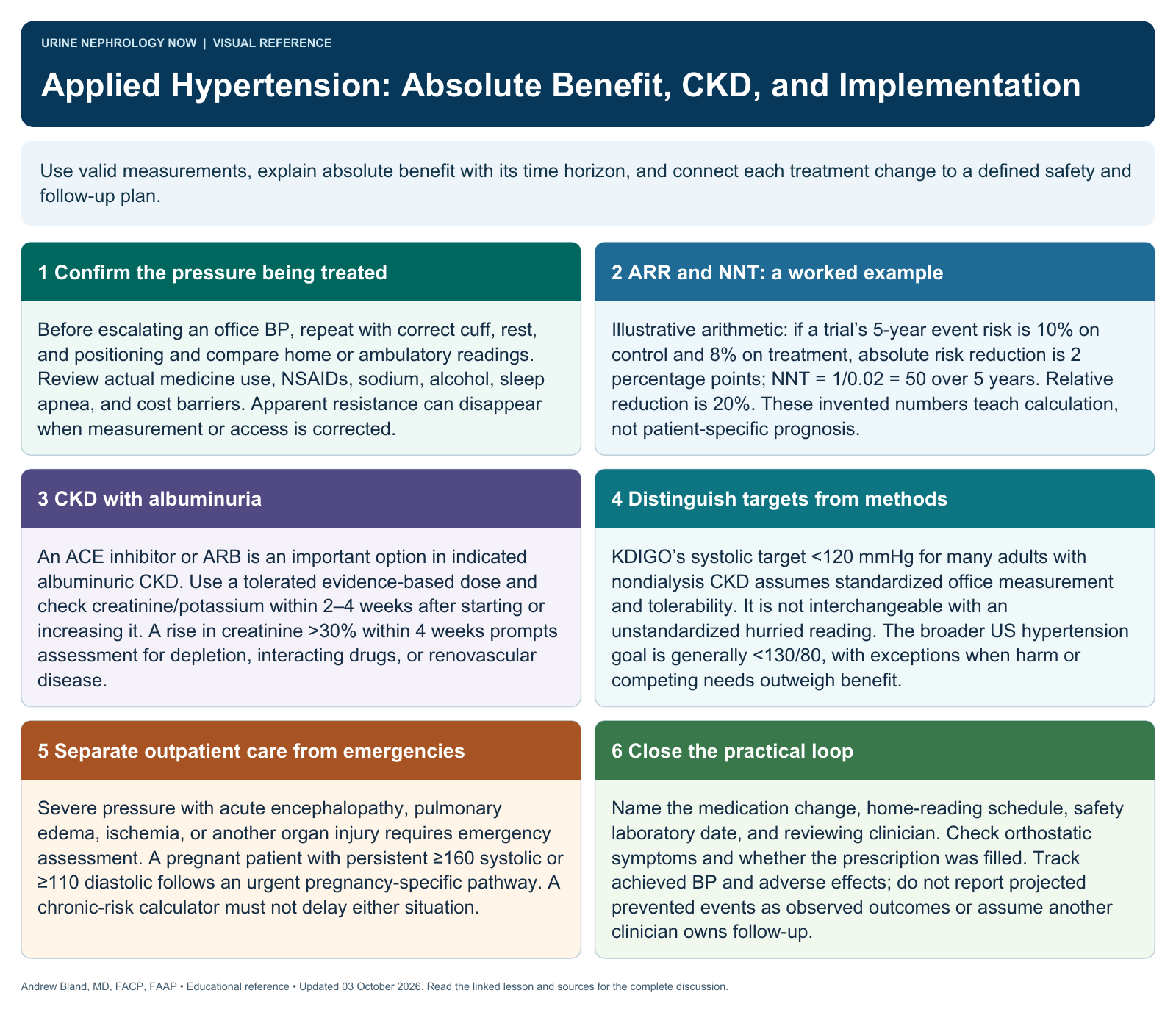
- Target: <130/80 mmHg (2025 AHA/ACC, ADA Standards of Care) given high CV risk. Because this patient has CKD, also teach the other number: KDIGO 2021 (Blood Pressure in CKD) suggests a target systolic <120 mmHg when tolerated, using standardized office measurement (grade 2B, driven by the CKD subgroup of SPRINT); it explicitly excludes kidney transplant recipients and patients on dialysis. Much of the gap is measurement technique rather than disagreement about physiology — KDIGO's lower number presumes a standardized or unattended reading, which most routine clinic cuffs do not meet.
Monitoring Strategy:
Weekly K+ checks initially, BP reassessment in 4 weeks. If inadequate response, consider confirmatory aldosterone suppression testing and CT adrenals for surgical evaluation.
Case 4: Pregnancy Hypertension Emergency
28-year-old at 34 weeks with severe hypertension
🚨 Emergency Presentation
Vital Signs & Presentation
BP: 172/110 mmHg (repeated x3)
Pulse: 88 bpm
Gestational Age: 34 weeks 2 days
Symptoms: Severe headache, visual changes
Physical Exam
Neurologic: Hyperreflexia, no clonus
Fundoscopy: Papilledema present
Edema: 3+ pitting to knees
Fetal: Reactive NST, estimated weight 10th %ile
Laboratory Results
Protein/Cr: 4.2 mg/mg (severe)
Platelets: 85,000/μL
AST/ALT: 95/110 U/L
Creatinine: 1.4 mg/dL (baseline 0.8)
Immediate Management Priority
This patient has severe preeclampsia with features of HELLP syndrome. What's your immediate BP management strategy?
✅ Correct: B - Labetalol 20mg IV with controlled reduction
Critical Safety Points:
- Avoid BP <140 mmHg: Risk of placental hypoperfusion
- 30-60 minute window: Delayed treatment risks maternal stroke
- Never use sublingual nifedipine: Unpredictable hypotension
Complete Management Protocol:
- Immediate: Labetalol 20mg IV → 40mg → 80mg q20min (max 300mg)
- Seizure prophylaxis: Magnesium sulfate 6g IV load, then 2g/hr
- Corticosteroids: Betamethasone for fetal lung maturity
- Delivery planning: Given HELLP features and 34+ weeks
- Monitoring: Continuous fetal monitoring, neuro checks q15min
Key Teaching Point: This represents a true hypertensive emergency requiring immediate but controlled reduction. The goal is maternal stroke prevention while avoiding placental compromise.
🏥 Implementation Challenges & Solutions
🚀 Guideline Implementation Roadmap
Assessment & Planning (Months 1-2)
Baseline performance measurement, staff education planning, EHR integration assessment for PREVENT calculator, and workflow design for new protocols.
- Current BP control rates analysis
- Medication adherence assessment
- Provider knowledge gap identification
- Technology infrastructure evaluation
Education & Training (Months 2-4)
Comprehensive provider education on 2025 guideline changes, PREVENT calculator training, and new emergency management protocols.
- Interactive workshops on guideline changes
- PREVENT calculator competency training
- Simulation sessions for emergency scenarios
- Case-based learning modules
Pilot Implementation (Months 4-6)
Small-scale implementation with select providers, workflow testing, and rapid-cycle improvement based on feedback.
- Champion provider identification
- EHR decision support activation
- Patient communication material development
- Quality metric tracking initiation
Full Deployment (Months 6-9)
System-wide rollout with continuous monitoring, performance feedback, and adjustment of protocols based on real-world experience.
- All-provider implementation
- Patient education campaign
- Community outreach programs
- Specialist integration coordination
Optimization & Sustainability (Months 9-12)
Performance optimization, outcome evaluation, and long-term sustainability planning with continuous quality improvement.
- Outcome measurement and reporting
- Provider feedback and additional training
- Process refinement and optimization
- Research and publication planning
⚠️ Common Implementation Pitfalls
🧮 PREVENT Calculator Misuse
Problem: Providers using calculator incorrectly or overriding results without documentation.
Solution: Mandatory training modules, EHR integration with decision support, and regular audit feedback.
🏥 Emergency Protocol Confusion
Problem: Continued use of "hypertensive urgency" terminology and inappropriate IV treatment.
Solution: Clear protocol cards, simulation training, and pharmacy alerts for inappropriate orders.
💊 Medication Selection Errors
Problem: Failure to use appropriate first-line agents or combinations.
Solution: EHR order sets, clinical decision support, and pharmacist consultation integration.
📊 Inadequate Monitoring
Problem: Poor home BP monitoring implementation and irregular follow-up.
Solution: Standardized monitoring protocols, patient education programs, and telehealth integration.
🤝 Patient Resistance
Problem: Patient concerns about intensive targets and medication changes.
Solution: Shared decision-making tools, patient education materials, and motivational interviewing training.
🔄 Workflow Disruption
Problem: New protocols slowing clinical workflow and provider frustration.
Solution: Workflow optimization, EHR customization, and phased implementation approach.
📊 Quality Improvement & Performance Metrics
📈 Implementation Performance Dashboard
BP Control Rate
Patients <130/80 mmHg
Target: ≥80%
PREVENT Calculator Use
New HTN diagnoses
Target: ≥90%
Medication Adherence
PDC ≥80%
Target: ≥85%
Home BP Monitoring
Active participation
Target: ≥75%
Inappropriate IV HTN Rx
Asymptomatic severe HTN
Target: <5%
First-Line Agent Use
Appropriate selection
Target: ≥85%
🎯 Comprehensive Quality Framework
Measures
- PREVENT calculator utilization
- Home BP monitoring setup
- Medication adherence counseling
- Lifestyle intervention documentation
Measures
- BP control rates (<130/80)
- Cardiovascular events
- Patient satisfaction scores
- Emergency department visits
Measures
- Hypotensive episodes
- Falls and syncope rates
- Electrolyte abnormalities
- Medication adverse events
Measures
- Control rates by race/ethnicity
- Access to specialty care
- Medication affordability
- Social determinant screening
Success Case Study: Regional Health System
12-month implementation results from 15-clinic system
Baseline Performance
BP Control: 64% <140/90 mmHg
Intensive Control: 42% <130/80 mmHg
Home Monitoring: 35% participation
Medication Adherence: 73% PDC ≥80%
12-Month Results
BP Control: 81% <130/80 mmHg
PREVENT Use: 87% new patients
Home Monitoring: 68% participation
Medication Adherence: 89% PDC ≥80%
Key Success Factors
Leadership: Strong physician champion support
Technology: Seamless EHR integration
Training: Comprehensive education program
Feedback: Monthly performance reporting
📋 Implementation Lessons Learned
- Phased rollout: 3-clinic pilot before system-wide implementation reduced workflow disruption
- Provider feedback: Monthly dashboards with peer comparisons increased engagement
- Patient engagement: Home BP monitoring program with app integration improved control rates
- Pharmacist integration: Embedded clinical pharmacists for medication optimization
- Quality improvement: Plan-Do-Study-Act cycles for continuous refinement
📚 Sources
- Whelton PK, et al. 2017 ACC/AHA HTN Guideline. Hypertension. 2018;71(6):e13-e115. PMID: 29133356.
- Cameron NA, Jones DW, Khan SS, Lloyd-Jones DM. 2025 AHA/ACC HTN Guideline Case Applications. Hypertension. 2025;82(12):2055-2063. PMID: 41204807.
- SPRINT Research Group. Intensive vs Standard BP Control. N Engl J Med. 2015;373(22):2103-2116. PMID: 26551272.
- Tita AT, et al; CHAP Trial. Treatment for Mild Chronic Hypertension during Pregnancy. N Engl J Med. 2022;386(19):1781-1792. PMID: 35363951.
- Williams B, et al; PATHWAY-2. Spironolactone vs placebo, bisoprolol, doxazosin in resistant HTN. Lancet. 2015;386(10008):2059-2068. PMID: 26414968.
- Khan SS, et al. AHA PREVENT Equations. Circulation. 2024;149(6):430-449. PMID: 37947085.
🎯 Clinical Integration Mastery
🧮 PREVENT Calculator Mastery
- Risk-guided treatment decisions for Stage 1 HTN
- Integration with clinical judgment for borderline cases
- Shared decision-making for complex scenarios
🔄 Complex Case Management
- CKM syndrome integrated approach
- Secondary hypertension screening protocols
- Emergency vs severe HTN differentiation
🏥 Implementation Success
- Phased rollout with champion providers
- EHR integration and decision support
- Continuous quality improvement cycles
📊 Quality & Performance
- Outcome-focused metrics over process measures
- Equity considerations in performance assessment
- Patient-centered quality indicators