Visual summary
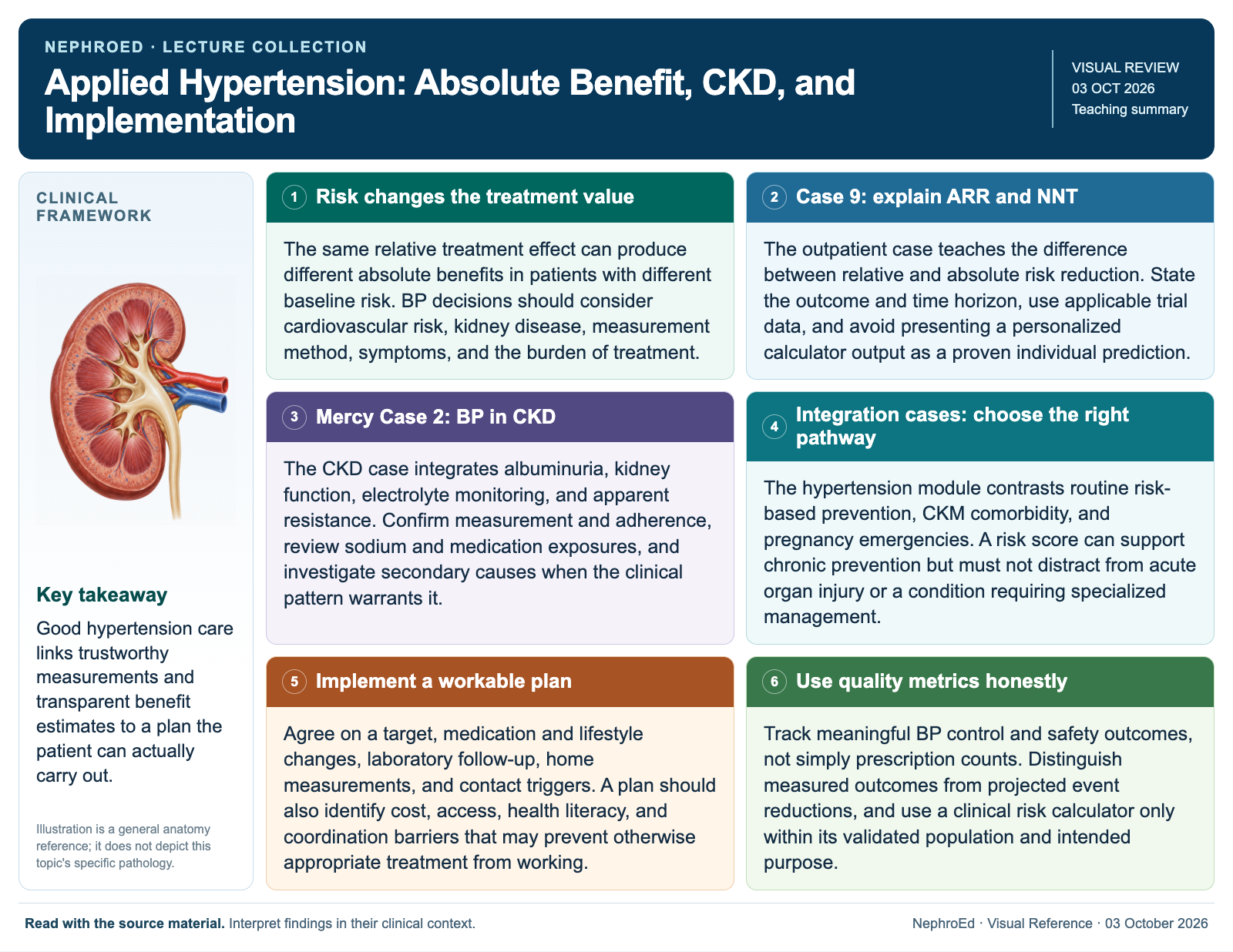
Good hypertension care links trustworthy measurements and transparent benefit estimates to a plan the patient can actually carry out.
Text version
Risk changes the treatment value
The same relative treatment effect can produce different absolute benefits in patients with different baseline risk. BP decisions should consider cardiovascular risk, kidney disease, measurement method, symptoms, and the burden of treatment.
Case 9: explain ARR and NNT
The outpatient case teaches the difference between relative and absolute risk reduction. State the outcome and time horizon, use applicable trial data, and avoid presenting a personalized calculator output as a proven individual prediction.
Mercy Case 2: BP in CKD
The CKD case integrates albuminuria, kidney function, electrolyte monitoring, and apparent resistance. Confirm measurement and adherence, review sodium and medication exposures, and investigate secondary causes when the clinical pattern warrants it.
Integration cases: choose the right pathway
The hypertension module contrasts routine risk-based prevention, CKM comorbidity, and pregnancy emergencies. A risk score can support chronic prevention but must not distract from acute organ injury or a condition requiring specialized management.
Implement a workable plan
Agree on a target, medication and lifestyle changes, laboratory follow-up, home measurements, and contact triggers. A plan should also identify cost, access, health literacy, and coordination barriers that may prevent otherwise appropriate treatment from working.
Use quality metrics honestly
Track meaningful BP control and safety outcomes, not simply prescription counts. Distinguish measured outcomes from projected event reductions, and use a clinical risk calculator only within its validated population and intended purpose.
Continue learning
This graphic summarizes a topic. The full educational pages provide the broader discussion and references.