A connected blood-pressure device is useful only when accurate measurements lead to an appropriate clinical response. Digital care combines measurement, transmission, review, communication, and follow-up; technology does not remove the need for a reliable care pathway.
Learning goal: Connect assessment, evidence, and a clear next clinical decision. Educational use; individual care requires the treating team’s assessment and applicable protocols.
Visual reference
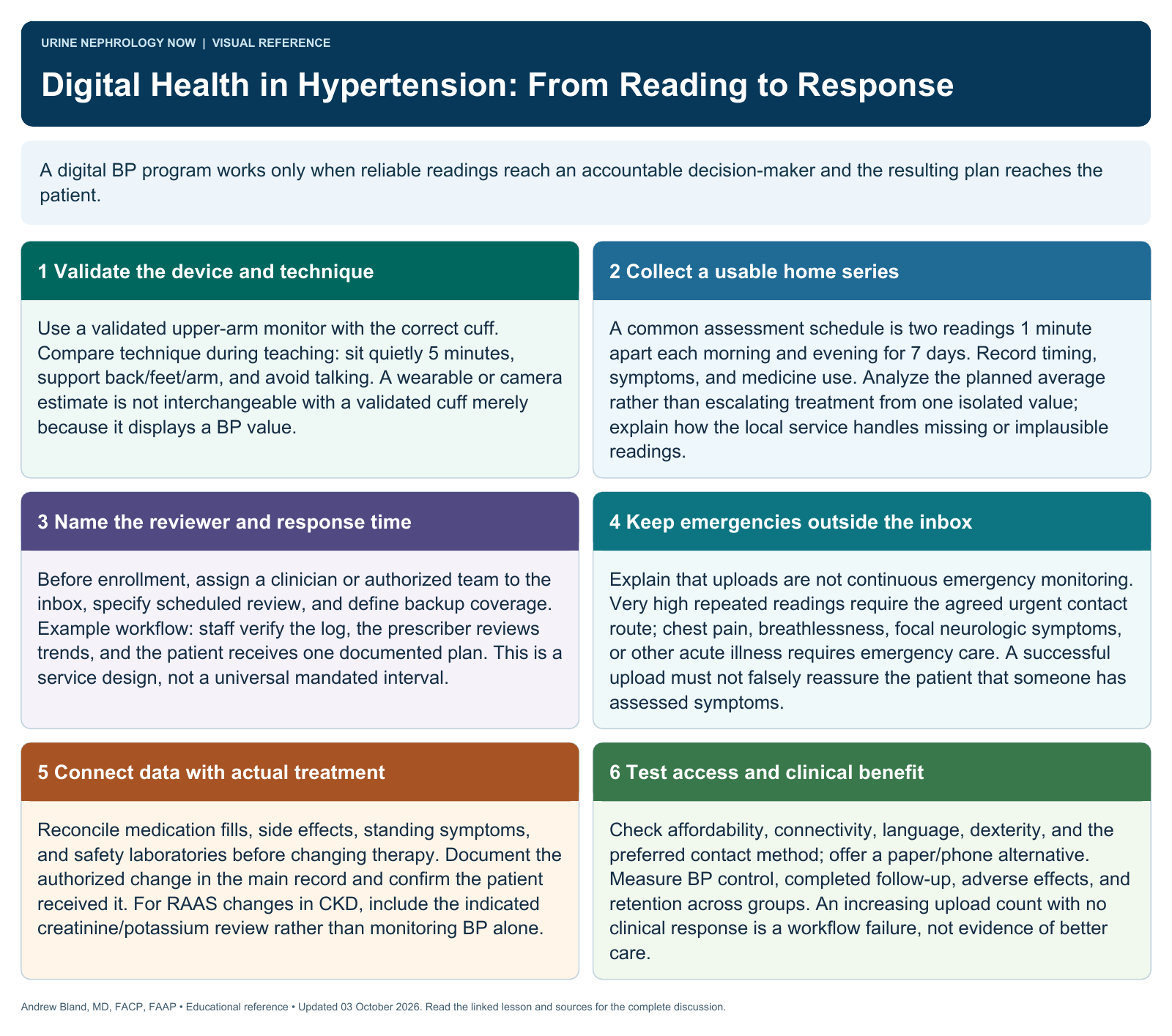
Browse the visual reference library · Download lesson Markdown
Start with valid measurement
Choose a device appropriate to the intended clinical use and validate the patient’s technique. Check cuff fit, positioning, timing, and repeated measurements. Do not assume a consumer wearable, camera estimate, or app is interchangeable with a validated upper-arm monitor merely because it displays a pressure value.
Define the data pathway
Agree what the patient will measure, how readings reach the team, and how missing or implausible values are handled. Ensure the record identifies the date, time, device, symptoms, and context. More readings can add information, but unreliable data can also create false reassurance or unnecessary alerts.
Assign clinical responsibility
Name who reviews incoming results, the expected review interval, escalation rules, and how treatment decisions are communicated. Telemonitoring is not continuous emergency supervision unless the service explicitly provides it. Give patients a separate urgent-symptom pathway and explain when they should seek immediate care.
Integrate into routine care
Remote review should connect home measurements with medication use, side effects, lifestyle, and the patient’s goals. A multidisciplinary model can combine automated reminders with clinician oversight. Avoid parallel app and clinic records that generate conflicting instructions or leave a changed prescription undocumented.
Plan for access and usability
Ask about connectivity, cost, language, vision, dexterity, literacy, and a preferred contact method. Offer training and an accessible alternative when needed. Security, consent, data access, and an understandable explanation of how information is used are part of making the service workable.
Evaluate whether it helps
Measure sustained follow-up, treatment changes, pressure control, symptoms, workload, and differences in participation across patient groups. A high upload count is not a clinical outcome. Investigate patients who disappear from the dashboard and revise the system when alerts are frequent but actions are unclear.
Apply the framework
What is missing if a clinic receives readings but no one owns the inbox?
Show the reasoning
The clinical response pathway. Assign responsibility, review intervals, escalation rules, and patient communication before relying on the service to support treatment.
References and evidence
These sources support the teaching framework. Trial populations, endpoints, and limitations should be checked before applying a result to an individual patient.
- Padwal R, Wood PW. Digital Health Approaches for the Assessment and Optimisation of Hypertension Care Provision. Can J Cardiol. 2021;37(5):711-721. PubMed 33340672
- Omboni S, McManus RJ, Bosworth HB et al.. Evidence and Recommendations on the Use of Telemedicine for the Management of Arterial Hypertension: An International Expert Position Paper. Hypertension. 2020;76(5):1368-1383. PubMed 32921195
- Minuz P, Albini FL, Imbalzano E et al.. Telemedicine and Digital Medicine in the Clinical Management of Hypertension and Hypertension-Related Cardiovascular Diseases: A Position Paper of the Italian Society of Arterial Hypertension (SIIA). High Blood Press Cardiovasc Prev. 2023;30(5):387-399. PubMed 37594686