Effective team care gives the patient and each professional a defined role. Accurate measurement, timely review, medication management, and support for practical barriers work together. Adding names to a care team is insufficient if no one owns the next decision.
Learning goal: Connect assessment, evidence, and a clear next clinical decision. Educational use; individual care requires the treating team’s assessment and applicable protocols.
Visual reference
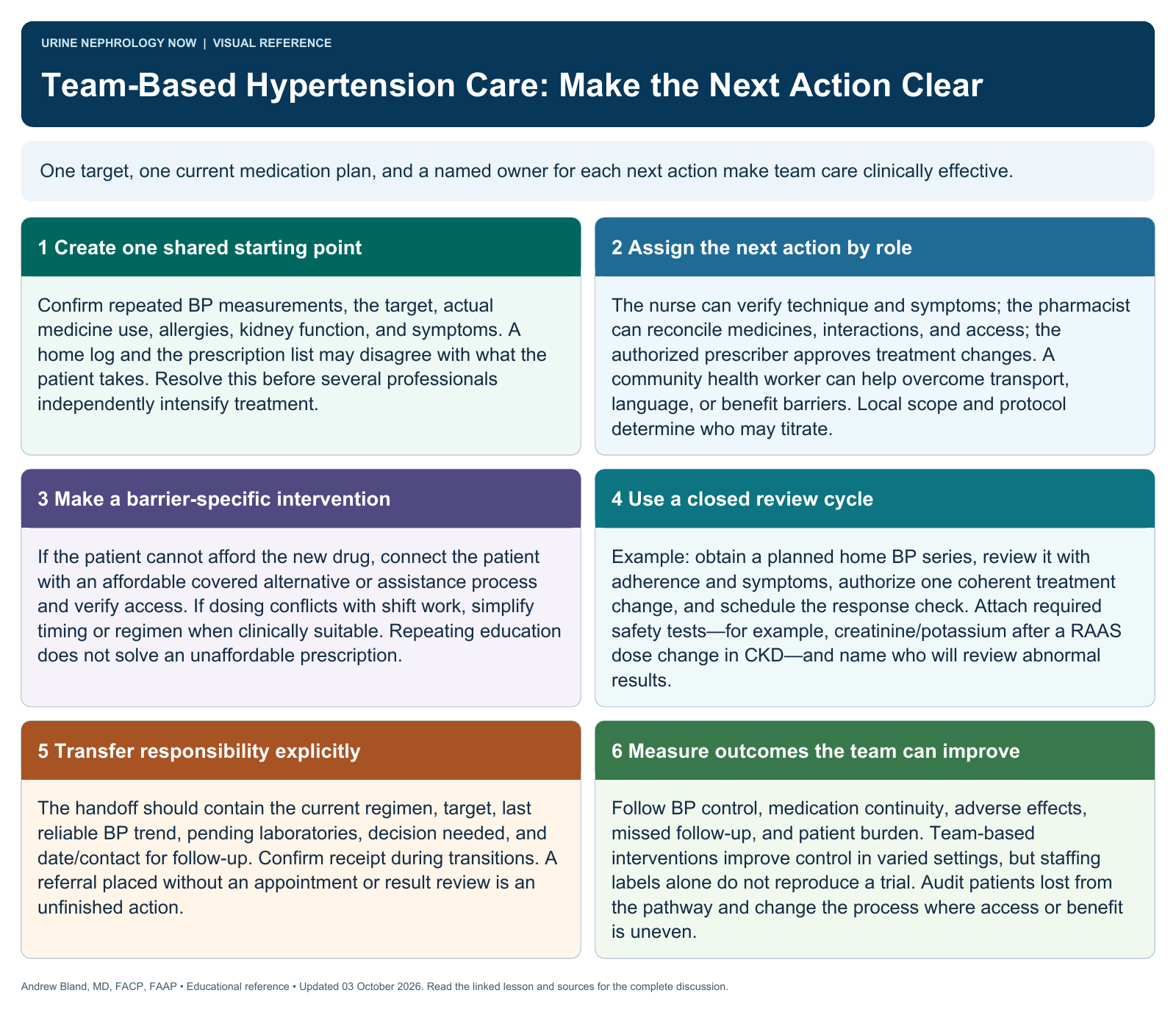
Browse the visual reference library · Download lesson Markdown
Begin with shared information
Use consistent measurement technique, an accurate medication list, home readings where available, and a documented treatment goal. Reconcile conflicting instructions before adjusting therapy. The team should know which results are reliable and what problem the current plan is intended to solve.
Define complementary roles
The prescribing clinician, pharmacist, nurse, and community health worker can contribute different expertise. Specify who reviews readings, assesses side effects, helps with medicine access, supports self-management, and follows referrals. Any protocol-based prescribing or titration must fit local authorization and supervision.
Partner with the patient
Ask about priorities, concerns, cost, work, food, transport, and experiences with treatment. Use teach-back and agree on a feasible next step. An apparent adherence problem may reflect an unaffordable medicine or a schedule that conflicts with daily life, rather than lack of understanding.
Create a review cycle
A useful cycle links measurement, interpretation, an authorized action, and reassessment. Set the next review date and required safety laboratories when relevant. Use an escalation pathway for severe symptoms or concerning readings, and avoid leaving responsibility implicit when several professionals are involved.
Interpret the outcomes evidence
The Community Guide review found improved pressure control across varied team-based interventions, particularly with nurses and pharmacists. The size of benefit varies by setting and program. Community-partnered pharmacist care in Black barbershops illustrates one successful model, not a guaranteed effect for every clinic.
Measure continuity and equity
Track control, follow-up, medication access, adverse effects, and patient experience. Look for groups who are missing visits or not benefiting. During transitions, identify the new responsible clinician and confirm receipt of the current plan so care does not stop at the referral.
Apply the framework
A patient has three clinicians and an uncontrolled home BP log. What must the handoff establish?
Show the reasoning
Who will interpret the log, what decision is needed, who can authorize it, when safety monitoring occurs, and when the patient will hear the plan.
References and evidence
These sources support the teaching framework. Trial populations, endpoints, and limitations should be checked before applying a result to an individual patient.
- Proia KK, Thota AB, Njie GJ et al.. Team-based care and improved blood pressure control: a community guide systematic review. Am J Prev Med. 2014;47(1):86-99. PubMed 24933494
- Victor RG, Blyler CA, Li N et al.. Sustainability of Blood Pressure Reduction in Black Barbershops. Circulation. 2019;139(1):10-19. PubMed 30592662