New hypertension therapies target aldosterone production, endothelin signaling, and other pathways, including RNA-based approaches. This lesson is an evidence-appraisal framework. Trial publication, regulatory authorization, availability, and suitability for a particular patient are separate questions.
Learning goal: Connect assessment, evidence, and a clear next clinical decision. Educational use; individual care requires the treating team’s assessment and applicable protocols.
Visual reference
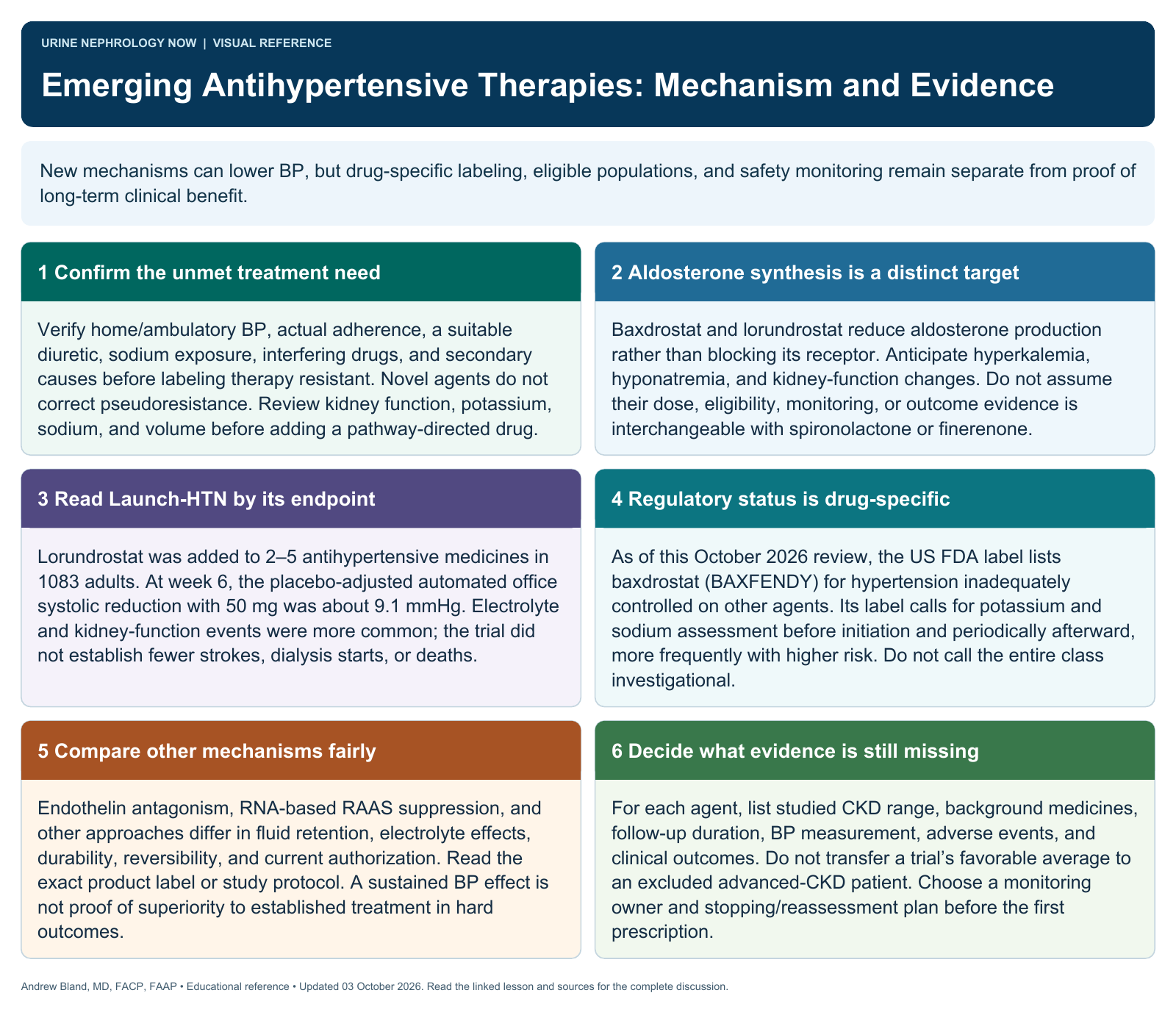
Browse the visual reference library · Download lesson Markdown
Confirm the clinical problem
Before considering a new agent, confirm measurement quality, home or ambulatory findings when appropriate, actual medicine use, interfering substances, volume factors, and secondary causes. Apparent resistant hypertension may reflect pseudoresistance or an incomplete conventional regimen rather than failure of all established treatment.
Connect mechanism with risk
Aldosterone synthase inhibition reduces aldosterone production; other approaches act through different pathways. Mechanism helps anticipate both benefit and adverse effects, but does not establish the size of clinical benefit. Kidney function, potassium, sodium, volume status, and concurrent medicines can alter eligibility and safety.
Read a contemporary trial
Launch-HTN evaluated lorundrostat added to existing treatment in adults with uncontrolled hypertension, including treatment-resistant hypertension. Its primary result concerned automated office systolic pressure at a specified follow-up. Hyperkalemia, hyponatremia, and kidney-function reductions were more frequent with active treatment; read eligibility and monitoring alongside efficacy.
Distinguish outcomes
A lower pressure in a short trial is not the same outcome as fewer strokes, heart-failure admissions, kidney failures, or deaths. Compare study design, comparator, duration, measurement method, withdrawal, and adverse effects. A trial population may exclude the advanced CKD or frail patient seen in clinic.
Review the treatment landscape
RNA-based therapies and other mechanisms are areas of active investigation, with questions about durability, reversibility, monitoring, and long-term outcomes. Treatments with cardiorenal benefits may lower pressure as one effect, but this does not automatically make them interchangeable first-line drugs for uncomplicated hypertension.
Keep adoption evidence-based
Check the current local product status, labeling, guidelines, and access before a real prescribing decision. Do not infer approval from a phase number or a published trial. Document why the patient fits the evidence, what will be monitored, and which clinician owns follow-up.
Apply the framework
What can a trial showing lower office systolic pressure establish?
Show the reasoning
It can support a blood-pressure effect under the studied conditions. It does not alone establish cardiovascular outcome benefit, suitability in excluded populations, or current regulatory approval.
References and evidence
These sources support the teaching framework. Trial populations, endpoints, and limitations should be checked before applying a result to an individual patient.
- Copur S, Burlacu A, Kanbay M. Novel approaches in antihypertensive pharmacotherapeutics. Curr Opin Nephrol Hypertens. 2025;34(5):350-359. PubMed 40265521
- Saxena M, Laffin L, Borghi C et al.. Lorundrostat in Participants With Uncontrolled Hypertension and Treatment-Resistant Hypertension: The Launch-HTN Randomized Clinical Trial. JAMA. 2025;334(5):409-418. PubMed 40587141
- Kidney Disease: Improving Global Outcomes (KDIGO) CKD Work Group. KDIGO 2024 Clinical Practice Guideline for the Evaluation and Management of Chronic Kidney Disease. Kidney Int. 2024;105(4S):S117-S314. PubMed 38490803