Visual summary
A blood-pressure trial can support an effect under the studied conditions. It does not alone establish cardiovascular benefit, suitability in excluded populations, or current regulatory approval.
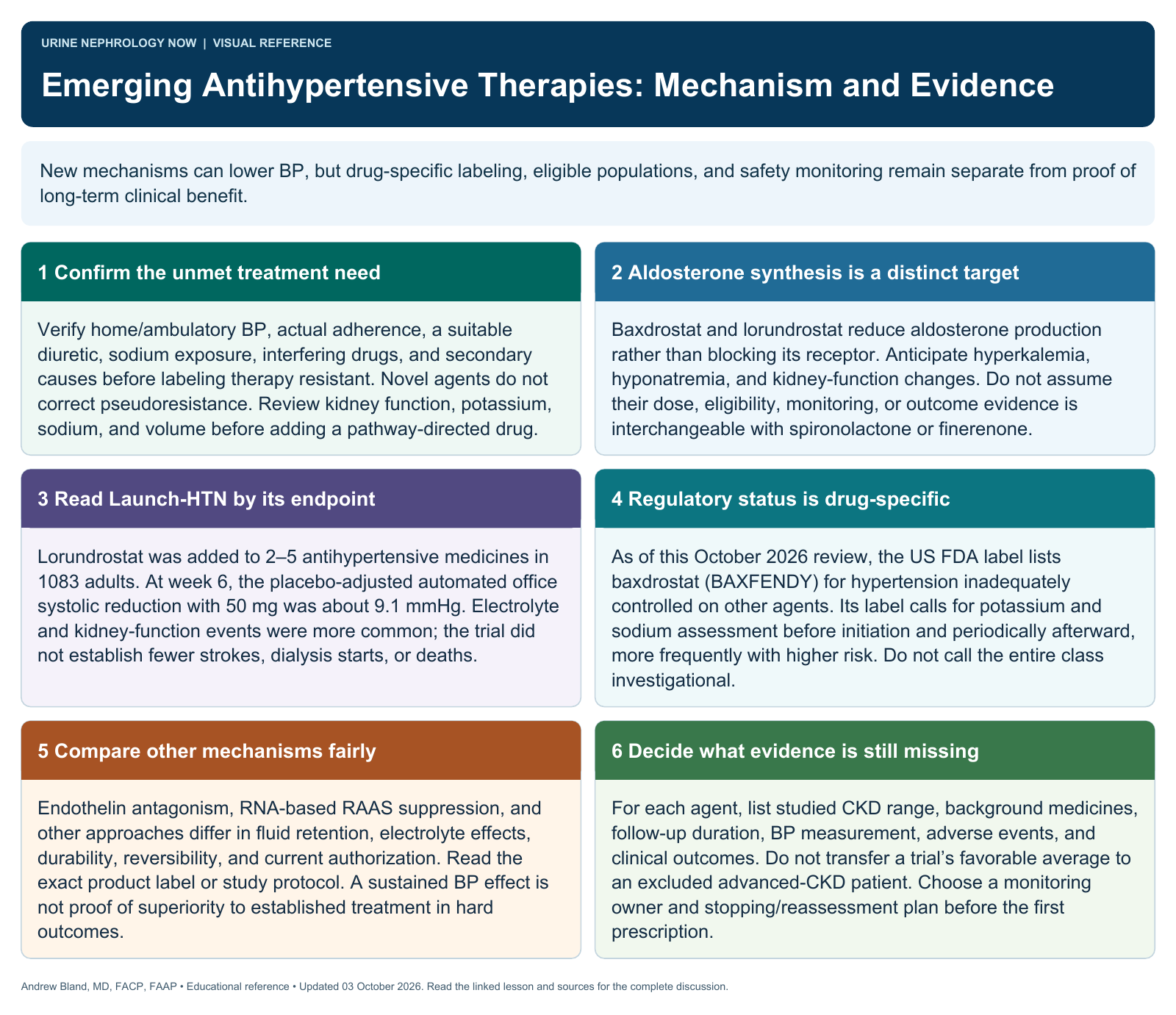
Text version
Confirm the clinical problem
Confirm genuine uncontrolled or resistant hypertension and address reversible contributors before selecting a novel therapy.
Connect mechanism with risk
Use mechanism to anticipate monitoring needs, including kidney function and electrolytes, without treating biologic plausibility as proof of benefit.
Read a contemporary trial
Interpret Launch-HTN as an add-on blood-pressure trial with defined eligibility and electrolyte/kidney safety findings, not a universal treatment instruction.
Distinguish outcomes
Separate blood-pressure endpoints from hard clinical outcomes and assess whether the studied population matches the patient.
Review the treatment landscape
Assess durability, reversibility, safety, and outcome evidence; cardiorenal benefit or a BP effect does not make every agent interchangeable.
Keep adoption evidence-based
Verify current authorization and labeling separately from trial publication, then document patient fit, monitoring, and follow-up responsibility.
Continue learning
This graphic summarizes a topic. The full educational pages provide the broader discussion and references.