Differences in hypertension outcomes arise within social, economic, environmental, and health-system contexts. A useful clinical response identifies the specific barrier a person faces and changes the care process, while measuring whether the improvement reaches those with the greatest unmet need.
Learning goal: Connect assessment, evidence, and a clear next clinical decision. Educational use; individual care requires the treating team’s assessment and applicable protocols.
Visual reference
Browse the visual reference library · Download lesson Markdown
Describe the actual gap
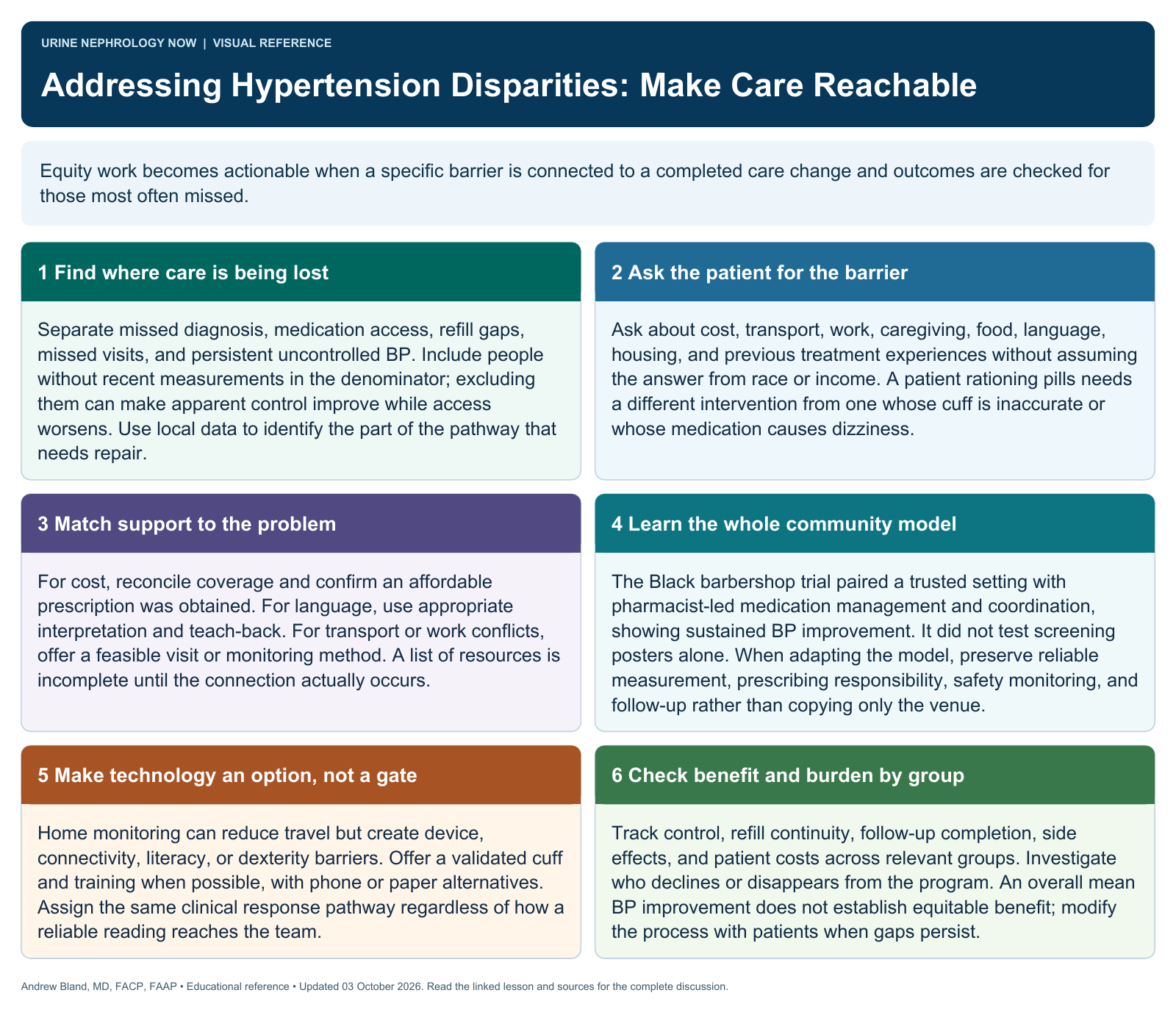
Examine accurate diagnosis, access to treatment, medicine continuity, follow-up, and control. Use relevant local data with attention to missing measurements and who is absent from care. An average improvement can conceal a widening gap between groups, so ask whose outcomes improved and whose did not.
Ask without assumptions
Explore cost, insurance, food access, transport, housing, work, caregiving, language, and prior experiences of care. Ask which issue the patient wants help with. Do not infer a person’s beliefs, biology, preferences, or ability to follow a plan solely from racial or social categories.
Reduce treatment friction
Simplify communication, reconcile medicines, address affordability, provide appropriate language support, and offer appointments or monitoring that fit the patient’s circumstances. Make a direct connection to support rather than handing over a list alone. Check whether the patient was able to obtain the medicine or service.
Learn from community partnership
A randomized study in Black male barbershop patrons combined trusted community engagement with pharmacist medication management and showed sustained pressure improvement. The key lesson is a coordinated, accessible care model. It does not show that screening alone or any community venue automatically produces the same benefit.
Build accountable team care
Agree who measures, treats, supports access, and follows up. Community partners need clear referral routes and feedback, while prescribing and safety monitoring remain within professional responsibilities. Involve patients in designing the process so convenience for the service is not mistaken for convenience for the patient.
Check benefit and burden
Track pressure control, side effects, retention, out-of-pocket burden, and patient experience across groups. Investigate who declines or cannot use an intervention, including digital services. Revise the program when participation is unequal; a referral or a technology offer alone does not establish equitable access.
Apply the framework
Does a successful community trial justify promising its exact BP reduction to every patient?
Show the reasoning
No. Explain the specific population and care model, then adapt and evaluate local implementation. Preserve the coordinated treatment component rather than copying only the setting.
References and evidence
These sources support the teaching framework. Trial populations, endpoints, and limitations should be checked before applying a result to an individual patient.
- Victor RG, Blyler CA, Li N et al.. Sustainability of Blood Pressure Reduction in Black Barbershops. Circulation. 2019;139(1):10-19. PubMed 30592662
- Proia KK, Thota AB, Njie GJ et al.. Team-based care and improved blood pressure control: a community guide systematic review. Am J Prev Med. 2014;47(1):86-99. PubMed 24933494
- Padwal R, Wood PW. Digital Health Approaches for the Assessment and Optimisation of Hypertension Care Provision. Can J Cardiol. 2021;37(5):711-721. PubMed 33340672