Device-based approaches to hypertension seek to alter neural signaling or vascular mechanics. The evidence differs substantially across devices and generations. This lesson supports appraisal and specialist discussion; it does not treat devices studied in small trials as routine substitutes for optimized medical care.
Learning goal: Connect assessment, evidence, and a clear next clinical decision. Educational use; individual care requires the treating team’s assessment and applicable protocols.
Visual reference
Browse the visual reference library · Download lesson Markdown
Recheck resistant hypertension
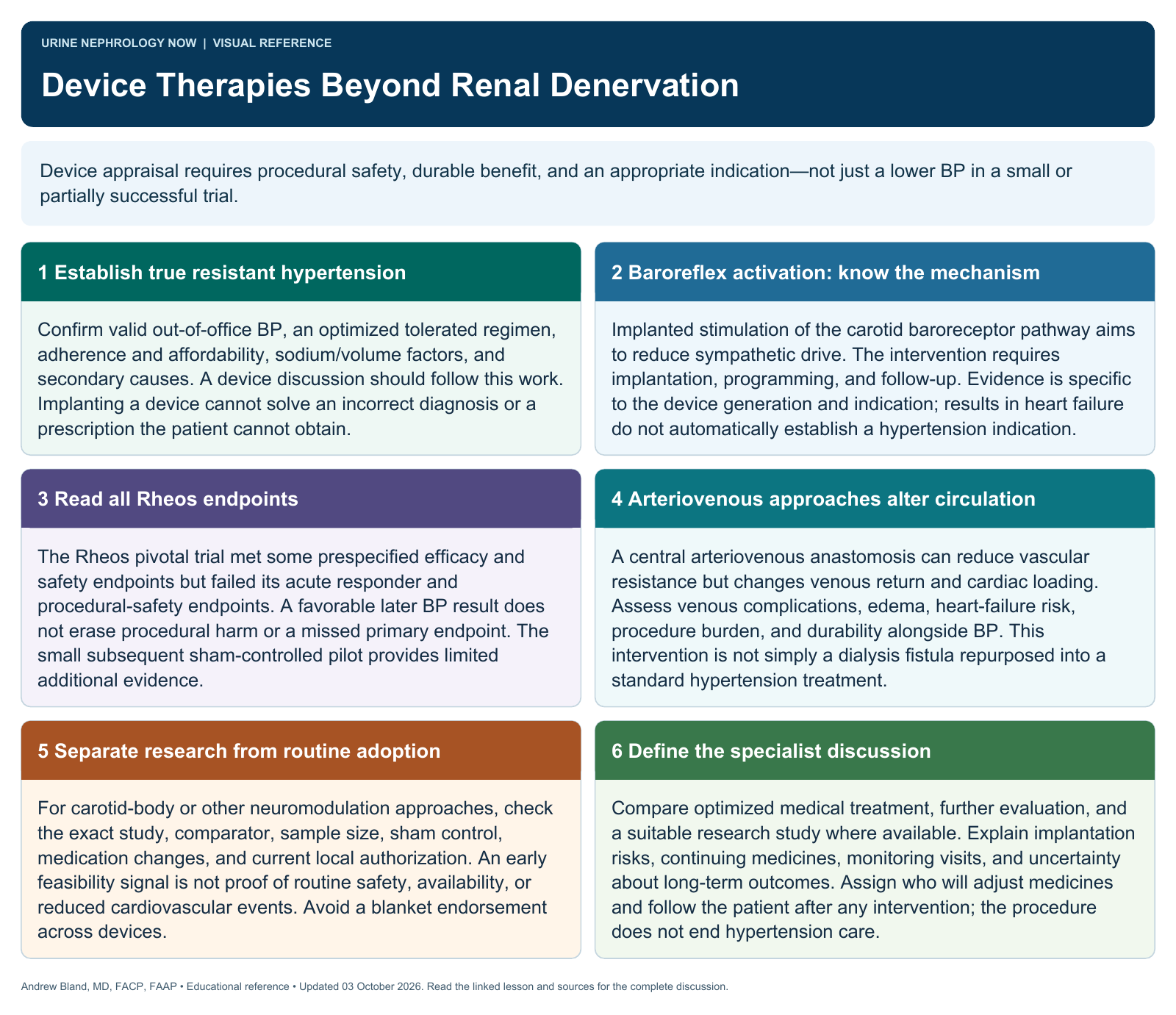
Confirm pressure measurement, adherence, drug combinations, interfering substances, and secondary causes before considering an invasive approach. Review out-of-office pressure when appropriate. A device will not correct a mislabeled diagnosis, an unaffordable medication, or a secondary cause that has not been identified.
Understand baroreflex activation
Baroreflex activation aims to modify autonomic signaling through stimulation of the arterial baroreceptor pathway. Trials evaluate a specific device, implantation method, programming, and patient group. Findings from one generation or indication cannot automatically be transferred to another product or to every person with hypertension.
Read the whole trial
The Rheos pivotal trial met some prespecified efficacy and safety endpoints but did not meet its acute responder and procedural-safety endpoints. A later sham-controlled pilot adds limited research evidence. A favorable secondary result or a small pilot should not be presented as definitive proof of broad safety and benefit.
Consider vascular approaches
Central arteriovenous anastomosis has been studied to lower resistance and pressure through altered vascular mechanics. This is a distinct intervention from creating dialysis access. Appraisal must include invasive complications, venous effects, cardiac loading, durability, and the difference between blood-pressure reduction and proven clinical outcome benefit.
Keep the research context clear
Carotid-body and other neuromodulation approaches require careful review of the actual study and current local status. Do not infer routine availability, authorization, or guideline endorsement from a conference description, mechanism, or trial title. Specialist and multidisciplinary assessment is needed for a real clinical decision.
Discuss choices honestly
Compare optimized conventional therapy, further evaluation, a relevant research study when available, and the burden of implantation and follow-up. Shared decision making should include uncertainty and alternatives. Specify who will manage medications and monitoring after any intervention; a procedure does not eliminate ongoing hypertension care.
Apply the framework
Why is a successful blood-pressure endpoint insufficient by itself?
Show the reasoning
Device decisions also depend on procedural safety, durability, patient selection, downstream clinical outcomes, and the current authorization for the specific device and indication.
References and evidence
These sources support the teaching framework. Trial populations, endpoints, and limitations should be checked before applying a result to an individual patient.
- Bisognano JD, Bakris G, Nadim MK et al.. Baroreflex activation therapy lowers blood pressure in patients with resistant hypertension: results from the double-blind, randomized, placebo-controlled rheos pivotal trial. J Am Coll Cardiol. 2011;58(7):765-73. PubMed 21816315
- Simonsen JR, Vikatmaa L, Vikatmaa P et al.. Sham-Controlled Randomized Pilot Trial on Baroreflex Activation Therapy in Resistant Hypertension. Hypertension. 2024;81(8):e91-e93. PubMed 39018380
- Lobo MD, Sobotka PA, Stanton A et al.. Central arteriovenous anastomosis for the treatment of patients with uncontrolled hypertension (the ROX CONTROL HTN study): a randomised controlled trial. Lancet. 2015;385(9978):1634-41. PubMed 25620016