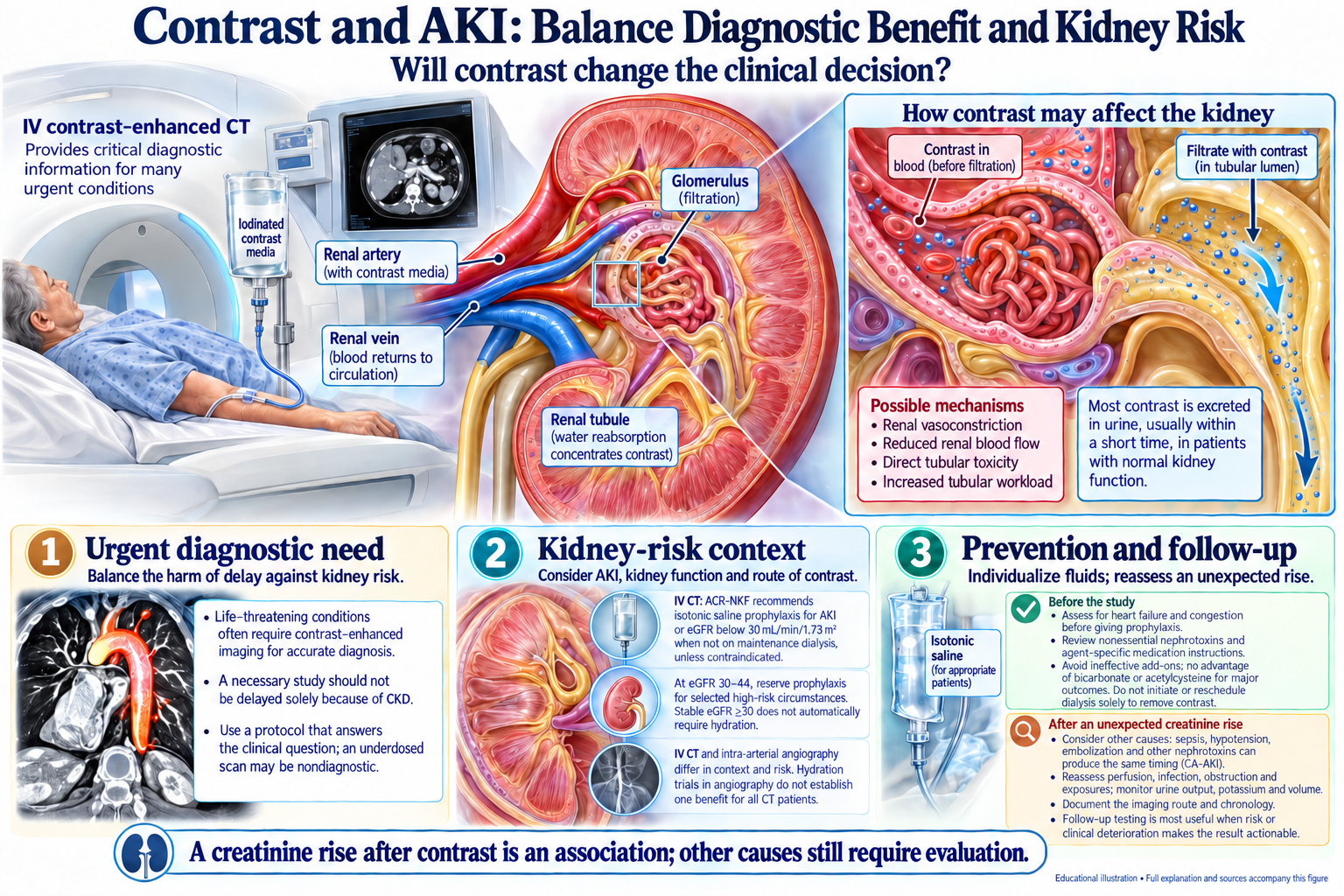
📋 Contrast and Kidney Risk: Clinical Context
Contrast-associated acute kidney injury (CA-AKI) describes AKI after contrast exposure without establishing causation. Contrast-induced AKI (CI-AKI) is the subset caused by contrast. Evaluate the imaging indication, route of contrast, recent kidney function, active AKI, hemodynamics, and competing causes of injury. Avoid delaying essential imaging solely because of an unvalidated risk estimate.
This lesson distinguishes evidence from intravenous CT and intra-arterial angiography. ACR–NKF consensus on intravenous iodinated contrast.
📊 What the Hydration Trials Actually Tested
PRESERVE
In high-risk patients undergoing angiography, sodium bicarbonate was not superior to isotonic saline, and acetylcysteine was not superior to placebo for the primary composite of death, dialysis, or persistent kidney impairment. This was not a trial of saline versus no hydration. It cannot supply a universal absolute risk reduction or number needed to hydrate.
Weisbord et al., 2018AMACING
In selected elective-procedure patients with eGFR 30–59, no prophylactic IV hydration was noninferior to saline for the study endpoint. Patients with eGFR below 30 were excluded. Hydration itself caused complications in some participants; the result must not be extrapolated to unstable patients or severe CKD.
Nijssen et al., 2017Hemodynamic or urine-flow-guided strategies
POSEIDON studied LVEDP-guided hydration during cardiac catheterization. REMEDIAL II evaluated a controlled hydration/forced-diuresis system in selected high-risk patients. These protocols require their original patient-selection and monitoring conditions; they do not justify giving every patient a fixed large fluid volume.
POSEIDON; REMEDIAL IIInterpretation: intervention, route, population, comparator, and endpoint must match the clinical question. There is no single validated hydration-benefit percentage or NNT that can be assigned from this page's patient characteristics.
💉 Comprehensive Contrast-Associated Nephropathy (CAN) Prevention
📋 Association and Causation
CA-AKI: AKI occurs after contrast exposure, whether or not contrast caused it. Acute illness, infection, hypotension, medications, and atheroembolism may contribute.
CI-AKI: a causal attribution to contrast, which requires stronger evidence than timing alone. The terms answer different questions; CI-AKI has not simply been replaced by CA-AKI. ACR–NKF consensus.
🧮 Use Risk Models in Their Intended Setting
The original Mehran score was developed for patients undergoing percutaneous coronary intervention. Its variables and definitions must be applied exactly. A modified collection of points is not the validated model, and its predicted rates do not transfer directly to intravenous contrast CT.
Use an appropriate validated model only for the procedure and population it addresses. A risk score predicts association; it does not calculate how much saline or a different contrast agent will reduce an individual patient’s risk. Original Mehran model.
For intravenous contrast, current kidney function, active AKI, clinical indication, and fluid-overload risk are more directly relevant to the prevention decision described in the ACR–NKF consensus.
💧 Individualize Prophylaxis and Fluid Volume
For intravenous iodinated contrast, the ACR–NKF consensus recommends IV isotonic saline prophylaxis for patients with AKI or eGFR below 30 mL/min/1.73m² who are not receiving maintenance dialysis, unless there is a contraindication such as significant fluid-overload risk. Prophylaxis may be considered in selected high-risk patients with eGFR 30–44. It is not routinely indicated for all patients with stable eGFR at or above 30.
When prophylaxis is appropriate, choose rate and duration with the procedural team, considering volume status, heart failure, urgency, and the applicable protocol. No universal 24-hour regimen is established as a gold standard for every setting. A rapid fluid load should not be chosen simply because a patient has heart failure.
Urgent diagnostic or therapeutic procedures should not be delayed automatically to complete a fluid schedule. Acetylcysteine is not recommended for prophylaxis. Bicarbonate has not shown superiority to saline. ACR–NKF consensus; PRESERVE.
🧪 Choose Contrast for the Procedure
Modern intravascular practice generally uses low- or iso-osmolar agents. For intravenous use, evidence does not establish a clinically meaningful universal kidney-safety advantage of iso-osmolar over low-osmolar contrast. Use a dose that yields diagnostic information; an inadequate study can cause harm and repeat exposure.
In CARE, iodixanol did not significantly reduce the trial-defined nephropathy rate compared with iopamidol in the studied cardiac angiography population. That result does not establish dialysis prevention or cost savings from a mandatory iso-osmolar strategy. CARE trial.
Osmolality is one physical property, not a substitute for comparative clinical outcomes. Agent choice, volume, route, availability, and patient factors should be considered together. ACR–NKF consensus.
📈 Reassess Kidney Function and Competing Causes
Monitor according to the patient’s baseline risk, acuity, and procedure. Check volume status and clinical course; obtain follow-up creatinine and electrolytes when indicated. Oliguria or deterioration requires prompt assessment rather than waiting for a scheduled laboratory test.
Use an accepted AKI definition and compare with the appropriate baseline. Older contrast trials used differing creatinine thresholds and observation windows, which limits direct comparison of their event rates. A creatinine rise after a procedure does not establish contrast as the cause. Avoid unnecessary nephrotoxins and review any fluid plan if congestion develops.
🎓 Interactive Learning Worksheet
💻 Contrast Planning: Questions to Discuss
🎯 Questions That May Benefit from Contrast
- Renal Mass Characterization: Enhancement pattern assessment
- Complex Cystic Lesions: Bosniak classification
- Vascular Imaging: CT/MR angiography
- Pre-operative Planning: Surgical anatomy
- Functional Assessment: GFR measurement, perfusion
🔎 Questions Often Answered Without Contrast
- Urolithiasis Evaluation: Non-contrast CT sufficient
- Hydronephrosis Assessment: US or non-contrast CT
- Renal Size/Echogenicity: Ultrasound adequate
- Post-operative Complications: Often non-contrast sufficient
- Serial Monitoring: US preferred for repeated assessments
🎯 Teaching Points
Match the imaging benefit to patient risk, distinguish association from causation, and apply evidence from the correct procedure and population. Use individualized prevention and monitoring. Neither a qualitative checklist nor a risk score can establish the causal benefit of hydration for a particular patient.
Read the linked trial and consensus sources before translating a protocol into care. The worksheet records considerations for discussion; it does not issue a treatment recommendation or estimate an event probability.